




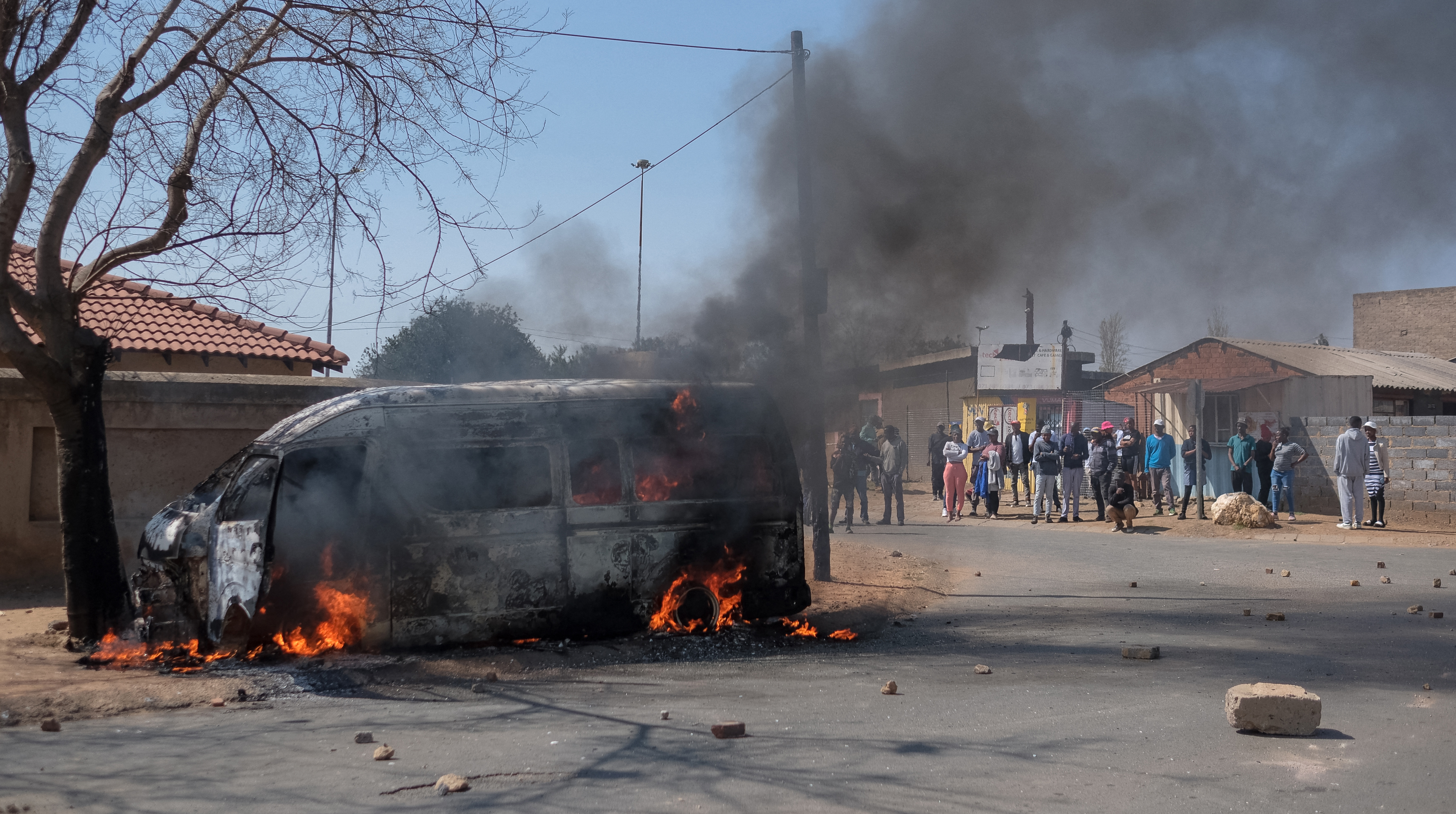
 A minibus taxi that was set alight near the Maponya Mall in Soweto on 14 August, the day after gunmen killed a ride-hailing driver at the mall. (Photo: Emmanuel Croset / AFP)
 South African National Taxi Council (Santaco) president Motlhabane Abnar Tsebe on Tuesday said the violence at Soweto’s Maponya Mall last week, which left an e-hailing driver dead and two others injured, was not just a transport story, but a tragic human story.
“A life cut short. It is about families that are broken, and it’s about communities that do not feel safe,” said Tsebe. “As Santaco, we cannot remain silent.”
Tsebe said if a Santaco member was implicated in violence, their membership would be cancelled and the council would demand they be held criminally accountable.
“We take full responsibility to ensure that violence is rooted out in the industry. We have strived over the years, but clearly, it’s not over. This tragedy is a call to intensify our work.”
“We cannot pretend that incidents of violence have nothing to do with us,” said Tsebe.
Read more: ‘It stops here’ — Soweto residents blast taxi industry after murder of e-hailing driver
Both Santaco and the Gauteng government have spoken out strongly against taxi-related violence following the Maponya Mall shooting, believed to be related to the local taxi industry’s feud with e-hailing services, but they’ve offered no clear plan to address the violence embedded within the industry.
While admitting Santaco was affected by taxi-related violence, Tsebe also distanced the country’s largest taxi association from the recent killings and killings in general, suggesting some of the violence might have been committed by disgruntled members who had been expelled.
“Like we have bogus doctors, false pastors, fake police and lawyers and scammers in financial services, we also have criminals in the taxi industry who are terrorising the community, and we say they must be dealt with,” said Tsebe.
/file/dailymaverick/wp-content/uploads/2025/08/Bheki-Taxi-ehailing-war1.jpg "Forensic police officers at the Maponya mall in Soweto on 14 August, the day after gunmen killed a ride-hailing driver at the mall. (Photo: Emmanuel Croset / AFP)")
Deadly feuds
In July, Gauteng Premier Panyaza Lesufi formed a taxi violence task team after 59 taxi-related murders were recorded in the province in the first three months of 2025. Following the Maponya Mall shooting, Gauteng MEC for Transport Kedibone Diale-Tlabela established a task team to investigate the conflict between the taxi industry and e-hailing drivers.
From Ismail Vadi to Jacob Mamabolo and Diale-Tlabela, successive transport MECs have committed to tackling taxi violence, with little to no success. Diale-Tlabela is currently focused on looking at issues between the taxi industry and the e-hailing sector. She said dedicated Monday meetings would be held to resolve disputes.
Regarding Maponya Mall, Diale-Tlabela said all public transport operators must be allowed inside the mall, which should remain open to protect jobs.
She has repeatedly committed to holding taxi violence mediation meetings and said the province had established platforms for engagement.
/file/dailymaverick/wp-content/uploads/2025/08/ED_569258.jpg "MEC Kedibone Diale-Tlabela during an engagement with Maponya Mall management and law enforcement officials at Maponya Mall on 18 August. (Photo: Sharon Seretio / Gallo Images)")
One problem, according to Santaco, is that half of its taxis in Gauteng are operating without licences. The MEC committed to speeding up licensing processes.
These measures appear piecemeal. The most deadly taxi feud in Gauteng has been between Soweto’s Witwatersrand African Taxi Association (Wata) and the Nancefield Dube West Taxi Association (Nanduwe), in which dozens of people have been killed. After three Wata members were murdered in April, Diale-Tlabela promised to intervene.
When Daily Maverick asked about the interventions this week, the MEC struggled to explain, complaining that the two associations weren’t properly organised.
Read more: Taxi violence crisis: MEC Diale-Tlabela unveils bold plan to shut down Soweto ranks
Reactive intervention
Gauteng MPL Nicole van Dyk (DA) this week accused the Gauteng government of showing “a pretence of concern” when taxi violence led to a public outcry.
“How many more lives must be lost through this ongoing violence between these two sectors operating in the transport industry?” she asked.
“As usual, Lesufi’s government is reactive, showing up only to make a pretence of concern rather than doing the actual work that will positively impact people’s lives.”
Van Dyk called for regulations to be imposed on the taxi industry to ensure the safety of commuters.
“Without any regulations, the taxi industry continues to operate unregulated, and as an informal business, these wars will never end. It’s high time that this government put the safety of its residents first by implementing stringent measures to curb this lawlessness,” she said.
Beyond regulations
Dr Siyabulela Christopher Fobosi, a senior researcher at the University of Fort Hare, said the provincial department should introduce a proactive regulatory and mediation framework, but the ongoing violence went beyond the lack of a legal framework.
“The conflict is much more complex, driven by deep-seated issues that go beyond a lack of legal framework,” he said.
“These include economic competition, where e-hailing services threaten the livelihoods of traditional taxi drivers, and a perceived regulatory imbalance, where e-hailing services are seen as not having to follow the same strict rules.
“Furthermore, informal power structures within the traditional taxi industry, which rely on intimidation and violence, won’t be dismantled by legislation alone.”
He said that while a clear legal framework was essential for providing clarity, creating a level playing field and establishing a formal grievance process, it was only one piece of the puzzle.
“Legalisation won’t solve the issue if it fails to address the underlying economic anxieties and power dynamics,” said Fobosi.
“The persistence of taxi violence stems from what I have previously described as the aporia of collective violence — a situation where violence becomes both a means of control and an outcome of systemic failure,” said Fobosi.
Read more: Blood on the tar: The challenge of ending collective violence in SA’s minibus taxi industry
He said that historically, the taxi industry had operated in a grey area where territorial dominance, rather than legal authority, determined route control.
“Successive interventions have failed to address this entrenched culture of impunity. Drivers and associations, under immense economic pressure, view competition as a zero-sum game, escalating disputes into violent confrontations. Without systemic reform, violence remains the default method of conflict resolution.”
He said MECs had failed to deal with the matter because they focused on short-term crisis management, “suspending routes, brokering fragile peace deals, or launching recapitalisation schemes, without tackling the structural issues.
“Ending this crisis requires moving beyond piecemeal interventions towards a structural transformation of South Africa’s public transport governance.”
Read more: Silent resistance in South Africa’s taxi ranks — the hidden economy of ‘imali yesokisi’
Gauteng e-hailing app
On the e-hailing dispute, Diale-Tlabela said e-hailing operators wanted the government to help them establish their own app in Gauteng that could be led by young South Africans rather than companies like Uber or Bolt.
“There is a whole lot of issues which [e-hailers] are raising with us, some within our control, others out of our control,” said Diale-Tlabela.
Hundreds of e-hailing drivers marched to the Gauteng Department of Transport’s offices on Tuesday, saying that if the department had acted on their complaints about the taxi industry, the death of Siyanda Mthokozisi Mvelase, who was killed at Maponya Mall, could have been avoided.
According to EWN, E-hailing Partners Council chairperson Henry Mathebula said, “They are sitting here with the taxi violence task team, who have been put to deal with these issues. Maponya Mall would not have happened if the department and the MEC had done the right thing.”
Uber and Bolt did not respond to requests for comment. DM