




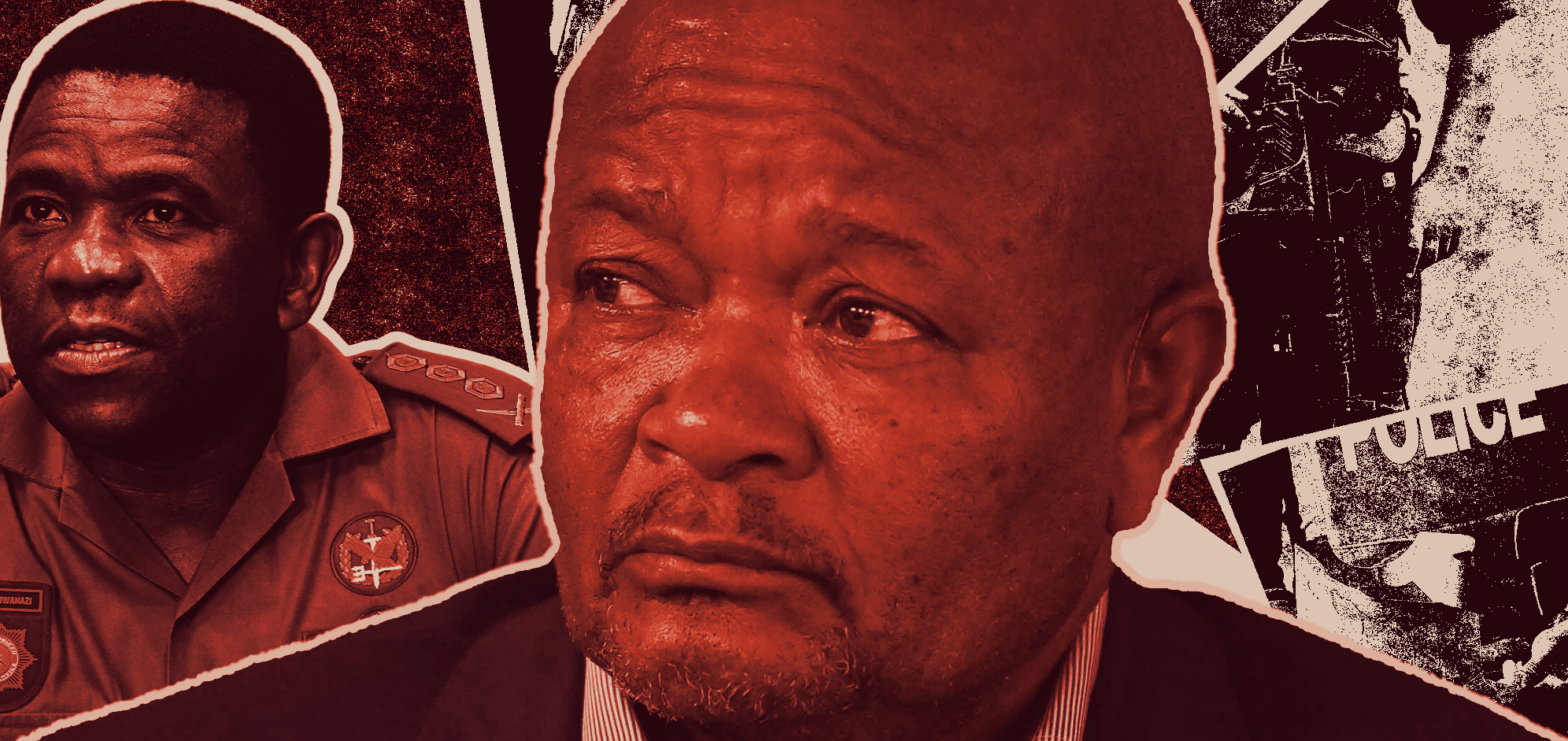
 Illustrative image, from left: KZN Police Commissioner Lieutenant General Nhlanhla Mkhwanazi. (Photo: Gallo Images / Darren Stewart) | (Photo: iStock) | Minister of Police Senzo Mchunu. (Photo: Gallo Images / Volksblad / Mlungisi Louw) | (Photos: SAPS) | (Photo: Gallo Images / Darren Stewart) | (Photo: Gallo Images / Fani Mahuntsi)
 The kind of grave aspersions cast against Police Minister Senzo Mchunu by KwaZulu-Natal Police Commissioner Lieutenant General Nhlanhla Mkhwanazi would have shocked many political observers in KwaZulu-Natal.
They are at odds with the type of public persona he has carefully crafted over the years. While some of Mchunu’s leading contemporaries in the ANC have been entangled in one form of scandal or another while amassing fortunes dubiously, the former teacher has largely stayed clear of adverse publicity.
Accumulation and display of wealth, financial inducements and links to political killings are not traits readily associated with his rise as a formidable player in the rough terrain that is ANC politics in KwaZulu-Natal.
While his homeboy and predecessor as police minister, Bheki Cele, was brash and certainly made his presence felt among subordinates, Mchunu is the epitome of calmness in a raging storm.
His demeanour belies a dogged, if not ruthless, quiet determination to succeed and reach the lofty heights of the ANC’s core national leadership in 2027.
If Mkhwanazi’s allegations are true, it is that ambition that could have led Mchunu into the embrace of those willing to sponsor a journey to the top through means legitimate and moral, or illegal and deadly, if indeed drug lords are funding his quest for power.
As ANC provincial secretary and chairman, as well as a member of the executive council and premier, Mchunu was highly regarded even by the opposition as a scrupulous individual – certainly not one to link with cartels involved in political killings.
Read more: Mkhwanazi’s warning — drug cartel, criminal syndicate infest SA law enforcement
More of a cerebral disposition than a charismatic figure, he does not rank high in the popularity stakes in his home province.
After he lost the ANC provincial chairmanship to Sihle Zikalala in December 2015, the newly elected leadership removed him unceremoniously as premier for “non-performance” and deployed him to the National Assembly.
His relationship with the provincial leadership soured, but President Cyril Ramaphosa boosted his political fortunes by appointing him to various critical Cabinet posts, including the latest as police minister.
It was a just reward for his steadfast alignment with the President’s slates during fiercely contested ANC elections in 2017 and 2022 against a strong anti-Ramaphosa push in KwaZulu-Natal.
Ramaphosa’s dilemma
Now, Mchunu has landed Ramaphosa in a quandary with Mkhwanazi’s explosive allegations. Mkhwanazi’s dramatic media briefing may have breached protocols, but the thrust of his message and the alarm bells ringing around the country leave the President with little room for indecision – he must act against one or both.
The timing could not have been worse for the ANC in the province.
Having been reduced to 17% of electoral support in the last election, a task team headed by party veteran Jeff Radebe is on the ground rebuilding the organisation.
Key among its renewal messages is that the party will no longer tolerate corruption and association with the kind of conduct Mkhwanazi alleges against Mchunu.
Revelations that Cele has also benefited from Vusimuzi Matlala’s generosity through his stays at the tender tycoon’s exclusive penthouse in a Pretoria hotel point to a deeper problem for the ANC in KZN.
Like Mchunu, Cele is a senior leader from the province and has served in the national executive committee for many years. News24 has reported that while Mkhwanazi has identified Matlala as key to the alleged criminal cartel buying influence with Mchunu and other top police officers, Cele is also caught in the web.
State Capture’s tentacles, generally associated with former president Jacob Zuma’s tenure in government, could have extended wider if Mkhwanazi’s explosive allegations are true.
Predictably, political rivals, including Zuma’s uMkhonto Wesizwe (MK) party, have called for Mchunu’s arrest. The Inkatha Freedom Party has urged President Ramaphosa to place the minister on special leave while an independent commission of inquiry probes the matter.
The challenge for Radebe’s renewal team is that both Mchunu and Cele have been vocal in denouncing Zuma’s conduct that brought the ANC into disrepute.
Its own alleged entanglement with criminal cartels is exactly the ammunition the MK party needed in its armoury to soil the image of the ANC as part of a criminal syndicate.
However, the MK party may be the least of the ANC’s problems, considering the number of those in conflict with the law among its own ranks.
The superhero cop
The IFP, which leads the Government of Provincial Unity (GPU) under Premier Thami Ntuli, has long been firmly in Mkhwanazi’s corner, even before this week’s revelations.
When the coalition government was formed last year, Ntuli moved the Community Safety and Liaison portfolio under his umbrella, and he works well with the provincial commissioner. He has irked the ANC by claiming during recent by-elections that policing in the province has improved under Mkhwanazi because the IFP “is in charge”.
The overwhelmingly positive response to Mkhwanazi’s allegations against Mchunu has political parties on a stampede for a slice of mileage to be extracted from the drama.
The police commissioner has been elevated to a superhero in a province ravaged by crime and political killings that he suggests may have involved politicians and police officers as instigators.
It is a public profile he has built steadily.
A decorated former head of the SAPS’s most elite operations unit, the Special Task Force, Mkhwanazi clearly relishes encounters with armed criminals who, as he would have all believe, commit the fatal mistake of firing first.
Amid concerns about a slide into the terrain of extrajudicial killings, Mkhwanazi’s team, with media in tow, regularly proudly showcases the successes of its operations against hardened criminals.
It is retributive justice on behalf of a KwaZulu-Natal citizenry that had lost hope in the state’s ability to protect the most vulnerable.
Since his deployment as KZN provincial commissioner in 2018, Mkhwanazi has resisted meddling by politicians in operational matters, pointing out that he reports to the national commissioner. This could not have been more evident than during the July 2021 looting frenzy when the security cluster sought to apportion blame for the glaring inadequacies exposed by the mayhem following Zuma’s imprisonment.
Cele differed publicly with then national commissioner General Khehla Sithole about how the police responded.
Mkhwanazi told a subsequent inquiry into the July 2021 unrest that “ministers are not employed to run operations”.
He would not have taken kindly to being instructed by Mchunu to disband the political killings task team that he felt was being frustrated by corrupt police and politicians compromised by criminal elements.
Now he has his sights on him.
Mchunu’s pipedream
While Mchunu is yet to explain himself fully, the court of public opinion may have already rendered his lofty political ambitions a pipe dream – notwithstanding a likely endorsement by Ramaphosa, a man he stood by when it was career-limiting to do so in the once mighty province of KwaZulu-Natal.
He has denied any links to the alleged cartel kingpin. His office said yesterday that he “has never met Mr Matlala, has never spoken to him, nor has the minister ever requested or received anything from him”.
After telling Parliament in March that he did not know Brown Mogotsi, the alleged linkman between him and Matlala, on Wednesday, Mchunu said he knew Mogotsi just as a comrade and not as an associate.
Read more: ‘No associate, just a comrade’ — Mchunu denies Mkhwanazi’s claim of ties to organised crime accused
National Assembly Speaker Thoko Didiza has asked the parliamentary committees on police, justice and constitutional development and the Joint Standing Committee on Intelligence to consider Mkhwanazi’s allegations urgently.
National Police Commissioner Fannie Masemola said he would brief President Ramaphosa about the “unprecedented, concerning and unfortunate” situation in the ranks of police leadership.
Whatever the outcome of all these deliberations, Mkhwanazi’s Sunday media briefing may yet turn out to be a catalyst for a reset of the country’s criminal justice system.
In the process, the truth shall be revealed about the character of a police minister that many in KwaZulu-Natal may have thought they knew. DM
Cyril Madlala is a former editor of Umafrika and The Independent on Saturday in KwaZulu-Natal. Over the years, he has reported extensively on provincial and national politics, particularly the transition from apartheid to the democratic dispensation.