




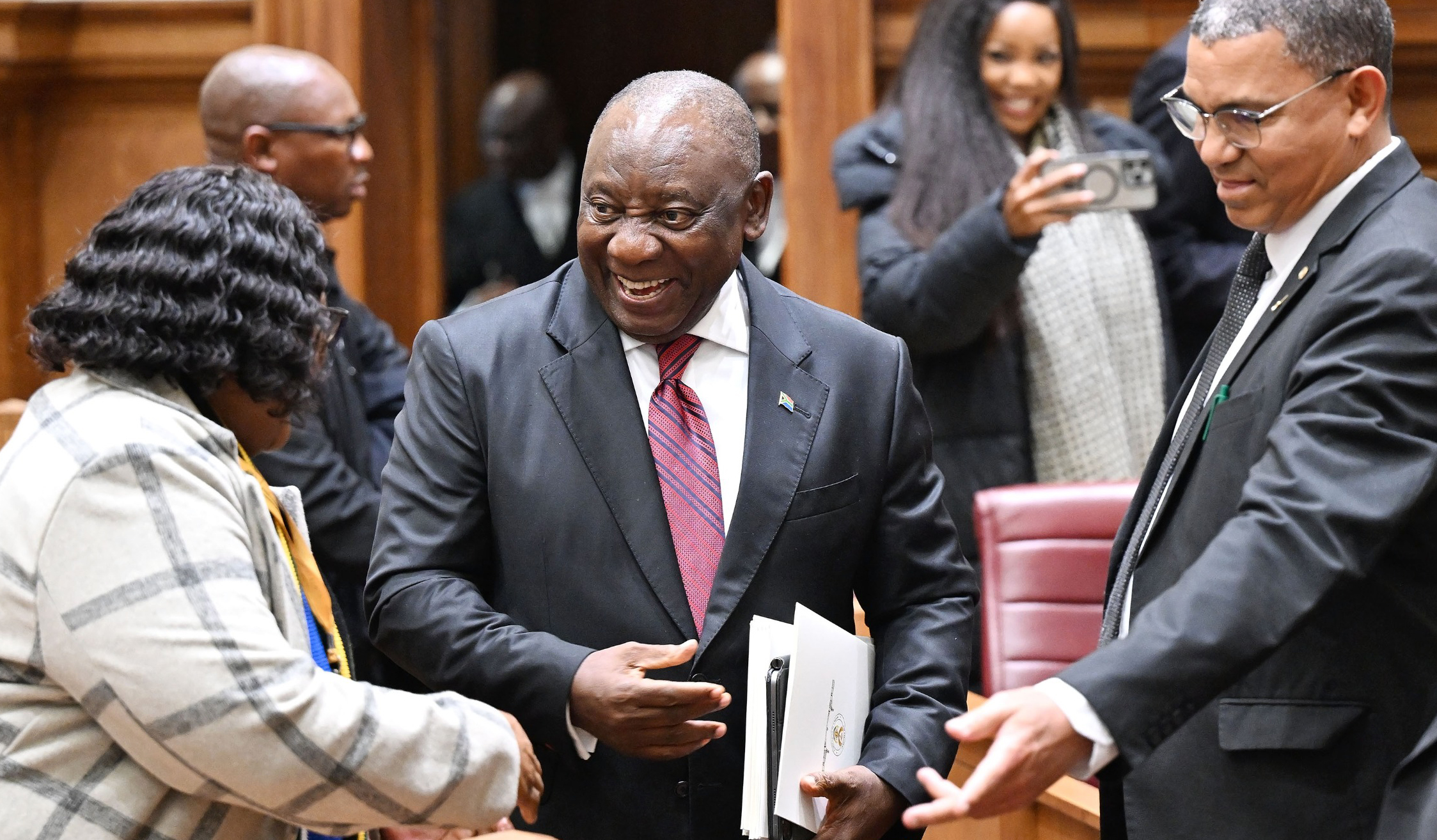
 President Cyril Ramaphosa at the NCOP Q&A session in Parliament on Wednesday, 25 June. (Photo: Phando Jikelo / RSA Parliament)
 President Cyril Ramaphosa says while parties in the Government of National Unity (GNU) may differ on certain policy issues, “the fundamental commitment to the GNU’s transformational agenda remains in place.
“At a broader level, through the Statement of Intent, which was signed by various parties as part of the Government of National Unity, we are committed to translate the values of our Constitution into focus — particularly with regard to the achievement of social justice, redress and equity. That is what we all signed up for when we entered into the Government of National Unity,” Ramaphosa told delegates in the National Council of Provinces (NCOP) on Wednesday, 25 June.
Read more: How South Africa’s poor continue paying for the privileges of the rich
He was responding to a question from the DA’s Nicolaas Pienaar on whether, with reference to his recent working visit to the United States, he conceded that the GNU had to rework its Broad-Based Black Economic Empowerment (B-BBEE) policies to attract more international investment.
Ramaphosa said Pretoria’s visit to the US had not focused on BEE. But not before poking fun at the Oval Office meeting with US President Donald Trump, in which Trump dimmed the lights to show a video splicing EFF leader Julius Malema’s rendition of “Dubul’ Ibhunu” and AfriForum’s white-cross farm protests to “prove” his false claims of a genocide in SA.
“I would’ve thought that we would not be making any reference to the United States, but, be that as it may, I’m rather pleased that the lights here have not been dimmed, because any act of dimming lights continues to worry me,” said Ramaphosa.
He continued: “Our visit to the United States did not focus on issues of Black Economic Empowerment. It focused on resetting our relationship with the United States and ensuring that we continue to open conversations with our major trading partners, and our commitment to Black Economic Empowerment — as expressed through various policy documents and statements — remains steadfast.”
The issue of BEE has once again become increasingly prominent for reasons involving the Trump administration’s focus on SA’s transformation policies and the recent publication of a B-BBEE policy direction that could allow Elon Musk’s Starlink internet service provider to operate in the country without ceding ownership.
At the same time, the DA, a GNU partner and SA’s second-largest party, is challenging section 15A of the Employment Equity Amendment Act in the Gauteng Division of the High Court, arguing it violates section 9 of the Constitution by enabling discrimination based on race.
The DA’s legal challenges to key pieces of legislation the ANC believes will further transformation, such as the Employment Equity Act, National Health Insurance, the Expropriation Act and the Basic Laws Amendment Act, have highlighted divisions within the GNU.
Read more:
- BEE — the beginning of a new phase in an old fight thanks to Trump and Ramaphosa
- BEE on borrowed time — why attacks on SA’s social engineering project won’t abate this time
Last month, Ramaphosa defended South Africa’s redress policies in Parliament, arguing it was not BEE holding South Africa’s economy back but exclusive ownership.
Transformation should be seen as a ‘national project’
Echoing his previous comments, Ramaphosa on Wednesday said that SA needn’t choose between transformation and economic growth.
“We must dispense with the false notion that we must make a choice between transformation and growth. Black Economic Empowerment is not only compatible with investment and growth, but is essential to the achievement of broad-based growth, as well as prosperity. It must be seen as a process through which we take measures — direct measures — to bring those who were excluded from economic activity into the economic mainstream.
“To think that it will happen on its own, when in the past measures were taken — including laws [that] were passed to ensure that only a minority benefits — we would be deceiving ourselves,” he said.
Ramaphosa said that although the government had made progress on transformation “across a range of measures, … we can do better.
“As with any other policy, we must constantly assess whether we are achieving our goals and whether we are making the improvements that we wanted.
“Various departments in our government, including the Department of Trade, Industry and Competition, are continuing to review the various measures that are in place, to align these with the priorities of our government in ensuring that we have industrialisation, inclusive growth and also that we facilitate access to finance for emerging black-owned and managed enterprises,” he said.
Transformation, he said, should be seen “as a national project”.
“It should never be seen as a project that belongs to just a few amongst us. All of us must be involved in this, including those who benefited under the previous system. They must be seen to be actively involved in advancing the system of all, because failing to do so could lead to lack of growth in our economy — it could lead to reversals. So all hands — black and white — must be on deck to promote transformation in our country, to enable all South Africans to play a role in the economy of their country,” he said.
/file/dailymaverick/wp-content/uploads/2025/06/WhatsApp-Image-2025-06-25-at-15.48.12.jpeg "The NCOP meeting on Wednesday. (Photo: Phando Jikelo / RSA Parliament)")
Starlink deal
In an appearance before Parliament last month, following his department’s publication of the policy direction that could significantly alter the way SA regulates empowerment in the information and communication technology sector, Communications and Digital Technologies Minister Solly Malatsi maintained the direction was not giving Starlink “special dispensation”.
The proposed direction provides communications licence applicants with a workaround to a rule in the Electronic Communications Act that requires licence-holders to be 30% owned by historically disadvantaged groups. Musk has previously criticised SA’s ownership laws ad nauseam.
This is the main barrier that has prevented Starlink from applying for a licence to operate in South Africa, as it does not comply with the rule, according to a News24 report.
Malatsi faced backlash from several MPs, who called for the withdrawal of the proposal, which has been published for public comment.
On Wednesday, Ramaphosa said that as far as he was concerned, Malatsi had not violated any of the country’s laws in publishing the policy direction.
“There are going to be hearings — there are going to be public hearings — where our people will make inputs on the efficacy of what he has announced. What he has announced is very much in line with our laws. There is no violation as far as he’s concerned and as far as I’m concerned with regard to our laws, and it’s not specifically aimed at one or any company,” said Ramaphosa.
He said the policy direction was aimed at ensuring that those who wanted to participate in this process “may find greater ease to do so”, and it was also aimed at “synchronising that communications [legislation]” with other laws. DM