



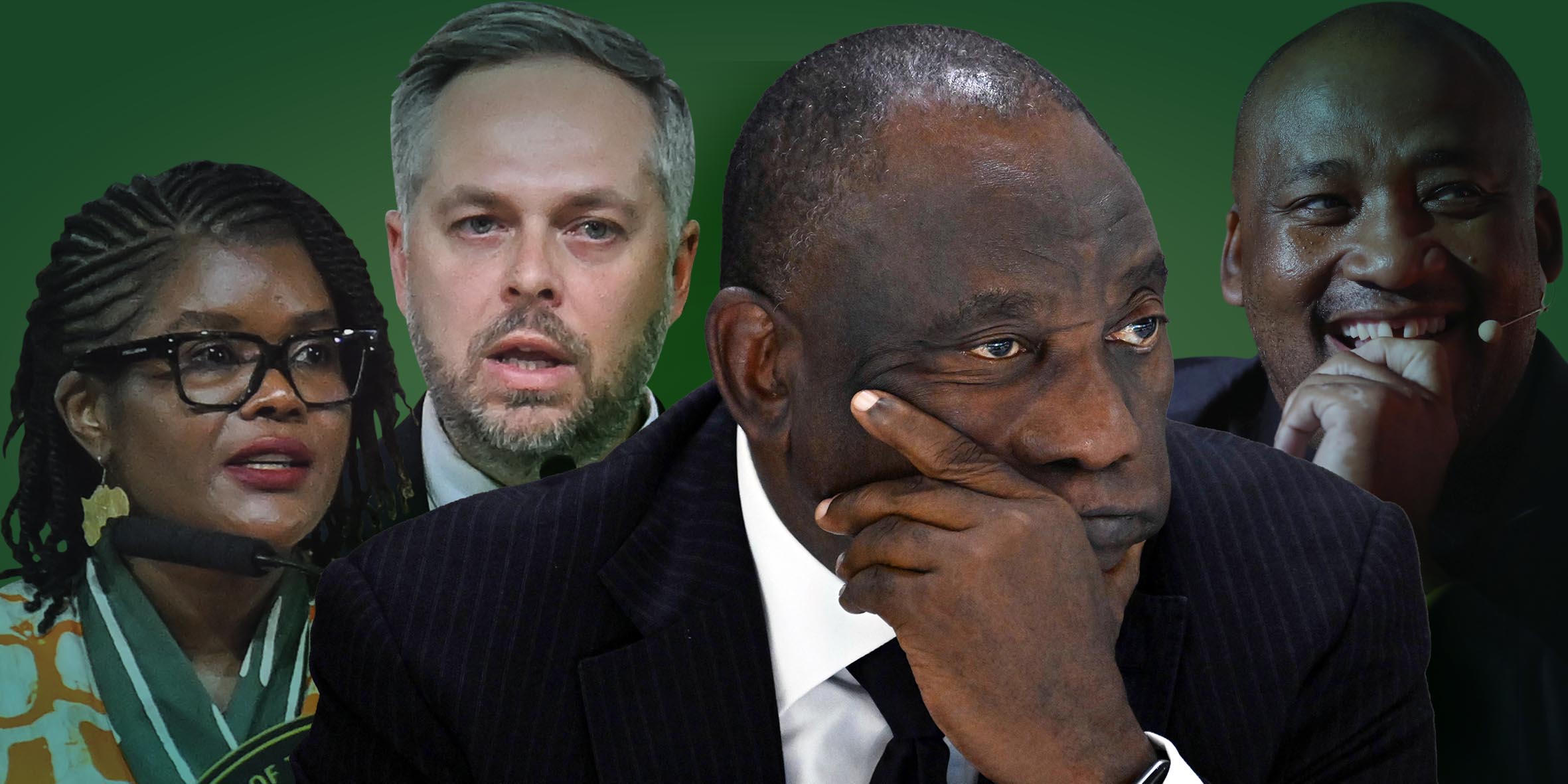
 (Illustrative image, from left: Higher Education Minister Nobuhle Nkabane. (Photo: Gallo Images / Jeffrey Abrahams) | Minister of Home Affairs Leon Schreiber. (Photo: Gallo Images / Jeffrey Abrahams) | President Cyril Ramaphosa. (Photo: EPA-EFE / Emmanuel L Dunand / Pool) | Minister of Sport, Arts and Culture Gayton McKenzie. (Photo: Shelley Christians)
 When it first became clear that a national coalition was being formed around the African National Congress (ANC) and the Democratic Alliance (DA), it was already obvious that it would be incredibly diverse. This has led to a Cabinet in which it can sometimes appear that ministers are following different agendas. And the person at the centre of it all, President Cyril Ramaphosa, appears to be unable to instil discipline or ensure competence.
Even now, a full year after the ministers were sworn in, the diversity of our Cabinet can be breathtaking. It is not just that two parties that have competed against each other so personally for so long are working together. It is also because the Pan Africanist Congress (PAC) and the Freedom Front Plus, along with the Patriotic Alliance (PA) and the Inkatha Freedom Party (IFP), appear to be rubbing along together fairly well.
It is almost a part of our South Africanness that, for the moment at least, our politicians generally have warm personal relations, despite the very real differences in the constituencies they represent.
When Ramaphosa visited flood-affected communities in the Eastern Cape last week, his delegation included ministers from the IFP and the DA, and it was clear they were being included in the same way ANC ministers were.
It was somehow typically South African. Everyone has a chance to do their thing.
Cooperation
It was perhaps this element of our society that might have led to hopes that perhaps, despite their ideological differences, members of the Cabinet would all work together to move in the same direction.
There are some areas in which this has happened.
For example, there have been virtually no leaks from Cabinet meetings, even though some parties would stand to gain from doing this.
Some have indeed given an account of what happened during the most tense moment of this coalition, the argument over the Budget, but even so, very few details have emerged in the public domain.
Also, considering that there are many departments with a minister from one party and a deputy or deputies from another, instances of open conflict have been rare.
Of course, there are some. Particularly in the two situations where the current minister is from the DA, while the deputy minister is the previous ANC minister.
Both in the Communications Ministry and in Public Works and Infrastructure, there have been brief public spats involving the DA’s Solly Malatsi and the ANC’s Mondli Gungubele (over Malatsi’s withdrawal of the SABC Bill) and the DA’s Dean Macpherson and the ANC’s Sihle Zikalala over several issues (including the Expropriation Bill and how the department has been run).
But in some areas, which could be considered political flashpoints, there has been relative peace.
In the Department of Trade, Industry and Competition, for example, which administers BEE, it appears that the minister, the ANC’s Parks Tau and one of the deputies, Andrew Whitfield, have avoided open conflict.
This is no small achievement.
Considering the previous habits of both the ANC and the DA, and the very real differences on issues like the National Health Insurance, the fact that there has been no public conflagration is in itself important.
Cohesion
That said, there is an apparent lack of cohesion within the Cabinet.
This was on full display two weeks ago.
While Malatsi was making it easier for a service owned by the world’s richest man to come to South Africa, Mineral Resources and Petroleum Minister Gwede Mantashe was unveiling new proposals that place onerous new transformation conditions on the mining industry.
In some cases, it appears that individual ministers, no matter which party they are from, are making important progress. But strange things still happen.
Last year, Home Affairs Minister, the DA’s Leon Schreiber, unveiled new regulations for digital nomads. The government had promised these changes for many years, but he did it within months of taking office.
This led to speculation that either Schreiber was just more competent than the ANC or that his predecessor, the ANC’s Aaron Motsoaledi, had refused to publish the changes.
This forced Ramaphosa to issue a statement, confirming that Schreiber had his full support.
Renegades
But two other factors so far also stand out from the behaviour of this Cabinet.
The first is that several members have not moderated their behaviour, despite now holding national office.
PA leader Gayton McKenzie, for example, appears to be in continual campaign mode. While it may be significant for a political party leader to make prejudiced and xenophobic comments, it is much more significant when those words come from a Cabinet minister.
Despite very strong criticism of his comments, the President has not taken action against him.
Meanwhile, the country’s best-known public masticator, Higher Education Minister Nobuhle Nkabane, has shown complete disrespect for Parliament and accountability.
Worse, it appears her claim that the list of names of people she would appoint to chair the Setas came from an independent panel is a complete lie.
If and when this is confirmed, Ramaphosa will be under pressure to remove her as she will have lied to Parliament.
Coalition weakness
All of this demonstrates a major weakness of the current arrangement. Ramaphosa cannot really take action against a minister who is not from the ANC. To do so could risk the entire coalition.
This probably explains why he has not acted against McKenzie. And even if he were to speak to the PA about this, McKenzie is its leader. And even if the party agreed to his removal, it would probably replace him in the Cabinet with their deputy leader, Kenny Kunene.
It would not be long before he made comments very similar to those made by McKenzie. Or, given Kunene’s track record, something much worse.
This reveals the second dynamic.
Ramaphosa also appears unable to act against ANC ministers. If he can’t act against ministers from other parties, can he act against those from his own?
It may still be important, though, to remember that some of these dynamics are also the result of old ANC habits.
For example, there was at least one example of a deputy minister contradicting a minister in public (when Godfrey Oliphant was the deputy minister of Mineral Resources, he publicly criticised Mosebenzi Zwane during the State Capture era).
And of course, there are plenty of examples where a minister appeared impervious to presidential discipline.
The most public example was Pravin Gordhan, who took on Jacob Zuma in the most public way in 2016 and 2017.
Competence
Another old ANC habit may well relate to the fact that several people in the Cabinet have been shown to lack competence.
Nkabane’s handling of the Seta debacle may be a good example. But Minister in the Presidency Khumbudzo Ntshavheni’s statement that the government would “smoke out” illegal miners during an incident in which at least 80 people died may be another.
There is still no indication that Small Business Development Minister Stella Ndabeni (formerly Ndabeni-Abrahams) has acted as a cheerleader for business.
The Minister of Land Reform and Rural Development, PAC leader Mzwanele Nyhontso, has been largely absent from debates and discussions about his portfolio, while there are other examples of ministers who appear to have made little progress in their portfolios.
This suggests that while much has changed within our Cabinet because of the introduction of other parties, much remains the same. DM