




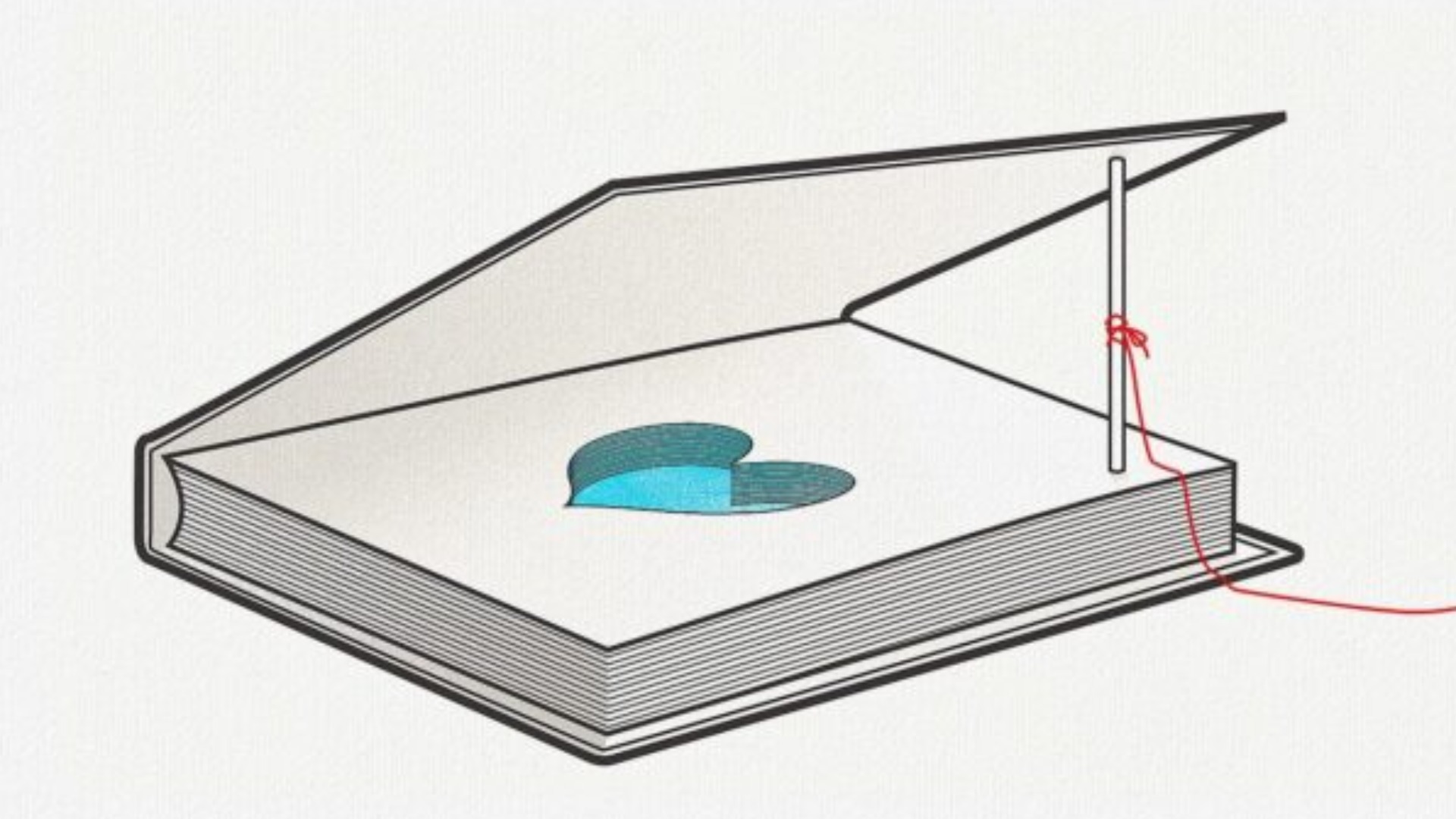
 We need to read good literature to help us refind connection because we have been desensitised and dehumanised by the ceaseless exposure to what is abnormal in human relations. (Illustrative image: Pixabay)
 One of my happiest recent discoveries in contemporary fiction has been the novels of Irish writer Sally Rooney. The hype around her latest book Intermezzo — together with a moving op-ed she wrote in 2024 about the climate crisis — piqued my interest. This was enough to get me to buy two of her earlier novels, Normal People (2018) and Beautiful World, Where are You (2021).
Both are captivating pieces of writing. So much so, that when she saw me poring over them, a good friend jokingly accused me of reading “girl books”. If books that explore complexity in twenty-first century relationships are girl books, then guilty as charged!
Much of Beautiful World Where Are You is taken up with a correspondence by e-mail between its two main women characters, Alice Kelleher and Eileen Lydon. It’s a deeply philosophical set of letters, kind of like letters were once upon a time when they were a vehicle for a quieter, private, more considered and reflective form of communication between two humans.
But in Beautiful World Where Are You the letters are also a literary device that enables Rooney to defy convention by probing dark and difficult questions about modern society in a novel that, otherwise, is a racy relationships novel that gives many pages over to the intimate sex lives of the two women.
Literature is always full of surprises. I alternate fiction with history or politics. This was reading in part for escape. But in one of Alice’s letters I came across a passage that coincided with my own ponderings about the loss of compassion evident in many people. The passage reminded me of a few lines I’d written and then deleted in a recent column exploring the reasons for our numbness about the human tragedy in the Stilfontein mine massacre.
Read more: Stilfontein massacre: South Africans need to rediscover compassion and solidarity
In one of her letters to Eileen, Alice, a successful young novelist who has suffered a breakdown and retreated to a small coastal village a few hours from Dublin, reflects on the writings of her contemporaries, lamenting how: “The problem with the contemporary Euro-American novel is that it relies for its structural integrity on suppressing the lived realities of most human beings on earth. To confront the poverty and misery in which millions of people are forced to live, to put the fact of that poverty, that misery, side by side with the lives of the ‘main characters’ of a novel, would be deemed either tasteless or simply artistically unsuccessful. Who can care, in short, what happens to the novel’s protagonists, when it’s happening in the context of the increasingly fast, increasingly brutal exploitation of the majority of the human species? Do the protagonists break up or stay together? In this world what does it matter?”
(These might equally be Rooney’s “notes to self” when thinking about her own creative process.)
Alice goes on: “… the novel works by suppressing the truth of the world — packing it down tightly under the glittering surface of the text. And we can care once again, as we do in real life, whether people break up or stay together — if, and only if, we have successfully forgotten about all the things more important than that, i.e. everything.”
Alice has a point here. Literature or no literature it’s a fact that too few twenty-first century humans make an effort to understand the feelings of people living in desperate poverty, our fellow humans. As writers like novelist Elif Shafak and Joan-of-all-genres Kae Tempest point out, elitist politics and technology have conspired to ensure we have lost our sense of connection to most other human beings.
Both believe that reading literature is a way back to a state of compassion. Says Tempest in her book On Connection: “It’s basically like this: anything that can remind me that at all times, other people are existing and that their existence is as fully felt as my own, is useful. Music and literature take me straight into someone else’s experience, and straight out of my own.”
We need to read good literature, to help us refind connection because we have been desensitised and dehumanised by the ceaseless exposure to what is abnormal in human relations, real and imagined violence that comes at us through our TVs and phones. In fact, we don’t even register many of today’s horrors as abnormal.
Further as inequality has deepened and even middle class-dom has become more physically removed from those stuck in poverty we have also lost touch with each other. Poor and not so poor bump into each other every day — but might as well live on different planets.
Apartheid in the soul
My emotionally formative years were in the 1970s and 1980s. As a young person, grappling with my whiteness and privilege, through English literature I accidentally discovered my shared humanity with people whom race and class might otherwise have separated me from. It probably started with studying Shakespeare’s King Lear and having to learn the outcast king’s “Poor naked wretches” soliloquy:
“Poor naked wretches, wherso’er you are,
That bide the pelting of this pitiless storm,
How shall your houseless heads and unfed sides,
Your loo’d and window’d raggedness, defend you
From seasons such as these? ”
Lear’s epiphanic “Oh, I have ta’en too little care of this” could be as much an admission of negligence for the 21st century oligarchs as it was for the seventeenth century monarchs.
Except that they are beyond self-realisation and introspection.
From that moment on I began to seek out novels that evoked empathy, sympathy and connection, novels that filled out the lives and feelings of human beings on the hard end of deprivation.
For example, I remember the shock of reading French writer Emile Zola’s Germinal, a classic novel about the conditions of French mineworkers in the 19th century.
During the British mineworkers strike in 1984, and whilst reading English Literature at Oxford University (Oxford was twinned with Welsh coal mines that I visited as part of the Miners’ Support Group), I was moved by Welsh writer Lewis Jones’s Cwmardy, a novel about the lives and travails of Welsh mineworkers.
Around the same time, George Orwell’s The Road to Wigan Pier, which he wrote after embedding himself in working class life in Yorkshire and Lancashire in 1936, was a kick in the guts.
Closer to home, I listened to songs such as Hugh Masekela’s Coal Train, singing the life-stories of migrant workers from across southern Africa, and read Wally Serote’s To Every Birth Its Blood. (That was years before black-on-black xenophobia had turned migrant workers into enemies, while our erstwhile liberation movement leaders simultaneously have dinner dates with the wealthy mine owners who had exploited generations of mineworkers and continue to control the wealth they created.)
The only South African novels I can think of more recently that made a similar deep impression on me were the late Sello Duiker’s Thirteen Cents and The Quiet Violence of Dreams: I would recommend both to people wanting to understand the real life feelings of homelessness and addiction among the deprived youth you (don’t) see on the street every day.
These novels helped me to feel what should be obvious to us all: that all humans, regardless of their socioeconomic status, have the capacity to love, have dignity, want to realise their potential, dream and experience the same pain we do.
Novels made real to me the human consequences of poverty and inequality in the world.
Kae Tempest puts in perfectly in Brand New Ancients, an award-winning poem about the nobility of individual men and women, whose beauty and opportunity is thwarted by ennuic poverty and the social diseases of marginalisation:
… we are still mythical.
We are still permanently trapped
somewhere between the heroic and the pitiful.
We are still Godly,
that’s what’s made us so monstrous.
It just feels like we’ve forgotten
that we’re much more
than the sum of the things that belong to us.
Every single person has a purpose in them burning.
Look again.
Allow yourself to see them.
In her letter to Eileen, Alice seems to suggest that in these dying and dystopian days where we scrabble for hope in the carnage of neo-liberalism there are commercial barriers to writing and publishing novels that build connection and compassion — writing that incubates empathy and understanding across the minefields that have been laid to make us think we are different from each other.
Admittedly, there’s no shortage of great literature, or of great literature with deep political messages — I think of Paul Lynch’s Booker prize winning Prophet Song or 2024 Nobel prize for literature winner Han Kang’s Human Acts.
Read more: A review of the 2023 winner of the Booker Prize, ‘Prophet Song’
Perhaps it’s a sign of the dying of the light that we write so obsessively about it.
But, that said, where are the books that put us inside the thoughts of the millions of climate refugees, or the young men and women unable to advance in life because of permanent unemployment, or the waste picker, the zama zama or the hungry child in a hungry family.
Indeed, to go back to where my thoughts departed from Alice Kelleher’s letter to the Stilfontein massacre, who will conjure up words to help transport us deep underground, into pitch black, narrow, airless tunnels, where men spent days dying of starvation.
What were they thinking about?
How did they experience pain?
What were their life histories?
Who were the heroes?
So I guess my question is where is the literature that will reinspire readers with an understanding that every human feels joy and sorrow, with the beauty and power of solidarity when people work together, the energy to rebel against the vile status quo and with the belief that another world is possible and is worth fighting for. DM