




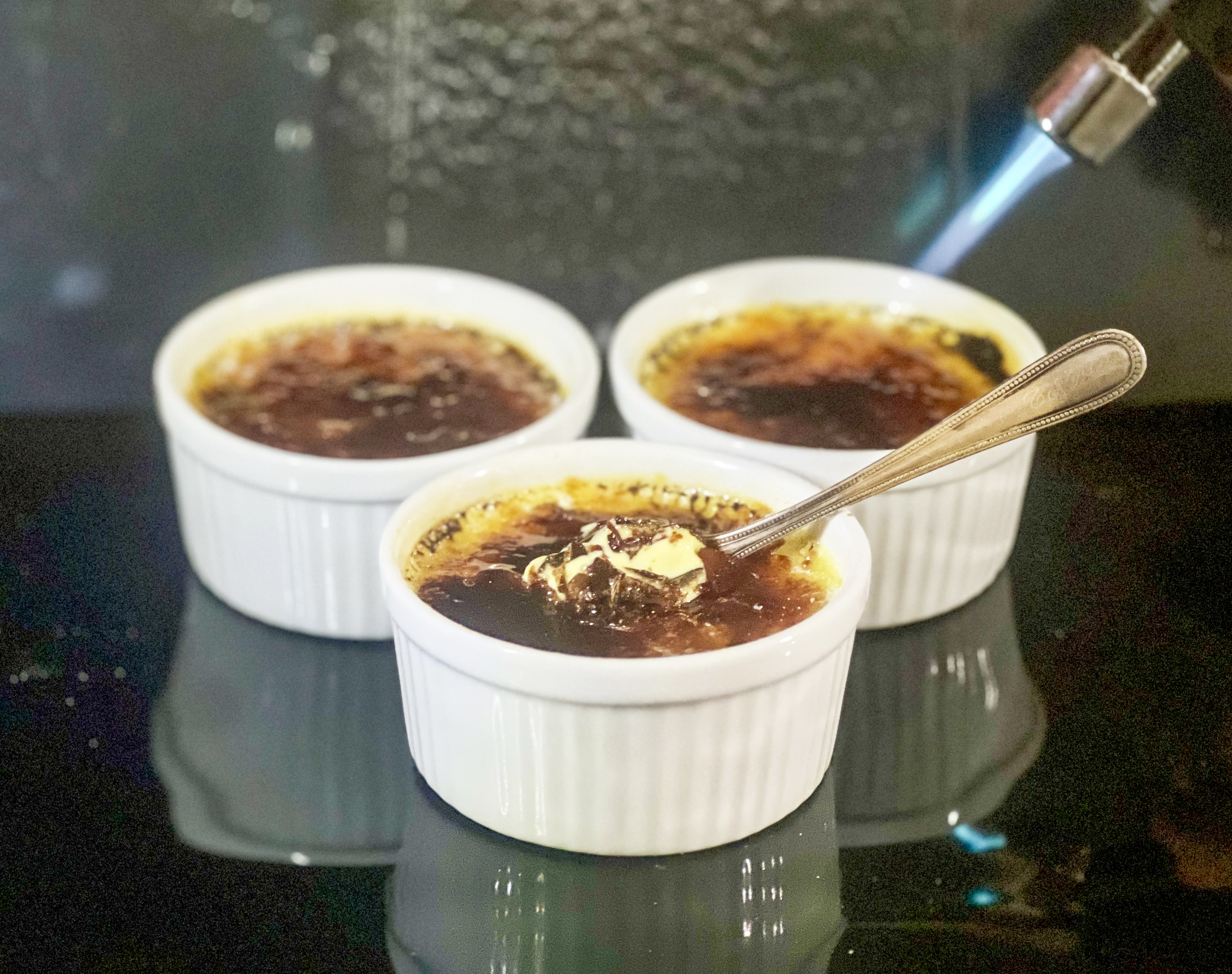
 Bête noire, beaten: Tony Jackman’s orange crème brûlée. June 2024. (Photo: Tony Jackman)
That word is in the headline for a reason. Perfect. This hasn’t always been the case. All cooks have a bête noire, that thing that they want to cook, and cook well, that eludes them. Or that they think eludes them. Something they had a go at many years ago, perhaps. And it flopped. And they never went back to it again.
There’s a reason why you’ve never seen a recipe for crème brûlée in TGIFood. It goes back a while, to circa 2007. I’d written that day’s menu and rashly added at the bottom: crème brûlée. 😬
Not with a grimacing face though: we didn’t have emojis yet. But that emoji would have been a good fit, as it turned out.
“Turned out” being an apt phrase — it didn’t turn out well at all.
The caramel topping didn’t crack.
All four crème brûlées at one table were sent back to the kitchen.
To me.
By a table of chefs from Stellenbosch.
😬😬😬😬
To a cook with a sense of pride, this is like doing a stand-up comedy routine for a roomful of other stand-up comics and being booed off stage.
Ever since, I’ve avoided making crème brûlée again. Looking back now, this was stupid. What I should have done is put it right back on the menu the next day, and get it right this time. And made it a regular feature. And built up confidence in myself.
I’ve thought for a couple of years that it was time to crush the demon. To annihilate it, send it running for the hills. And last weekend, 17 years after that excruciating flop, I had a go again. And got it right. Very right. Perfect, in fact.
And now I can’t wait to make them again. So, you can expect crème brûlée in various guises to crop up here once in a while from now on. Because I’ve gone from 😬 to 😇. (With due humility.)
My first shot at a crème brûlée after nearly two decades had to celebrate the best thing growing in my garden at the moment. And that’s the two trees laden with oranges. The navels are ripe and ready, the Seville oranges on the tree alongside it, still smallish and green. They’ll be ready in three months or so, so my orange season is going to run throughout the winter and into spring.
Read more in Daily Maverick: Winter on the Platteland: An Ode to the Orange
But you can’t put citrus juice into a custard. Dairy and acid don’t like each other one bit. They’re each other’s bête noire. So, to get that orange flavour, all you need is the zest, finely grated. But I wanted the orange presence to be emphatic, so I used the finely grated zest of two navel oranges to achieve a result that said this is Orange with a capital O. And that worked too.
Finally, it had to be madly, wildly creamy. So I had a generous hand with the cream, and used one more egg yolk than most recipes call for. As my cooking partner for the day said with a shrug when I suggested this, “What harm can an extra yolk do?”
He also had a tip for an alternative way to make a caramel topping that he’d been taught at chef’s school: to make a simple sugar-water caramel, pour it onto greaseproof paper and, when it has cooled and set hard, to crush it into tiny bits which you spoon on top of the custard in their ramekins. Then, use a blowtorch to melt it and reset.
In the end, we went the other route, but give that a try if it appeals to you. Just make sure that the caramel you make is super hard.
Tony’s orange crème brûlée
(Makes 4 in standard ramekins)
Ingredients
500 ml cream
100 ml full cream milk
Finely grated zest of 2 oranges
Yolks of 6 extra large eggs
50 g caster sugar
Extra caster sugar for the topping
A blowtorch
Method
Pour the cream and milk into a saucepan.
Add the finely grated zest of 2 oranges and stir. Be sure that the zest has not formed any clumps. (Use a fork or whisk.)
In a bowl, whisk the egg yolks with the caster sugar until light and creamy. Put some elbow grease into this, it took me at least five minutes.
Put the saucepan on the heat and bring the cream and milk to just before boiling point, then take it off the heat immediately.
Pour this slowly into the beaten egg yolks/sugar mixture, while whisking vigorously and continuously until it thickens.
Pour into four ramekins and refrigerate until well chilled.
When it is time to serve them, sprinkle caster sugar on top to cover the custard entirely. Then use a blowtorch to melt the sugar from edge to edge. This can be repeated: once the first layer was melted and golden, we did a second layer and torched that too. It made for a lovely hard, crunchy caramel when cracked with a spoon.
And the toppings of all four of the crème brûlées cracked. Perfectly. Hope those four chefs read this. 😇😇😇😇 (Sorry, but I’ve earned those.) DM
Tony Jackman is Galliova Food Writer 2023, jointly with TGIFood columnist Anna Trapido. Order his book, foodSTUFF, here
Follow Tony Jackman on Instagram @tony_jackman_cooks.