




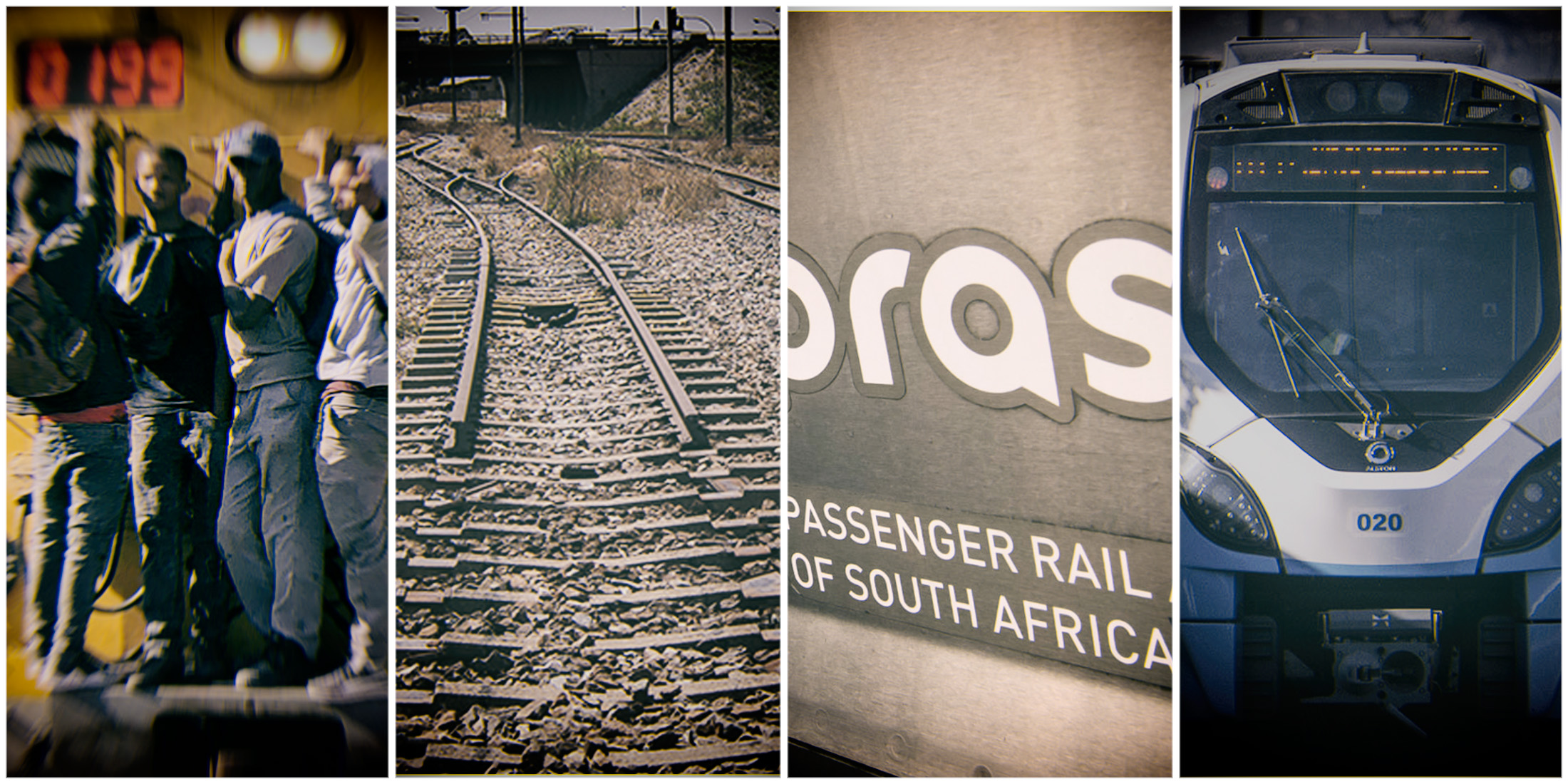
 Illustrative image: Commuters hang on to trains at Rondebosch Station in Cape Town. (Photo: GroundUp / Ashraf Hendricks) | Missing rails at the Old Benrose Station in Johannesburg. (Photo / Shiraaz Mohamed) |(Photo: Gallo Images / Rapport / Deon Raath ) | Prasa’s new People’s Train. (Photo: Brenton Geach)
 The looting of Prasa, South Africa’s passenger rail service, began around 2012 under the leadership of CEO Lucky Montana. If you want to understand the scale of the graft, a Treasury investigation into 216 contracts awarded by Prasa between 2012 and 2015 found that only 13 were legit. The total value of the contracts was around R15-billion.
The result of this corruption has been the destruction of South Africa’s commuter train service. In 2010, rail passengers were making over 500 million train journeys a year. By 2022, this figure had fallen to 19 million. In Cape Town, the most significant Metrorail line servicing underprivileged communities including Khayelitsha and Mitchell’s Plain, has effectively not been operational since 2019.
According to estimates, this has forced an additional 1 million passengers onto the roads daily, whereas previously they would have used trains. So if you are a Capetonian frustrated by the terrible traffic in the city in recent years, you can trace that back pretty directly to the looting of Prasa.
Read more in Daily Maverick: How Prasa was looted and left for scrap
Now let’s talk about Transnet, the government’s custodian of ports, rail and pipelines. Transnet is in charge of the trains that transport cargo rather than humans.
As revealed by the Guptaleaks investigations, the scale of Transnet corruption was the biggest since the Arms Deal in the 1990s. To give just one example, a contract was signed with the Chinese Railway Rolling Stock Corporation in 2014 to buy just over 1,000 locomotives for the price of R54.4 billion, with almost a quarter of the value of this going to Gupta companies.
Of the trains which have arrived so far from this contract, they have been late and pretty much useless. This in combination with the full picture of Transnet corruption, and a spiralling issue with criminal syndicates stealing cables, has meant that the ability of local businesses to transport their goods via rail has been drastically reduced.
Read more in Daily Maverick: Transnet turnaround looks promising, but set to be a long haul
How are those goods being transported now? Via trucks. Which is presenting huge problems for roads and for traffic. In fact, the heavy volume of trucks on the roads is tearing up road infrastructure. This is the reason for many of our potholes, because the roads simply cannot take this kind of pounding. Trucks also account for almost 10% of fatal crashes on South African roads these days, according to a recent study from the Road Management Traffic Corporation.
Together, the collapse of Prasa and Transnet have made all our lives more difficult in multiple ways. That’s the thing about corruption. It isn’t just an abstract concept. It brings down nations. And this is why we need civil society and we need journalism. To expose corruption and to put pressure on those in power to hold the corrupt accountable. DM
Read more in Daily Maverick: State of the Media news hub