



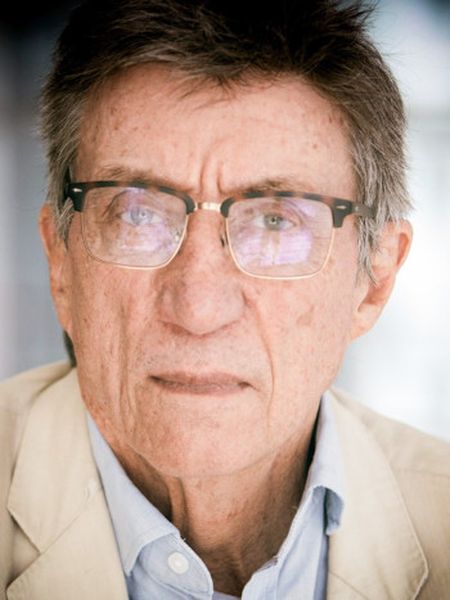
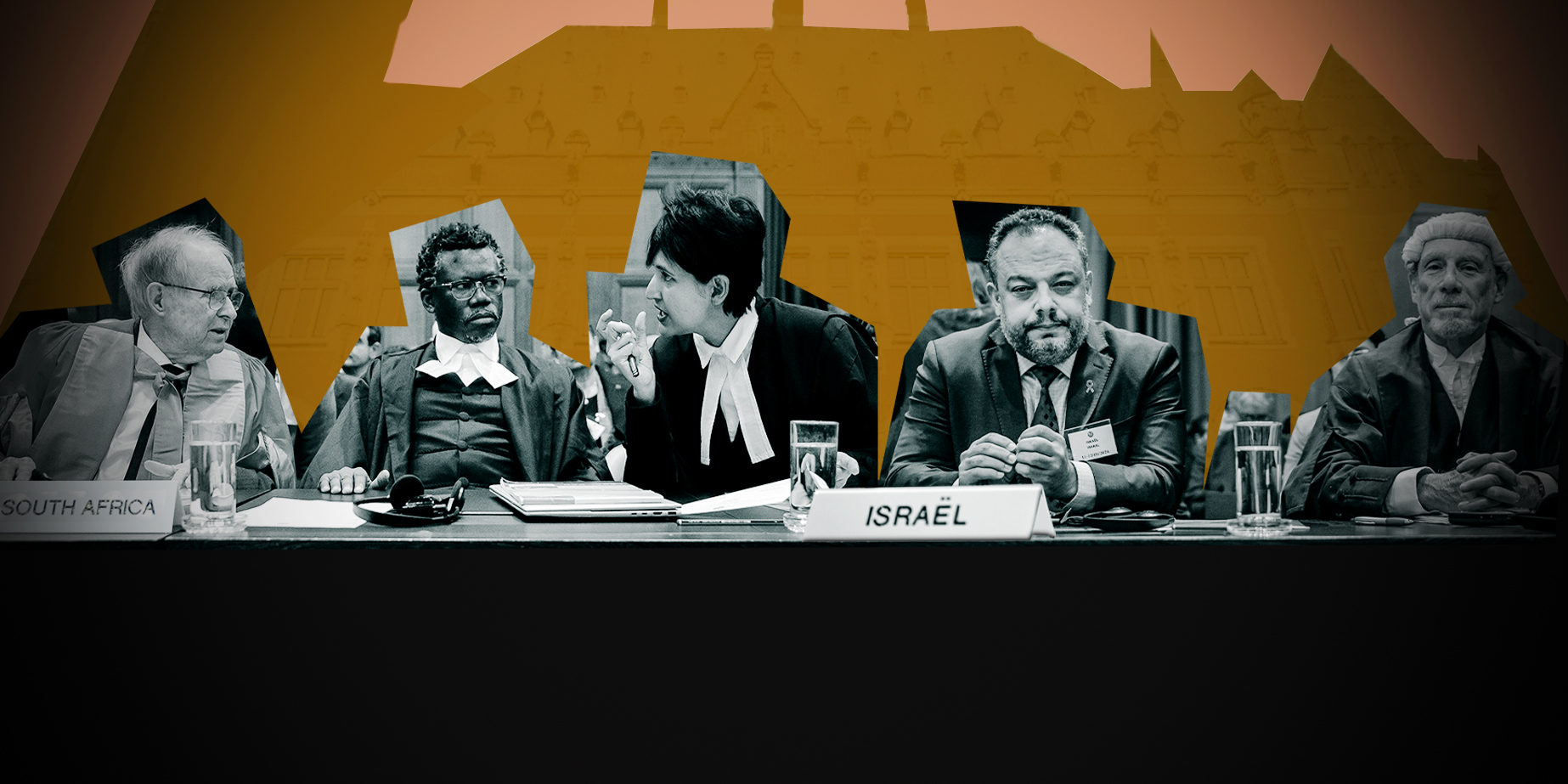
 Illustrative image | South African delegation members John Dugard, Tembeka Ngcukaitobi and Adila Hassimon | Legal Counselor of Israel's Foreign Ministry, Tal Becker and lawyer Malcolm Shaw, (Photos: EPA-EFE/REMKO DE WAAL)
 Israeli lawyers asserted the country’s right to self-defence on Friday in response to the submission by South Africa on Thursday that the ICJ should take urgent and immediate provisional measures to stop Israel from committing alleged genocide. The urgent measures would be pending a final determination by the court on whether it was perpetrating genocide in Gaza in violation of the Genocide Convention.
The court could decide on provisional measures within weeks, though the final determination is expected to take years.
Israel’s lawyers argued that an order for Israel to stop its attack on Hamas in Gaza would leave it exposed to further attacks by Hamas like the one it conducted on October 7 last year, killing about 1 200 people, mostly civilians and taking about 240 hostages. About 100 of those hostages remain in the hands of Hamas.
The lawyers devoted considerable time to providing graphic evidence of this attack which allegedly included murder, torture, rape and the burning alive of civilians, including children.
Read more on Daily Maverick: Israel asks the ICJ to throw out SA’s ‘curated and inaccurate’ genocide case
Israel’s lawyers more broadly blamed Hamas for much of the massive death and destruction in Gaza, which SA accuses Israel of in its application.
Tal Becker, legal adviser to the Israeli Ministry of Foreign Affairs, said that after the 7 October “slaughter – which Hamas openly vows to repeat - and to the ongoing attacks against it from Gaza, Israel has the inherent right to take all legitimate measures to defend its citizens and secure the release of the hostages. This right is also not in doubt. It has been acknowledged by States across the world.
“Under the guise of the allegation against Israel of genocide, this Court is asked to call for an end to operations against the ongoing attacks of an organization that pursues an actual genocidal agenda”.
So if anyone should be ordered by the ICJ to prevent genocide, it was South Africa, Becker said.
/file/dailymaverick/wp-content/uploads/2024/01/GettyImages-1926925249.jpg "Barrister Malcolm Shaw and Israeli legal counsellor Tal Becker laugh prior to today's hearings of Israel's point of view as South Africa has requested the International Court of Justice to indicate measures concerning alleged violations of human rights by Israel in the Gaza Strip on 12 January 2024 in The Hague, Netherlands. (Photo: Michel Porro/Getty Images)")
He said SA enjoyed close relations with Hamas “despite its formal recognition as a terrorist organisation by numerous States across the world” and that even after the October 7 attacks, SA had hosted a senior delegation in South Africa for a “solidarity” gathering.
So the ICJ should instruct SA to comply with its own obligations under the Genocide Convention “to end its own language of de-legitimization of Israel’s existence; end its support for Hamas; and use its influence with this organization so that Hamas permanently ends its campaign of genocidal terror and releases the hostages.”
Becker said if the court granted a provisional measure calling on Israel to suspend its military operations, this would amount to “an attempt to deny Israel its ability to meet its legal obligations to the defence of its citizens, to the hostages, and to over 110,000 internally displaced Israelis unable to safely return to their homes.”
Read more in Daily Maverick: ‘Nothing will stop this suffering, except an order from this court’ — SA sets out the evidence against Israel
Becker said there were many distortions in SA’s application to the court. It barely mentioned Hamas and gave the impression that only Israel was fighting in Gaza, that there was no intensive armed conflict taking place between the two parties at all, no grave threat to Israel and its citizens, only an Israeli assault against Gaza.
“The Court is told of widespread damage to buildings, but it is not told, for example, how many thousands of these buildings were destroyed because they were booby-trapped by Hamas, how many became legitimate targets because of the strategy of using civilian objects and protected sites for military purposes, how many buildings were struck by over 2000 indiscriminate terrorist rockets that misfired and landed in Gaza itself.”
Yet, Becker said, “Hamas has smuggled countless weapons into Gaza, and has diverted billions in international aid, not to build schools, hospitals or shelters to protect its population from the dangers of the attacks it launched against Israel over many years, but rather to turn massive swathes of the civilian infrastructure into perhaps the most sophisticated terrorist stronghold in the history of urban warfare.”
“Hamas has systematically and unlawfully embedded its military operations, militants and assets throughout Gaza within and beneath densely populated civilian areas. It has built an extensive warren of underground tunnels for its leaders and fighters several hundred miles in length throughout the Strip, with thousands of access points and terrorist hubs located in homes, mosques, UN facilities, schools and perhaps most shockingly, hospitals.
He said SA had said over 23,000 Palestinians had died in the war so far - although he said this was the figure of Hamas – “hardly a reliable source.”
But he added that SA had not told the court how many thousands of casualties were, in fact, militants, how many were killed by Hamas fire, how many were civilians taking direct part in hostilities – versus how many “are the tragic result of legitimate and proportionate use of force against military targets.”
He said Hamas was contributing to the dire humanitarian situation which SA accused Israel of causing by stealing and hoarding aid, And he said SA had failed to mention “the extensive Israeli efforts to mitigate civilian harm, or “the humanitarian initiatives being undertaken to enable the flow of supplies and provide medical attention to the wounded.”
Israeli advocate Omri Sender said that contrary to SA’s claim that Israel was deliberately creating conditions inimical to life for the Palestinians, it was taking a raft of measures to provide them with humanitarian aid – including the recent opening of a dozen bakeries. He said that 108 trucks of food were now entering Gaza a week compared to 70 a week before the war.
He also said two new water pipelines had been installed, and water infrastructure plants damaged in the war were being repaired. And he said Israel had established four new field hospitals and two new floating hospitals, with two more hospitals on the way.
Read more in Daily Maverick: Middle East crisis news hub
“The key component of genocide – the intention to destroy a people in whole or in part – is totally lacking,” Becker said. “What Israel seeks by operating in Gaza is not to destroy a people, but to protect a people, its people, who are under attack on multiple fronts, and to do so in accordance with the law, even as it faces a heartless enemy determined to use that very commitment against it.”
/file/dailymaverick/wp-content/uploads/2024/01/GettyImages-1926973492-1.jpg "Barrister Malcolm Shaw speaks on behalf of the Israeli delegation during today's hearings of Israel's point of view after South Africa has requested the International Court of Justice to indicate measures concerning alleged violations of human rights by Israel in the Gaza Strip on 12 January 2024 in The Hague, Netherlands. On January 11 and January 12 at the International Court of Justice (ICJ), the judicial body of the United Nations, in The Hague, South Africa seized the ICJ, to ask it to rule on possible acts of \"genocide\" in the Gaza Strip by Israel. (Photo: Michel Porro/Getty Images)")
British barrister Malcolm Shaw said the atrocities of October 7 showed the threat to Israel was “real and imminent”. They did not justify the violation of law in reply, still less genocide, “but they did justify the exercise of a legitimate and inherent right of a state to defend itself under the UN Charter to put an end to the continuing attacks against it.”
Shaw said that genocide was a uniquely evil crime and should be treated as such. “If claims of genocide become the common currency in every conflict, the meaning of genocide will be lost.”
Shaw also argued that SA’s claim should be thrown out because it had not established that it had a dispute with Israel as required by ICJ rules. South Africa had failed to demonstrate that it had given Israel a full opportunity to respond diplomatically to the allegations of litigation before SA resorted to litigation.
“Particularly in a matter of such severity as an accusation of genocide.”
He said SA had cited no evidence of exchanges with the Israeli government, which would be the normal way of addressing a dispute between states.
Shaw said on 21 December, SA had sent a note verbale to Israel raising its concerns about genocide. He said SA’s application to the ICJ had said Israel had not responded to the note verbale. “This is incorrect,” he said. Israel responded the same day, and SA confirmed receiving the note. On 27 December the director general of Israel’s foreign ministry proposed an urgent meeting with his SA counterpart to discuss the issue.
But the note from the Israeli embassy to this effect could not be delivered to South Africa’s Department of International Relations and Cooperation (Dirco) supposedly because of the holidays. Dirco had then advised the Israeli embassy to hand deliver the note on 2 January. But SA submitted its genocide application to the ICJ on 29 December.
Shaw said SA had, therefore, rejected a good faith effort by Israel to address the genocide question – which could have resolved it without resorting to the ICJ.
This apparent procedural slip-up by South Africa could give the ICJ the chance to dodge SA’s application by arguing that it has no jurisdiction as no dispute had been proved, said UCT international law professor Cathleen Powells.
Advocate Shaw also addressed South Africa’s charge that Israel’s genocidal intent in Gaza had been clearly demonstrated by a host of statements from senior officials, including Prime Minister Benjamin Netanyahu and President Isaac Herzog.
Netanyahu, for instance, had urged Israeli troops to “remember what Amalek has done to you” – a clear reference to the Biblical command by God to Saul for the retaliatory destruction of an entire group of people known as the Amalekites,” South African advocate Tembeka Ngcukaitobi had argued.
But Shaw said the sole responsibility for the conduct of the war was a collective one which lay with the war cabinet and the national security council which he said had only issued statements making clear that Hamas and not the Palestinian people as a whole were the enemy.
Shaw also quoted a statement from Netanyahu in which he made the same point. But that statement was made only this week and one observer suggested it might have been made precisely to influence the ICJ case.
South African justice minister Ronald Lamola dismissed this argument in a press conference after the hearing, saying it was obvious that the statement of a prime minister was authoritative and that Israeli soldiers had acted on it – as South Africa had demonstrated in its submission.
British barrister Christopher Staker said that SA’s requests for provisional orders by the ICJ to cease its military operation would cause “irreparable prejudice “ to Israel by denying it the right to self-defence. It would give the advantage to one party in a conflict over the other.
He made the broader point that many of the other measures requested by South Africa to be directed at Israel went well beyond the ambit of the Genocide Convention and also beyond the conflict in Gaza.
/file/dailymaverick/wp-content/uploads/2024/01/11937454-1.jpg "Israel's legal team at the International Court of Justice (ICJ), prior to the hearing of the genocide case against Israel, brought by South Africa, in The Hauge, The Netherlands, 11 January 2024. (Photo: EPA-EFE/REMKO DE WAAL)")
For instance, the proposed order that Israel should take all reasonable measures to prevent genocide. He said this applied to the Palestinian people generally. This opened the possibility to later claims that actions by Israel having nothing to do with Gaza were in breach of this provisional measure. He said there was no justification for the provision measure to extend beyond the main claim itself – that Israel is committing genocide in Gaza.
Powell said the Israeli team had made a stronger case than she had expected including Shaw’s point that SA might not have proved it had a dispute with Israel under the rules of the Genocide Convention.
And Staker’s point about the provisional measures sought by SA going well beyond the Convention were also quite strong.
She noted, however, that Israel had not responded to several claims by SA, including its allegation that some 85% of Gaza’s population had been displaced by the war and its claim that whole neighbourhoods had been flattened.
Instead, Israel had come with a few facts, loading all of the blame on Hamas, such as the claims that it was using mosques and UN facilities etc to fire rockets.
“I'm rather hoping the ICJ accepts jurisdiction so that the claims of Hamas being so embedded amongst the civilians can be judicially tested,” she said. DM