




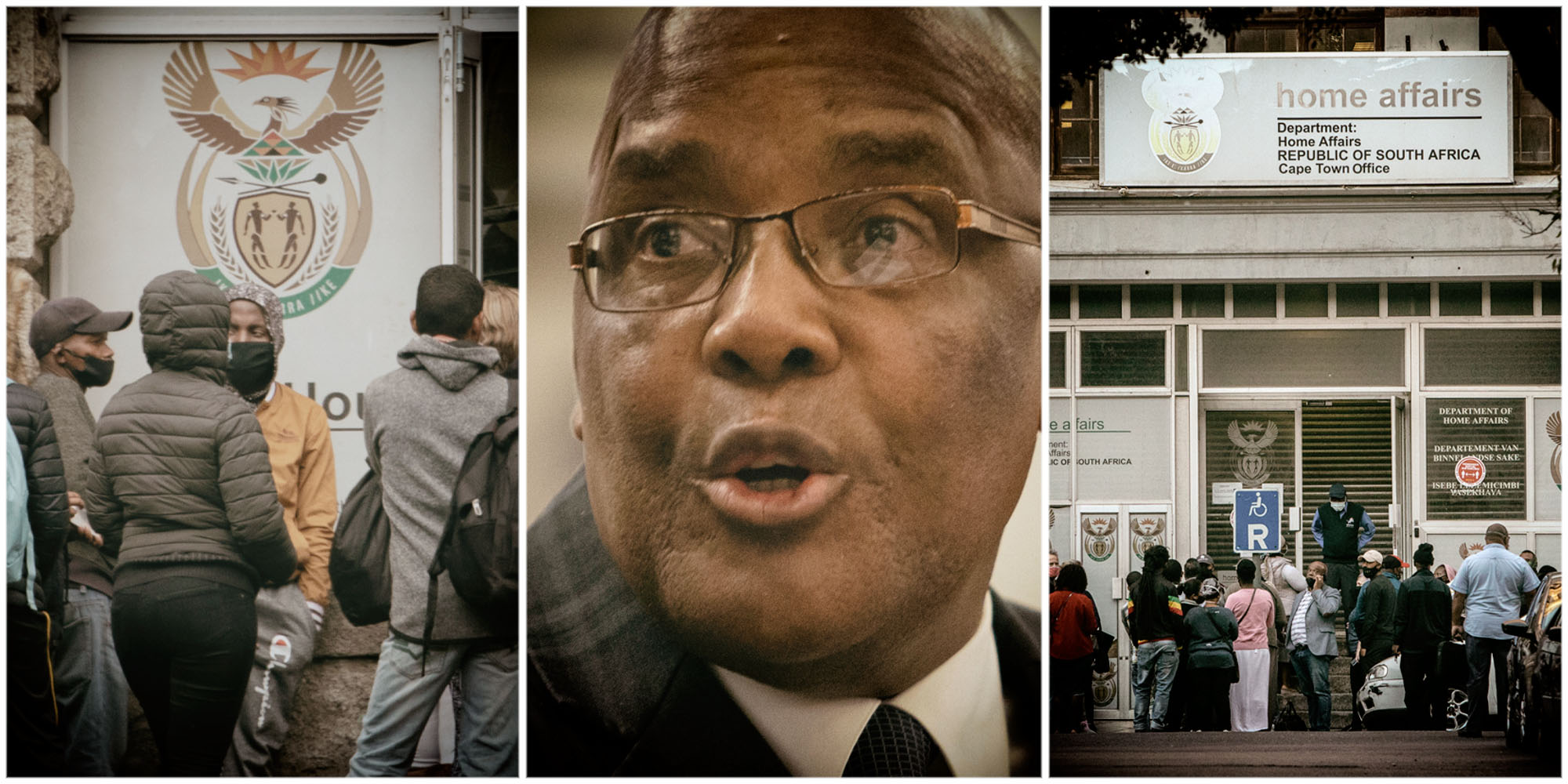
 People queue outside Department of Home Affairs offices in Cape Town. | Department of Home Affairs Minister Aaron Motsoaledi. (Photos: Leila Dougan)
 The proposal to temporarily exit the 1951 United Nations Refugee Convention and associated protocols in the new White Paper on Citizenship, Immigration and Refugee Protection, effectively a government policy statement, was not wholly unexpected, as Daily Maverick reported in August.
The proposal jars South Africa’s participation in international law and international treaty obligations, particularly at a time when the country seeks to push for a multipolar world not dominated by the West, and of continued calls for reform in international governance structures like the UN.
But Home Affairs Minister Aaron Motsoaledi on Sunday said South Africa had “to press the reset button” to correct its “serious mistake” of having acceded to the 1951 UN Refugee Convention and subsequent 1967 protocols without reservations, effectively domestic exceptions to the international regimen, like many other countries.
“It is not surprising that South African courts developed jurisprudence regarding asylum and refugees in the absence of reservations and exceptions ... which is always unfavourable to the interests of the state,” Motsoaledi said at a briefing on the white paper.
“The [proposed] refugee protection and immigration legislation must provide for reservations and exceptions... South Africa does not have the resources to grant the socioeconomic rights envisaged in the 1951 convention.”
Read more in Daily Maverick: Motsoaledi advocates for review and temporary withdrawal from two international agreements on refugee protection
Such language seems to leverage off widespread discontent, often linked to populist targeting of foreign-owned spaza shops by, among others, Operation Dudula. However, the recent Census 2022 indicated at most three million foreigners in South Africa’s population of 62 million.
Motsoaledi has recognised the increasingly violent clashes and added his department “has no idea” how many illegal residents are in South Africa. However, between 15,000 to 20,000 undocumented foreigners are deported every year.
Undocumented migrants
“South Africa today is a great place to live in and many people in the world aspire to live, work or to be citizens of South Africa even though some South Africans don’t believe this. In the result, many foreign nationals come to South Africa and stay in the country illegally. No one can account for all undocumented migrants.”
Benefits were cited as an attraction during Sunday’s briefing on the white paper, which has a public comment deadline of 19 January 2024.
Invoking pan-Africanism, the white paper cites reservations that effectively exclude refugees from the same benefits and treatment as nationals made by Australia, the UK and elsewhere in the Global North, but also Zimbabwe, Zambia, Angola, Mozambique and Uganda.
Motsoaledi insisted that in pursuing such exceptions and reservations to the 1951 UN Refugee Convention and 1967 protocols, South Africa was “just doing what we are allowed by the UN”.
According to the white paper, refugee reception centres at ports of entry will facilitate screening, including with virtual hearings. Proposed measures would also make it possible to return asylum seekers and refugees to their home countries once the threat there is gone, and steps also would be made possible against those who apply for asylum in South Africa even if it was not the first safe country they entered as is stipulated internationally.
Boards and appeal boards to determine refugee matters — a sharp separation would be made with economic migrants — should be staffed by retired judges and legal practitioners with at least five years’ experience.
The white paper proposes one law on refugees, immigration and citizenship to ensure gaps and loopholes are closed. Currently, three laws govern this: the 1998 Refugees Act, the 2002 Immigration Act and the 1995 South African Citizenship Act.
Some proposals are new, such as giving the existing Home Affairs’ anti-corruption unit its own statutory powers. The white paper suggests SAPS officers should be seconded to the anti-corruption unit, with “the rationale being that members of the SAPS enjoy wide statutory powers, including search and arrest without a warrant”.
Other proposals reiterate existing arrangements, such as the advisory board for critical and scarce skills that dates back to the 2004 Immigration Amendment Act. While the white paper proposes including organised labour representatives, this board already includes departments like Trade and Industry, SAPS, Defence, Higher Education, Labour and Employment and the South African Revenue Service.
Operation Vulindlela
However, the scarce skills issue remains politically sensitive. Questions hang over the speedy visa applications that are central to Operation Vulindlela, the initiative by the National Treasury and the Presidency to implement key structural reforms to bolster economic growth. Business and others have long complained that despite undertakings, the visa system remains haphazard.
While Home Affairs already has an immigration section, the white paper’s proposals for an immigration division seem aimed at strengthening the employment criteria — legal and policing experience. And the proposed immigration appeals structure seeks to relieve the director-general and minister who currently must deal with all appeals and exemptions.
The white paper emphasises the need for an effective record of those who become naturalised South African citizens. While this already exists, the Gupta naturalisation debacle has highlighted inefficiencies and loopholes alongside the failure of Home Affairs to table this record annually in Parliament.
Crucially, the white paper wants a wholly new IT system for Home Affairs so fraudulent activity in citizenship, immigration and refugee applications can be identified early.
It is unclear from the proposals whether that would be a separate IT system from the one at Home Affairs offices, where multiple parliamentary questions have been raised about repeated shutdowns and the resultant long queues outside officers for those wanting passports, IDs, birth certificates and other official documents.
The white paper, published for public comment until January 2024, took four years to draft and will replace the 2017 version, which wasn’t implemented.
The next step in the current white paper process will be considering the public comments and, on the back of this, drafting the new omnibus immigration, refugee and citizenship legislation. But with the 2024 elections widely expected in May, such legislation is unlikely to be finalised any time soon — and is set to kick over to the post-elections Cabinet and Parliament. DM