




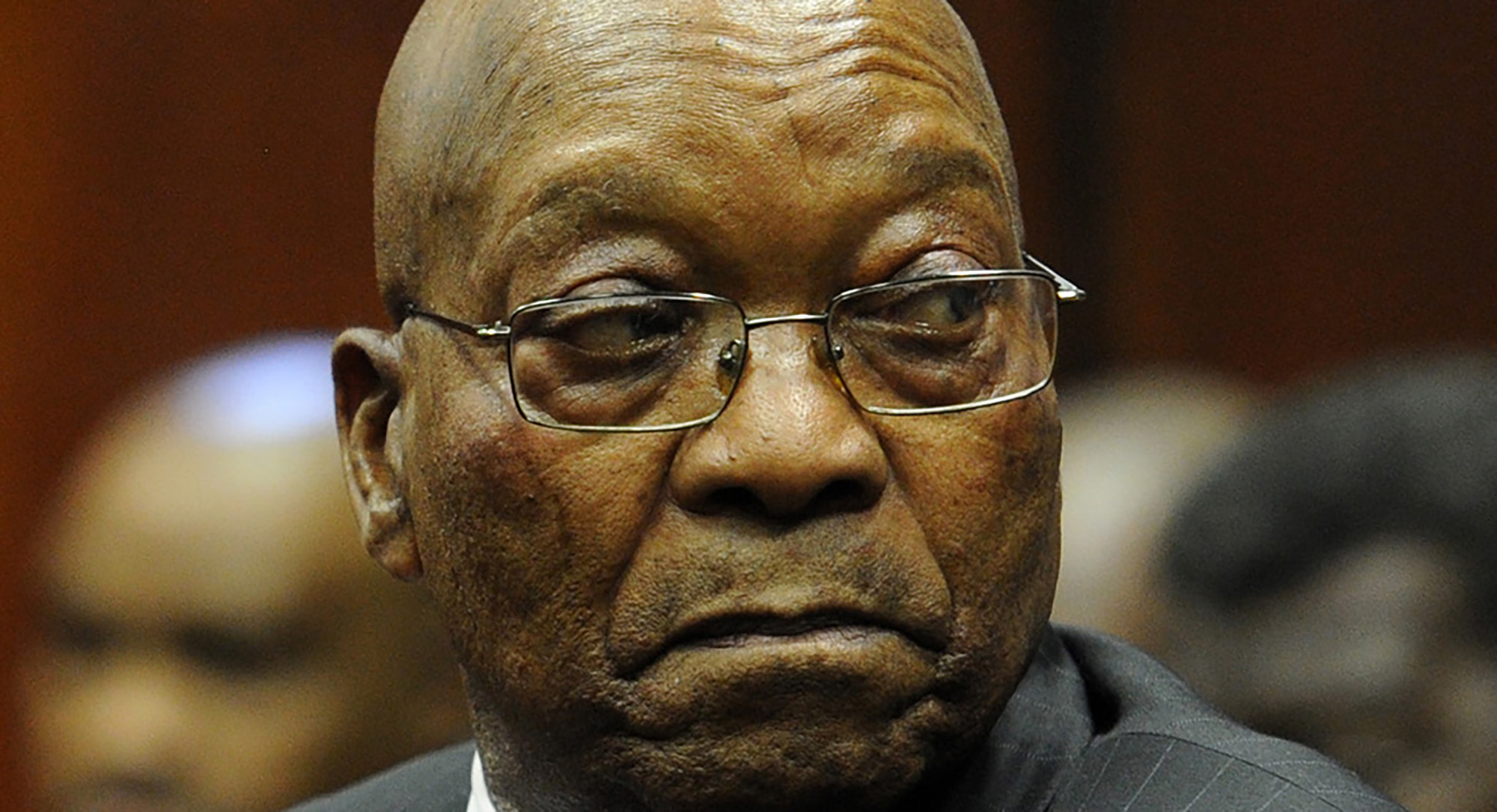
 Former president Jacob Zuma. (Photo: Felix Dlangamandla / Netwerk24)
 When Pietermaritzburg High Court Judge Piet Koen granted the postponement of former president Jacob Zuma’s corruption trial, it marked the latest episode in a legal saga that started in the early 2000s. Zuma has used the law to effectively evade prosecution, never having to account for the crimes he is accused of.
Zuma’s defence strategy with its postponements, appeals and other legal stratagems bears all the hallmarks of the Stalingrad strategy. It has given Zuma some success, but it cannot be sustained for much longer. He will inevitably have to face trial.
The Stalingrad strategy aims not to assert constitutional rights in good faith but to employ a series of legal tactics to frustrate and wear down the prosecution. The strategy often sits between two extremes. The one is a legitimate “first line” of defence where the accused person raises legal challenges in an attempt to protect their constitutional right to a fair trial as per section 35(3) of the Constitution.
The other extreme, a “second line” of defence, is when the accused exploits the legal system to cause a significant delay in proceedings, thereby causing a violation of another constitutional right — the right to have a trial begin and conclude without an unreasonable delay (in terms of sec 35(3)(d) of the Constitution). In the event of the second line of defence succeeding, the accused may apply for a “permanent stay” of their trial, meaning that the case is no more and the accused no longer runs the risk of prosecution for these charges.
However, the prospects of success of either of these defences (mainly the second) depend on the perception of success. I propose two possible conceptions of success. The first and perhaps obvious success is simply avoiding the consequences that flow from criminal liability for as long as possible. In this regard, Zuma has been largely successful. Save for his brief stint in Estcourt Prison for contempt of court — which is unrelated to his corruption case — and which he has now also evaded through dubiously granted medical parole, he has been a free man.
His second defence — the permanent stay of prosecution — has not been so successful. For a defence of a permanent stay to be successful and a criminal trial done away with, it would need to be shown that, on balance, the pre-trial prejudices (such as negative press coverage) suffered by Zuma outweigh the “interests of society in bringing suspected criminals to book”.
https://www.dailymaverick.co.za/article/2022-04-28-anc-tackles-integrity-crisis-after-reputational-damage-caused-by-step-aside-rule-bans-charged-members-from-contesting-positions/
The Constitutional Court in Sanderson v Attorney-General, Eastern Cape, held that the ultimate question is whether the burdens borne by the accused, because of the delay, are unreasonable. In answering this question, the inquiry is to focus on the prejudices which are a result of the delay. This shifts the basis of the reasonableness inquiry from a specific period of time to the weight of the burden.
Unfortunately for Zuma, much of the delay and, thus, potential burden has been self-inflicted and is still immeasurably less than the interests of society to bring him to book. This was confirmed by a full bench of the KwaZulu-Natal High Court in November 2019 when it denied his bid to have his prosecution permanently stayed, and later by the Supreme Court of Appeal when it denied his appeal application based only on the papers filed (without an oral hearing).
This has forced Zuma to change track and pursue a completely different tactic – that of ousting lead prosecutor advocate Billy Downer SC, accusing him of bias and misconduct. This led to Zuma’s application, in terms of section 106 of the Criminal Procedure Act, that Downer has “no title to prosecute” and should therefore be removed from the case.
/file/dailymaverick/wp-content/uploads/2022/04/OD-Des-Zuma-downer-ruling1.jpeg "Pietermaritzburg High Court Judge Piet Koen. (Photo: Sandile Ndlovu)")
But this tactic was predictably unsuccessful, and Judge Koen dismissed it as lacking merit. The Supreme Court of Appeal agreed and denied him leave to appeal, saying any appeal on this ground has “no prospects of success”.
Zuma now seeks to evoke the exceptional procedure of a reconsideration of his appeal by the president of the Supreme Court of Appeal. This was the grounds on which he sought a postponement of his criminal trial on Monday, 11 April 2022 and which Judge Koen was hard-pressed to grant until 11 May 2022.
On any reasonable reading of Zuma’s appeal papers, the chances of him succeeding are barely anything above zero. But that is not the point of the Stalingrad strategy. The very reason for pursuing such a strategy is to wear down the prosecution and delay the consequences of criminal liability.
While Zuma’s defence has successfully delayed his corruption trial for the past 20 years, he is fast running out of options. The pressure is mounting, and the cracks in the Zuma defence are beginning to show. His legal team stood up on 11 April and resorted to making underhanded threats by suggestively reminding the court that the July 2021 insurrection was “partly motivated or sparked, to whatever extent, by a sense of public outrage at perceived injustice and special treatment of Mr Zuma”.
If anything is to be taken from the legal debacle that has played out over the past 20 years, it is that the South African legal system is robust and will not cave in the face of pressure, irrespective of its source. The Zuma camp, in various capacities, with its relentless reliance on the law as sword and shield, has forced our courts to take heed of the Stalingrad strategy and develop robust mechanisms to put a stop to it.
And it is for this reason the Stalingrad strategy will not continue to find success in Zuma’s corruption case. The road may be long and winding, but it will inevitably lead back to Zuma standing before the Pietermaritzburg High Court for trial. DM
Tayla Pinto holds an LLB from the University of Cape Town and is pursuing an LLM in constitutional and administrative law. She is a senior research assistant at the Democratic Governance and Rights Unit and is also a project manager at the iNtaka Centre for Law and Technology.