




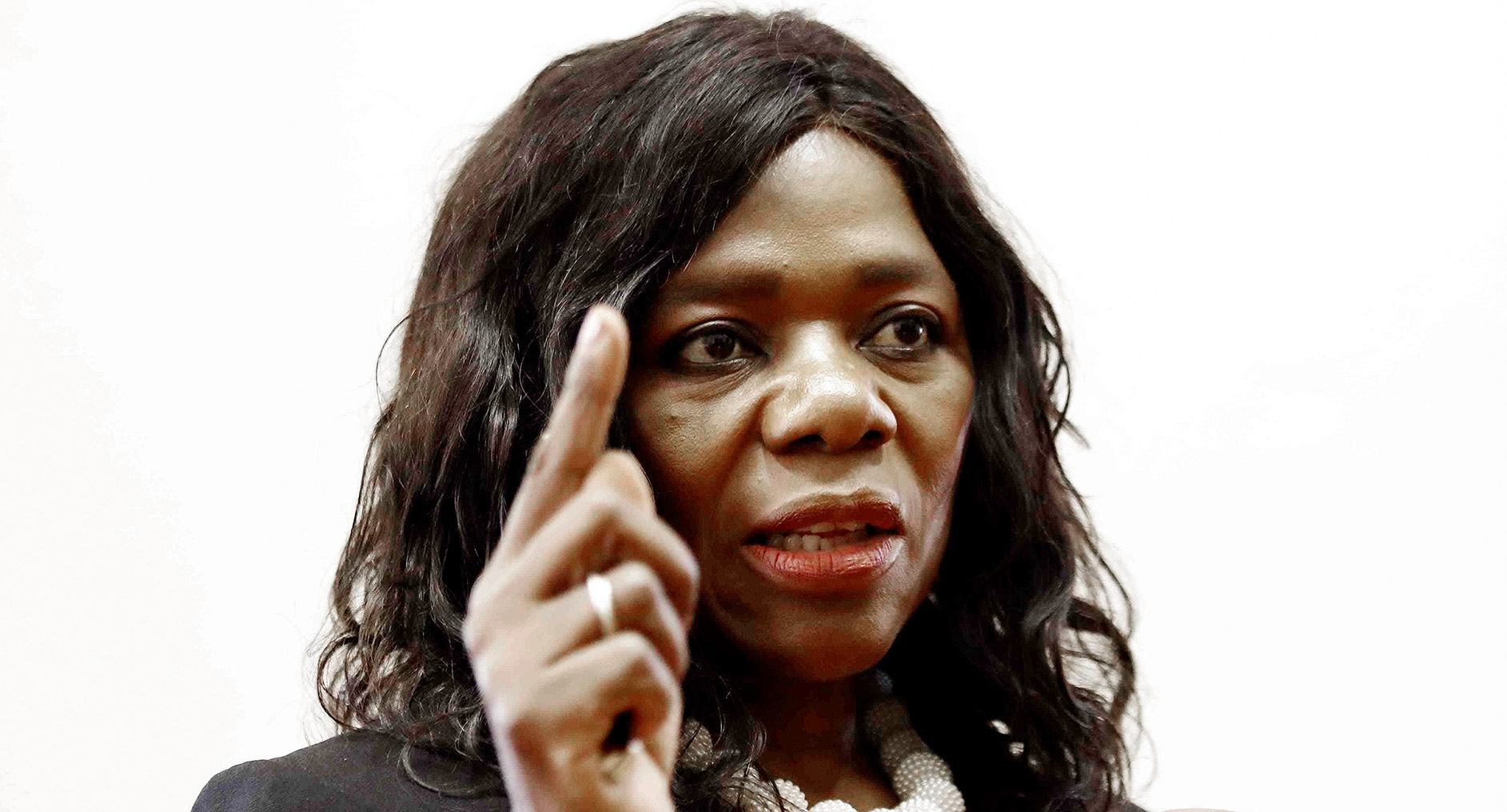
 Social Justice Chair at Stellenbosch University Professor Thuli Madonsela. (Photo: Gallo Images / Esa Alexander)
 With only one day left in April, the clock on food security is rapidly ticking towards midnight for the six million recipients of the special Covid-19 Social Relief of Distress (SRD) grant which expires on Saturday, 1 May.
On 28 April, activists rallied behind the call to extend the grant on several fronts. A joint press conference of the Black Sash and the #PayTheGrants campaign called for the grant to be extended until it is turned into a Basic Income Guarantee (BIG).
The press conference was followed a few hours later by a webinar held to launch proposals for a universal basic income guarantee that have been developed in a new Policy Brief by the Institute for Economic Justice (IEJ). The Brief (available here) provides a costing of a BIG, as part of government’s fulfilment of its constitutional obligation of ensuring the right of “everyone access to social security and… appropriate social assistance”.
The IEJ researches a number of levels as “viable starting points” for such a grant — the food poverty line (R585 per person, per month), lower-bound poverty line (R840) and upper-bound poverty line (R1,268) — and finds such a grant affordable. It argues that it can be financed through adjustments to the tax system, including the introduction of a wealth tax.
The webinar brought together heavy hitters Prof Vivienne Taylor, former head of the Department of Social Development at UCT; Prof Madonsela, Social Justice Chair at Stellenbosch University; former #FeesMustFall leader Shaeera Kalla; and Saftu General Secretary Zwelinzima Vavi. It was also addressed by Daddy Mabe, a grant beneficiary and member of the Assembly of the Unemployed, as well as Lebogang Mulaisi, Cosatu’s labour market policy coordinator.
Taylor spoke first on why a Universal Basic Income Guarantee (UBIG) is important for SA in a post-Covid economy. She said the “constitutional, political, moral and economic imperatives had not changed since the debate started more than two decades ago” when she chaired the Committee of Inquiry into a Comprehensive System of Social Security which issued various reports and its final recommendations in 2002. Taylor pointed out how social security proposals had been on the policy agenda from 1998 to 2006, but were sacrificed to the values and beliefs of policymakers who “chose neoliberal arguments about the economy over investment in human beings”.
However, Taylor commended recent “encouraging shifts” by the government and the ANC to recognise a BIG, noting that they were driven by civil society. Covid-19, she said, ought to be a turning point. She disputed the adequacy of the current social security system which, even though reaching 17 million people, has a huge gap when it comes to the adult unemployed — more than 10 million people.
Filling this gap, Taylor argues, is “a social justice imperative”.
Finally, Taylor spoke of the imperative of social inclusion, noting the millions “disengaged from society by poverty and inequality which fuels conflict and violence in SA”. Hunger breeds anger, Madonsela added later and Zwelinzima Vavi warned of a “coming social-political implosion” driven by the social crisis.
Taylor says that evidence shows how cash transfers to the poor support not only local economies, but can have a multiplier effect to benefit the broader economy as a whole. “The evidence shows that a BIG can contribute to macroeconomic resilience and acts as a stabiliser and buffer in times of economic crisis”, she argued.
Providing a BIG as a right reduces “arbitrary discrimination and corruption” in means-tested grants and would save on administrative costs.
BIG: ‘A constitutional imperative’
Madonsela agreed with Taylor on the social importance of grants, particularly for women, “a dialogue we have heard since the dawn of democracy”. She emphasised, though, that what made SA unique is that here social security was “a legal imperative, a constitutional obligation”.
In a recent article, Madonsela said it was perplexing “why no income sustainability plan has yet been drafted by the department of social development. This would have ensured that when the grant ended, there would be another way to address the human development needs that it helped to meet — not least of which is simple food security.”
She said this element needed to be resolved “by close of business tomorrow. The SRD may not be enough, but it’s made a difference.”
Madonsela called for the need for “rethinking capitalism” because income, which is now denied to millions of people, “is the basis for every other human right”.
Daddy Mabe spoke on why grants are important for the dignity of beneficiaries and communities. He criticised the stigmatising of grant recipients. “We want to work”, he said, “but the system cannot absorb all of us. It’s not because we are lazy.” His appeal to the president was “think of us as being your own children, so that tomorrow you don’t curse yourself for failing to implement what is obvious”.
Mulaisi from Cosatu referred to “a level of avoidance in government regarding a BIG”, calling it “a political hot potato” and lamenting “never-ending discussions at forums like Nedlac”. This, she said, is why we need an effective advocacy movement and why the labour movement supports a UBIG.
Finally, Kalla talked about being “constantly snubbed by government” with letters and appeals not answered: “Government is not taking people’s lives and livelihoods seriously.” She said civil society will not be surprised when the grant is cut because last year the special Caregiver grant was terminated, long before the Covid crisis had passed for women and children.
Kalla noted that SA had ratified the UN International Covenant on Economic, Social and Cultural Rights (ICESCR), but said activists are “struggling to understand what mechanisms can be used to hold the government to account for failing to fulfil its obligations under international law.” She explained that activists were now using the language of a Basic Income Guarantee (rather than grant) to emphasise that there was a “moral and social right to participate in the economy” and that social security is not charity.
“We cannot be silent. We cannot be sad or broken-hearted. We need to act.” DM/MC