



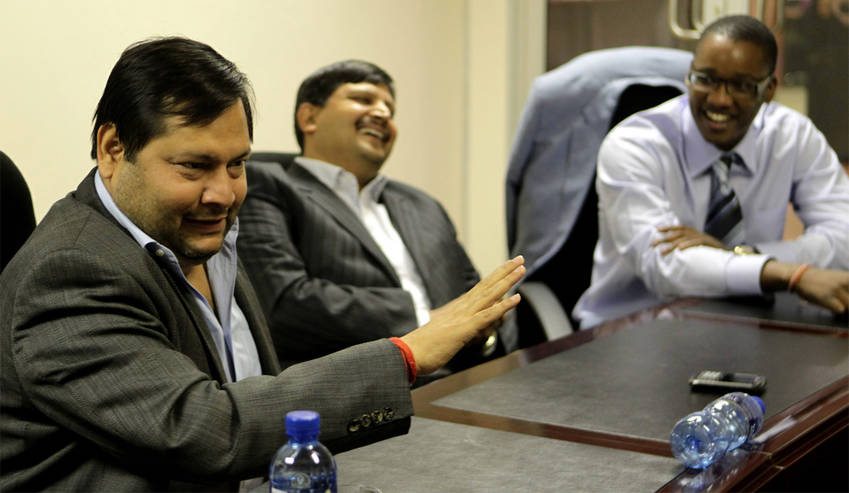
 File Photo: Ajay and Atul Gupta and Duduzane Zuma (Muntu Vilakazi for Gallo Images)
 The sanctions impose bans on travel to the UK and freeze their assets there “to stop corrupt individuals using the UK as a safe haven for dirty money”, Raab said.
The regime blocks designated individuals from channelling money through UK banks or entering Britain.
“Corruption has a corrosive effect as it slows development, drains the wealth of poorer nations and keeps their people trapped in poverty,” Raab said. “It poisons the well of democracy.
“The individuals we have sanctioned today have been involved in some of the most notorious corruption cases around the world.
“Global Britain is standing up for democracy, good governance and the rule of law. We are saying to those involved in serious corruption: we will not tolerate you or your dirty money in our country.”
James Duddridge, UK Minister for Africa, said: “The launch of the Global Anti-Corruption Sanctions regime sends an important message: that the UK will stand up for fair and open societies around the world by taking action against those responsible for serious corruption.
“The South African people know better than most the corrosive effect corruption has on a country, its economy and its people.
“Today, the UK is supporting the important efforts of the South African authorities to tackle corruption, by imposing sanctions against Ajay Gupta, Atul Gupta, Rajesh Gupta and Salim Essa for their roles in serious corruption which caused significant damage to the South African economy.”
It is understood that the UK government informed the South African government in advance that it was taking the measures. The British foreign service said the sanctions were being imposed partly in tandem with the US, which was also announcing further anti-corruption sanctions on Monday. In October 2019 the US also imposed travel and financial sanctions against the three Gupta brothers and Essa under its Global Magnitsky sanctions regime.
The others being targeted in UK’s anti-corruption sanctions are;
- Those involved in the diversion of $230 million of Russian state property through a fraudulent tax refund scheme uncovered by Sergei Magnitsky - one of the largest tax frauds in recent Russian history.
- Sudanese businessman Ashraf Seed Ahmed Hussein Ali, widely known as Al Cardinal, for his involvement in the misappropriation of significant amounts of state assets in one of the poorest countries in the world. This diversion of resources in collusion with South Sudanese elites has contributed to ongoing instability and conflict.
- Several individuals involved in serious corruption in Latin America, including facilitating bribes to support a major drug trafficking organisation and misappropriation that has led to citizens being deprived of vital resources for development.
The UK foreign ministry said “corruption hurts individuals and undermines global trade, development and the rule of law. Over 2% of global GDP is lost to corruption every year, and that corruption increases the cost of doing business for individual companies by as much as 10%.
“Corruption also threatens our national security by exacerbating conflict and facilitating serious and organised crime, creating space for terrorist and criminal groups like Daesh (Islamic State) and Boko Haram to operate.”
The UK’s Global Anti-Corruption regime which it launched on Monday as well a separate sanctions regime it launched last year against violators of human rights – including members of the Zimbabwe government- are concrete signs of a tougher foreign policy which is has embarked upon since leaving the European Union. DM