




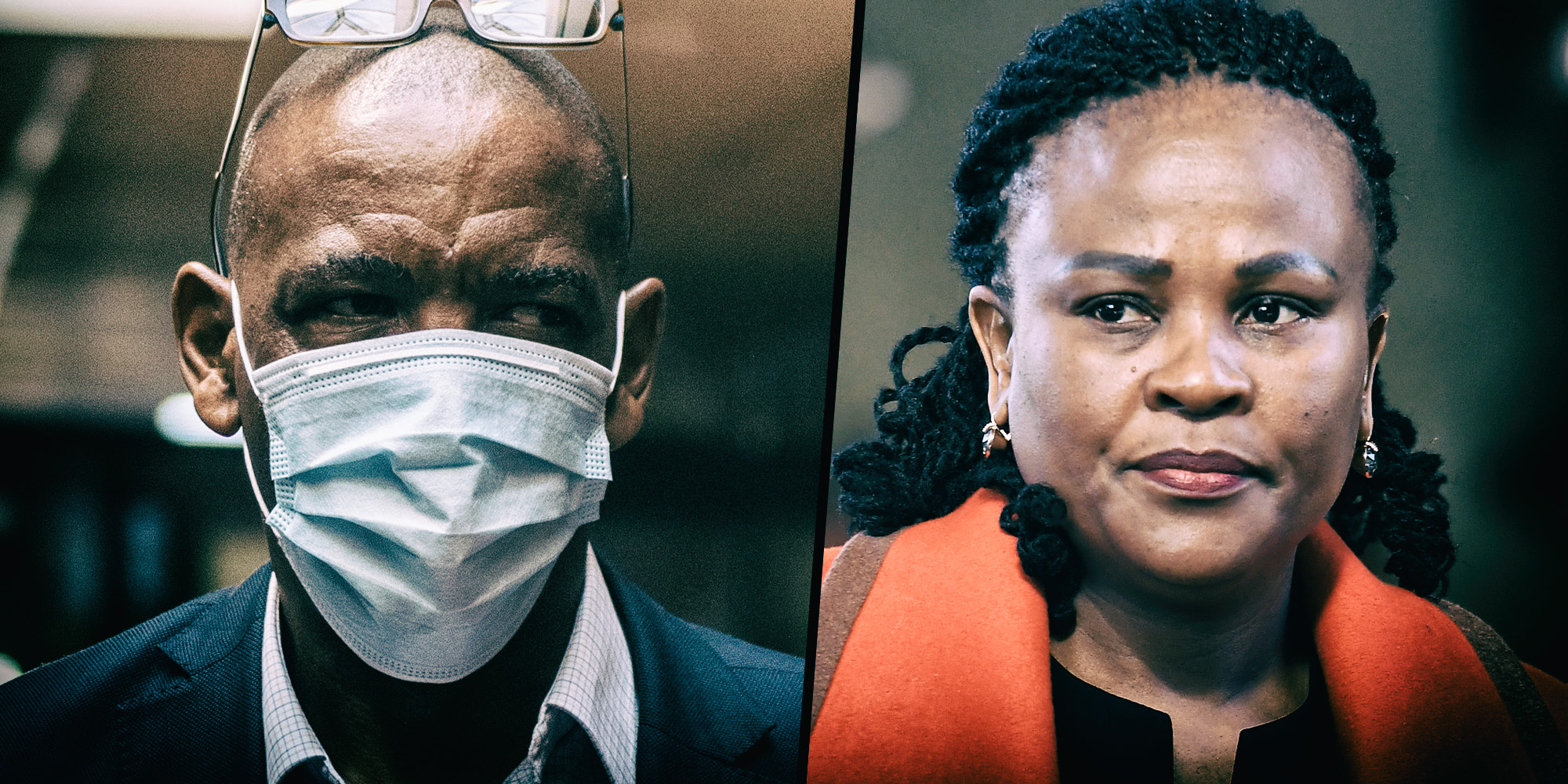
 ANC Secretary-General Ace Magashule. (Photo: Gallo Images / Alet Pretorius) | Public Protector Busisiwe Mkhwebane. (Photo: Gallo Images / Netwerk24 / Felix Dlangamandla)
 ANC MPs will soon vote on whether the process investigating the fitness for office of Public Protector Busisiwe Mkhwebane should continue, and go to the committee stage. On Monday, the party’s National Working Committee is expected to discuss the latest issue on which the party is divided.
On Sunday, the ANC Secretary-General, Ace Magashule, said that “principled” MPs of the party would not vote against Mkhwebane because the motion to remove her has been brought by the DA. In the end, as is so often the case in our country, the final decision on her future is likely to be decided by the balance of forces in the ANC’s National Executive Committee (NEC).
Last week, an independent panel comprising former Constitutional Court Justice Bess Nkabinde, advocate Dumisa Ntsebeza (who is about to be appointed a judge on the African Union Court of Human and People’s Rights) and advocate Johan de Waal lodged the report of their investigation into Mkhwebane.
They found that there was prima facie evidence of sustained incompetence and misconduct, based on her conduct in several cases. As a result Parliament’s MPs now have to decide, by a simple majority vote, whether to hold a formal inquiry which would see her conduct probed by a committee of MPs. If they did decide to remove her, a two-thirds majority of Parliament would be necessary for the final decision.
Such is the balance of power in the National Assembly that essentially it is now up to the ANC to decide what to do. The DA obviously wants her removed, while the EFF, UDM and the ATM support her.
Central to this is Magashule.
He told the Sunday Times that it would be wrong for ANC MPs to vote with the DA on any matter of principle, and that the DA is trying to divide the ANC on this issue, along with several others.
Of course, the ANC didn’t need the DA to divide it when a figure as polarising as Mkhwebane is concerned, who has given many the impression that her primary goal has been to weaken President Cyril Ramaphosa and sabotage his efforts to rid South Africa of State Capture.
As the independent panel noted, the Public Protector lied under oath in court papers, and held meetings with then-president Jacob Zuma and the State Security Agency before releasing her decision “instructing” Parliament to change the mandate of the SA Reserve Bank. She currently faces a criminal charge for perjury. For some, just the fact that she was found to have lied under oath is enough to say she should no longer be in that position.
But this is South Africa.
Mkhwebane has furiously denied the claims against her – even though her decisions have been consistently against Ramaphosa and his allies, and mostly gave a pass to Magashule and his allies (one of the most contentious cases saw her simply failing to ask Magashule about the Estina Dairy project, so her findings were thrown out by a court).
It is important to note that Magashule’s comments about ANC MPs and the Public Protector concentrate on the fact the resolution against her has been brought by the DA. He does not appear to be attempting to delve into the merits of the case against Mkhwebane, and he is not talking up her competence.
Neither are other people who say they support her. The focus is on “voting with the DA” rather than Mkhwebane himself.
This again brings into question the entire issue of being a member of Parliament for a party in our system.
If the DA were to say the sky is blue, would ANC MPs be ordered to say the sky is green? If there was a question of principle brought up by the DA, for example, “This House believes in non-racialism”, would ANC MPs be ordered to turn their backs on one of the party’s guiding principles?
Magashule stands accused of avoiding an argument about Mkhwebane’s competence, because of the continued, repeated and consistent findings against her. In short, Mkhwebane is hard to defend on substance.
Intriguingly, the National Assembly Speaker, the ANC’s Thandi Modise, appears to differ from her party’s secretary-general.
She is quoted by the Sunday Times as saying last week that, “It would be a very sad day, though, I must say it upfront, that with the report that all of you party leaders have in our hands, we say we don’t want a committee stage, because then we would really be putting democracy in this country to shame”.
It is likely that whatever happens, this process will drag on for some time. Mkhwebane has already said she will see out her term, and has shown she is happy to challenge every decision against her in court.
She appears to have suggested that it is important for the process to continue.
It would seem unfair both to the nation and to Mkhwebane for the panel’s findings of prima facie evidence of “sustained incompetence” and “misconduct” not to be formally investigated.
This would be morally wrong. If the process ended here, Mkhwebane’s name would be sullied forever. There would be no chance for her to clear her name.
We have seen in the past what happens when a process is started and evidence is brought in public and through formal processes, but no final finding is made.
A good example is the Western Cape Judge President, John Hlophe. Because the first claims against him that he tried to influence Constitutional Court cases go back to March 2008 and there has never been a final outcome to them, his name has been badly tarnished. Had the proper procedures been gone through by the Judicial Service Commission, and his name perhaps been cleared, the past decade of his life could have been very different. He might have even been promoted to a more senior position in the judiciary.
But because the process was not completed and there was no outcome, the fighting around him and over him has continued, in many ways to his detriment.
There are virtually no examples of the ANC’s parliamentary caucus voting on divided lines, (apart from the August 2017 secret vote of no confidence in Zuma), and it seems almost impossible to imagine that it will do so in this case. Rather, MPs will vote as they have been instructed to by the party.
This means that the balance of power then rests with the NEC. It is here that Mkhwebane’s future is likely to be decided.
It is already clear that Magashule is not guaranteed to prevail here and that there will be a tough fight for either side of the argument.
On Sunday Transport Minister Fikile Mbalula tweeted that “Mkhwebane is a hired gun not the Public Protector”. He also said that Magashule was wrong to say Mkhwebane cannot be removed, asking, “Which structure of the ANC arrived at that position?”
This suggests that not only are some in the NEC happy to contradict Magashule, they are also happy to do it in public, which may well encourage others to do the same thing.
In the meantime though, if one accepts the thesis that Mkhwebane is serving political masters, her use to them has become limited.
Her findings have much less political effect now than they did in the past, because people are increasingly cynical about her and her conduct. And a growing number of people have challenged her findings in court and won. While these cases constitute only a small percentage of the matters she has investigated and made findings on, by a strange coincidence most of them are cases that affect the political balance of power in the ANC. So even her findings may soon have very little impact.
However, her office still does have powers. It can subpoena officials and documents, and release information that it finds. In other words, it can still be used as an effective weapon in the ANC’s internecine battles.
It is likely that whatever happens, this process will drag on for some time. Mkhwebane has already said she will see out her term, and has shown she is happy to challenge every decision against her in court.
In the end, this may be another example of an internal dispute in the ANC weakening an important institution of our democracy. In the end, the Public Protector’s office will be badly damaged, and trust in our government and our institutions will have been eroded further, to no one’s long-term advantage. DM
Conflict disclosure: In March 2019, Grootes published an article highly critical of Mkhwebane, suggesting she was playing a political role. Her spokesperson, Oupa Segalwe, complained to the Press Ombudsman. You can read Grootes’s piece here and Segalwe’s response here.