




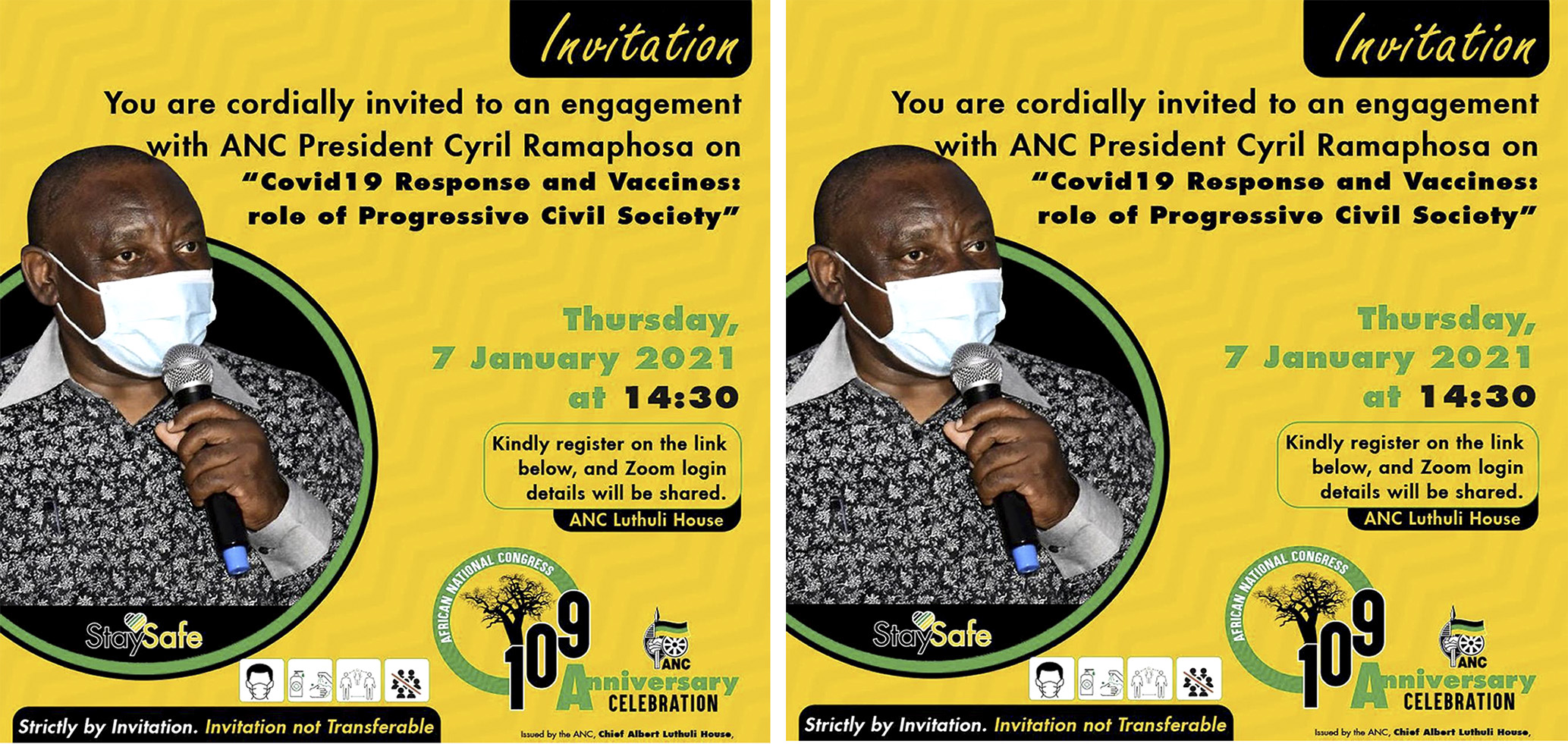
 President Cyril Ramaphosa said in a Zoom meeting that defeating Covid-19 was ‘not something that the government could do alone’, adding that there was a need to work together and ‘we are open to sharp criticism’.
 Ramaphosa drew an analogy with the scale of operations of the Independent Electoral Commission (IEC) organising elections, except that the IEC usually reached out to “only” 20 million people, and in this instance, the numbers would be twice that.
Ramaphosa also reported on preparations by the African Union (AU), noting that vaccines are a “game-changer”, and said that, working as a continent, “we have made remarkable progress and we are going to make sure that we are also going to get our vaccines”. The AU’s aim is to cover 60% of Africa’s population. He noted the challenges of fundraising faced by the AU and reported that the African Export-Import Bank would be playing a role in fronting up to $20-billion.
“All is working in a very positive way and we are hoping vaccines will be a game-changer in more ways than one.”
Not surprisingly, on a day that had earlier seen Health Minister Zweli Mkhize set out more details – and good news about earlier than expected access to vaccines for health workers – about the vaccine plan, much of the discussion focused on the practicalities and challenges of vaccine rollout.
In a presentation on behalf of the health minister, Dr Aquina Thulare from the Department of Health confirmed that the government would be the only purchaser of vaccines and spelt out more detail about the composition of a National Vaccine Coordinating Committee, as well as the envisaged roles that could be played by different sectors of society in mobilising uptake, demystifying and addressing vaccine hesitancy and countering misinformation.
Interestingly, and importantly for the poor, people living in overcrowded social conditions were flagged as being among those who lived in “congregate conditions” and should be prioritised for vaccinations.
Significantly, the presentations made to the meeting suggest that – after being stung by criticism – the government has moved swiftly this week to flesh out the details of a national vaccine rollout plan, as well as to coordinate the different parts and players in the interventions. There is a much higher degree of transparency to the plans, as well as evidence of attempts to pre-empt corruption and wastage by close monitoring of the vaccine distribution system.
For the first time, the presentation flagged that in the timeframe of the current Medium Term Expenditure Framework (MTEF) an amount of R8-billion to R10-billion will be allocated by the Treasury, which considers that “money should not be a barrier to rollout”.
Hugh Gosnell, formerly head of the Gauteng Health Department, put it this way: “The cost of R20-billion is less than the cost to the economy of having a raging epidemic for just one week. We can’t afford a single week delay in securing more vaccines from all the suppliers.”
Hot chat
As has become the norm in our Zoom world, over-long presentations and “inputs” were accompanied by revealing and varied conversations in the chat. While some health activists put emphasis on moving “from community buy-in to “ownership” of vaccines” and the importance of high-quality communication, a significant part of the conversation also pointed to enormous challenges the government and the ANC face in building trust and vaccine confidence.
For example, one traditional leader asked:
“Are these Vaccines coming with Bill Gates? How do we get to trust anything that’s related to Bill Gates as we believe he believes and supports Population Reduction? We are God’s Creation sir. No man gets to decide when we live or die? It’s totally insane. We are not COWS!!!! … What roles are you allowing the churches to play here sir? We are a Christian nation and prayer should be recognised as one of the essential services. We are definitely at WAR here!! We need more engagements. We need education and information. We should also allow our people the right to choose vaccinations.”
Others questioned whether Africa was developing its own vaccine, whether African traditional medicines are being investigated, and raised conspiracy theories such as the role of 5G and the 666 “mark of the devil”; others warned against the medical imperialism of Western pharmaceutical companies.
One church leader, approvingly citing Chief Justice Mogoeng Mogoeng, asked: “Is it true that the vaccine shall change our DNA and will it be compulsory and mandatory to take this vaccine?”
A pertinent question was also asked: “What is the ANC saying about its leaders publicly saying they won’t take the vaccines? I understand no one is forced to take them, but is it something that is discussed in the NEC? How will normal citizens take the vaccines when the ANC leaders are saying they won’t take it?”
These very real questions, whatever you may think about them, point to the multidimensional challenges the ANC faces, even if it is able to resolve access to sufficient doses of vaccine in the weeks ahead. And why a whole of society response, supported by progressive civil society and the public broadcaster, is going to be so essential if a vaccine is to help us achieve herd immunity against Covid-19.
In many ways, the government now seems to have an impressive and well thought out vaccine plan. The question will be whether the ANC and the government, fractured, corrupted, demoralised and extremely heterogeneous in its understanding of medicine, proves capable of putting this ambitious plan into practice. These will be the issues that bedevil us in the months ahead. DM/MC