




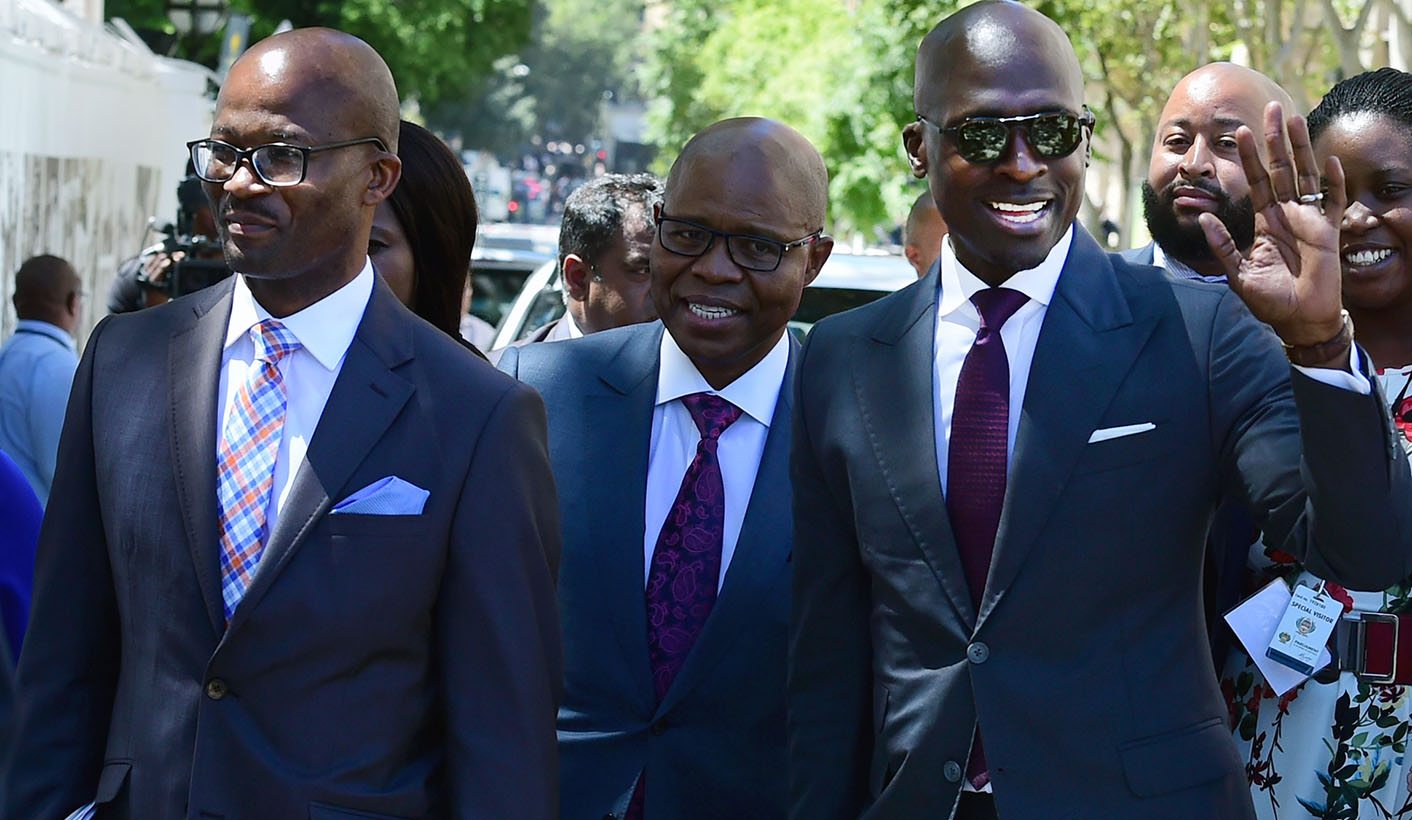
That it would not be a smooth ride for Finance Minister Malusi Gigaba became clear even before he stood at the podium of the National Assembly to deliver Budget 2018.
At the traditional pre-Budget speech briefing, the minister was asked about the North Gauteng High Court’s findings that he had lied under oath in an application by Fireblade Aviation to ensure that he stuck to his permission given as home affairs minister for the Oppenheimer-linked company to render private customs and arrivals facilities at OR Tambo International Airport.
“I stand by what I said,” Gigaba told journalists, saying he had yet to study the judgment and consult his lawyers.
And it came up again just after the Budget sitting started, in the absence of the EFF. DA Chief Whip John Steenhuisen stood up on a point of order, saying the sitting could not go ahead, or at least not with Gigaba at the podium.
“The minister has lied under oath and violated the Constitution. This renders him unsuitable not only to be a minister of state, but to deliver the Budget.”
Steenhuisen has already complained to the public protector following the court judgment.
This was the first public crack in the “new dawn” narrative that has dominated since President Cyril Ramaphosa presented his maiden State of the Nation Address (SONA) on Friday, a day after being elected and sworn in as president.
It hints at the as yet unresolved tensions not only within government, but also within the governing ANC. While Ramaphosa has promised a clean-up of corruption and State Capture, he dismissed calls by the opposition for the sacking of Gupta-linked and State Capture-linked members of his executive as the “character assassination” of Cabinet ministers and deputy ministers.
National Assembly Speaker Baleka Mbete would have none of Steenhuisen’s point of order. Submit a substantive motion for consideration, she ruled, and told Steenhuisen to sit down, but not before he shot back: “So you are going to defend the Zuptas, again.”
And then Gigaba finally got to the podium to deliver a Budget, described as “tough, but hopeful”, to build on boosted business and consumer confidence, a slightly improved economic growth rate of 1.5% and inflation at 5.3%. It was about stabilising public finances, more efficient government spending, good governance at State-owned Entities (SoEs) and South Africa not borrowing its way out of the difficult economic times.
The sharp edge, however, was the one percentage point VAT increase to 15% from 1 April 2018. Alongside other tax hikes, including an additional 52 cents per litre in fuel levies and lower-than-inflation increases to personal income tax brackets and rebates, that VAT hike was government’s decision to overcome a R48.2-billion revenue shortfall due to the South African Revenue Service’s failure to hit collection targets.
Gigaba tried to soften the blow. The VAT hike would be offset to cushion the poor and working class through above-inflation increases in social grants, healthcare initiatives and the phasing in of free higher education from this year for students from households earning less than R350,000 annually.
That was also the argument from ANC National Chairperson Gwede Mantashe. It was “unfair to say the poor are punished” as they and the working class are supported through the continuation of zero-rated food items, and other benefits in health and education. It was a tough Budget in a complicated environment.
“It’s a balanced Budget that ensures it floats the ship,” said Mantashe.
But the VAT hike was roundly condemned across the party-political spectrum, with the exception of the Freedom Front Plus, whose leader Pieter Groenewald said it was the only option to broaden the tax base.
Not so, said South African Federation of Trade Unions (Saftu) Secretary-General Zwelinzima Vavi, who described the Budget overall, and the VAT hike in particular, as “a full-blown insult”.
And, like others, Vavi argued that Gigaba was not the person to have delivered the Budget:
“We are being insulted… by allowing a man so tainted by the allegations of corruption to say how our monies should be spent.”
Labour federation Cosatu said in a statement afterwards that it was “disappointed by the government’s underwhelming 2018/19 Budget”.
Having “enthusiastically welcomed the vision and plan” outlined in Ramaphosa’s SONA, “the Budget is deafeningly silent on how is that going to be achieved… This Budget bares little correlation with the SONA and it is another missed opportunity”.
The DA disagreed with the VAT increase, with party leader Mmusi Maimane describing it as “an assault on poor people” and, in reference to the Jacob Zuma presidency, as “a consequence of the past nine years of mismanagement” .
Earlier DA MP Alf Lees said more than R112-billion could have been raised by selling off certain entities and government expenditure cuts.
“A country cannot tax itself into prosperity. It is time that government takes responsibility for its dire financial situation and to stop raiding taxpayers’ pockets whenever it faces a financial squeeze.”
Of course, privatisation is not a route the ANC government wants to take. At best, there is talk of engaging strategic minority partners, as with the financially troubled South African Express airline, as Gigaba hinted at the pre-Budget speech briefing, under a “consolidation of our aviation assets”.
United Democratic Movement (UDM) Chief Whip Nqabayomzi Kwankwa said increasing VAT was “a soft target”, letting off corporates who in recent years have embarked on an investment strike.
“You are taking from the poor to fund the rich,” Kwankwa said.
IFP MP Mkhuleko Hlengwa welcomed the concrete funding allocations for free higher education – R57-billion over the next three years, with just over 12-billion in the 2018/19 financial year – as a victory for young people’s struggles. He said it was “a difficult Budget to negotiate” for Gigaba.
“Under the circumstances, for all intents and purposes Jacob Zuma messed up the economy and we now need to pick up the pieces.”
The VAT hike largely overshadowed government plans to cut its spending by R85-billion, largely by reductions in national government (R53-billion), but significantly also by lowering transfers to provinces (R5.2-billion) and local government (R3.5-billion) and slashing conditional grants by R28-billion.
Effectively this puts pressure on provinces and municipalities to budget, plan and spend better for service delivery, while also potentially cutting the pipeline of political patronage.
When Gigaba got to the bits about good governance and fighting corruption, opposition benches heckled and booed.
When Gigaba got to the bits thanking former President Jacob Zuma, more boos and heckles followed.
He ploughed on, talking of “tough decisions” made in this Budget to ensure fiscal stability and sustainable public finances.
“The president has called for a social compact to move our country forward,” the finance minister said.
Gigaba’s own future? Well, amid all the speculation of a pending Cabinet reshuffle that Ramaphosa on Tuesday said he would announce at the appropriate time, the standard ministerial reply is: “I serve at the president’s pleasure.” DM
Photo: Finance Minister Malusi Gigaba, Deputy Minister Sfiso Buthelezi and their team arrive at Parliament for the 2018 Budget speech in the National Assembly. Photo: GCIS (Flickr)
Comments
Scroll down to load comments...