



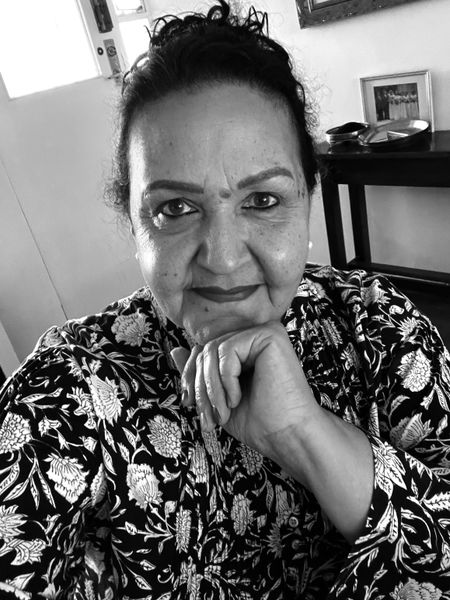
When I imagine my mother, gone these past 26 years, I see her in her garden, humming gently, a pair of secateurs in her muddy gardening-gloved hands. Her back bent – one half of a parenthesis – as she tended her prized roses. Trimming, shaping, pruning, cutting: a tuneless strain, more mantra than song, emerging from her into the garden. Tendrils of brown curls escaping from under her scarf. Outside with her roses; that was my mother’s happy place.
The roses. Ladysmith’s hot, dry summers and frosty winters apparently make hardy, disease-resistant roses the favourites, so my mama grew resilient varieties. There was the quintessential hybrid tea rose with its large scented blooms and long strong stems that were perfect for the vase. The Queen Elizabeth, named soon after the late queen’s coronation in 1954, with its tall, iconic, pink grandiflora. The white iceberg, created in the year of my birth, 1958. These she planted down the side of the house, in a bed she called her night garden. In it, the icebergs gave off a luminous glow, reflecting the moonlight.
We knew instinctively that gardening was her refuge, her “do not disturb me” time that she used to decompress, take a break from being a teacher and a mother of four, from cooking and marking papers.
My mom did not embroider or do cross-stitch; she did not knit or crochet or quilt or sew. Nor did she tie knots into macramé. But she did have two “old lady hobbies” she was passionate about: doing the crossword, always with a nice cup of tea, and gardening. Digging in the soil, spending time outdoors exposed to the elements in an impossibly wide straw hat. This was my highly strung mother’s Prozac; it’s what I now see as the tool she used to stop her from frequently losing her temper.
A cure for all times
Until now, neurotic me has a lifelong aversion to granny pursuits. Rather like bowls has, for decades, been thought of as a sport for old people, things that required needles (knitting and sewing) and hooks (crocheting and macramé) lived in the unfashionable grey zone, in more ways than just the colour.
Then, paging through the “Well” section of The New York Times, I read that granny hobbies were the antidepressants of their time, that women who did all those physical things used them, instinctively, as an antidote to feeling blue, to regulate their nervous systems. Of course, they didn’t know that that was what they were doing. To them, they were producing useful things: a jersey, quilt, plant hanger, blanket.
Women’s mental health, until recently, was treated with little consideration, perhaps even some disdain. The “pull yourself together” generation did not acknowledge the genuine distress that is often a chemical imbalance and not necessarily event-related, and women in particular were called hysterical, neurotic. Worst of all, difficult.
Think of Jane Austen’s Mrs Bennet in Pride and Prejudice. There was much eye-rolling as she took to her bed with her “salts”. Come to think of it, the Bennet girls – Lizzie, Jane, Kitty, Mary and Lydia – were always doing something calming: needlepoint, cross stitching, playing the piano. Nerve-calming pastimes, it appears, were alive and thriving in the Georgian era.
The stiff upper lip attitude to mental anguish was so strict. When I was in my early teens, I watched as my cousin was made to handle a miscarriage silently, shamefully, as though it were her fault. There appeared to be some anger from her mother-in-law. I’m not sure how she overcame the sadness and I hope she knitted herself out of it.
I’ve watched how her daughter, now in her mid-30s, has handled her miscarriage: with a blessing from her parish priest, a naming ceremony and a proper funeral, with tears and sadness and the telling of her story, with therapy and support from everyone.
Granny hobbies – knitting, crocheting and quilting among them – are calming. The repetitive movement combines with gentle concentration, which, of course, also produces a tangible result. We all know how satisfying is the act of producing something that someone receives with appreciation.
When nothing else worked
Recently, I started knitting for no noble reason. I wasn’t planning to make a jersey, join a craft circle or channel my inner grandmother. I simply needed something to stop me grinding my teeth. To my surprise, a pair of knitting needles succeeded where mindfulness apps, doses of a mood-stabilising drug and 5.30am swims in the pool had failed.
To preface this, 18 months ago I was forced into five dental sessions, replacing fillings with crowns and generally tidying up the teeth in my mouth. At my teeth-cleaning appointment this year, my dentist said I was grinding my teeth so badly, day and night, that I was undoing all his work.
I needed a tool that was cheap, easy and effective. Back I went to The New York Times article, which listed some of the side benefits of granny hobbies. Reducing anxiety was among them. I bought a pair of knitting needles and some wool and started casting on, one plain, one pearl.
I did the research: knitting is an excellent bilateral activity that engages both hemispheres of the brain. Crossing the body’s midline, passing yarn from one hand to the other and coordinating your hands across the centre, requires the brain to constantly build new neural pathways.
Also, the neurological benefits from knitting are vast. Most importantly, the repetitive hand movement forces the brain to focus on the present, acting as an active form of meditation, if you will, helping calm the subconscious and gloomy thoughts. This is an instant stress and anxiety reliever.
Experts say that hands-on activities engage visual, planning and tactile regions of the brain at the same time, improving memory and keeping the brain resilient. Hand-eye coordination exercises both sides of the brain, making communication between the hemispheres clearer.
The result? When I’m knitting, I don’t clench my jaw and therefore I don’t grind my teeth. It’s miraculous actually. I am experiencing all the benefits promised by granny pursuits. I’m not a gardener like my mother, but how hard will it be to grow and tend a balcony garden? The tangible reward will be fresh vegetables (at the very least a lettuce for my salad). So garden I will.
A last word. I turned my exploratory attempts into a scarf for a friend. She was so delighted it made the exercise doubly worthwhile. I mean, an unclenched jaw and a dose of happiness!
If that’s what it takes to help the nervous system… Oh, and what about those clever gogos, right? DM
Charmain Naidoo is a journalist and media strategist.
This story first appeared in our weekly DM168 newspaper, available countrywide for R35.
/file/attachments/2994/DM-260626_643039.jpg)