




Twelve people were shot dead in Cleveland, Johannesburg, on Tuesday night, 9 June. And more than ten injured. The men who did it, police think there were more than 10 of them, arrived by minibus at the Jumpers informal settlement, walked in through two gates, fired on whomever was in front of them, and drove off. By Wednesday morning there were no arrests and no motive anyone could state with any confidence.
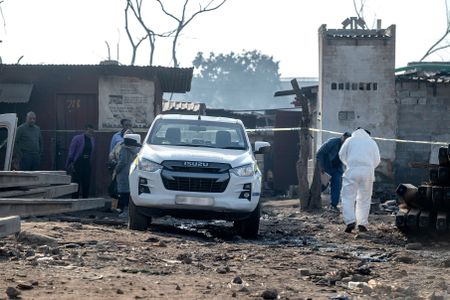
If that were the only incident, it would be a tragedy and we could grieve it as one. It isn’t. In December, 12 people were killed in Saulsville and another nine in Bekkersdal in the same week. In February, one attack in Meyerton left six dead and 18 wounded. Olievenhoutbosch, Langlaagte, Westbury, Eldorado Park, Reiger Park. The list goes back more than a year, and it reads like something out of a conflict zone.
And yet the official line is that violent crime in Gauteng is coming down. Both are true at once, and that is the problem.
What the crime stats say, and what they leave out
The decline is real, on paper at least. The South African Police Service (SAPS) released its figures for January to March 2026 on 22 May. Murder was down 9.5% nationally, from 5,727 to 5,181. In Gauteng, the provincial commissioner, Lieutenant-General Tommy Mthombeni, reported 5,066 fewer serious crimes than the same quarter year before, with carjacking down 17%. The acting police minister, Firoz Cachalia, called it “real and measurable progress”, and on the numbers he has a point.
But a murder rate is an average, and nobody lives inside an average. That same improving quarter still works out to 58 killings a day. A woman in Reiger Park is not comforted by a percentage. She hears automatic gunfire down the road and starts texting family to find out who is still alive. One Cleveland cancels out a quieter month for everyone who lives there, and no media briefing is going to talk them out of it.
That gap, between what the spreadsheet shows and what people actually feel, is the thing worth watching. As long as it stays open, people will trust neither the statistics nor the state that publishes them.
Will the figures swing back?
Probably, at least for the stations involved. A run of shootings on this scale pushes murder and attempted-murder numbers up, and the next quarter may show it. But I would not read too much into a single direction.
The data is slow, and it lags the events. A good quarter does not mean we have turned a corner, and a bloody month does not mean we haven’t.
What this stretch does show is how thin the margin is. A handful of well-organised massacres can swallow a year of patient, incremental progress and barely register on the next set of slides.
Why shootings keep happening
Every case has its own facts. But take a step back and the pattern is not exactly hidden.
The shootings keep landing in the same kind of place: dense, poor, working neighbourhoods where gangs, drug markets and extortion have been entrenched for years. The weapon is almost always an illegal gun, and there is often more than one shooter. This is not a tavern argument that got out of hand. It is planned, it is armed, and in some cases, it is aimed at a rival, a debtor or a whole community that is meant to take the hint.
Underneath all of it is money. Drug turf. Protection paid by taverns and taxi ranks. Revenge for an earlier killing. In parts of the province, the violent trade around illegal mining, which is a small war of its own, and which the police are already wondering aloud about in connection with the Cleveland shooting. The thread is not hard to follow: where there is an illegal market worth protecting, someone will kill to protect it.
Then there is the part officials prefer not to say. When arrests are slow, when dockets collapse, when trials crawl on for years and end in nothing, everyone watching draws the same conclusion. You can do this and walk away.
What would actually move the needle
After every massacre there are statements, candles and a ministerial visit to the scene. That cycle has not worked, so let me be blunt about what might.
Start with guns. South Africa has an illegal-firearm problem, and Gauteng is where you go to see it. Arresting the men who pull the triggers while the weapons keep flowing is bailing a boat without plugging the hole.
The work is in the supply: recovering guns at scale, tracing one weapon across several scenes, and actually holding someone responsible when firearms leak out of police armouries or out of dealers who should have lost their licences long ago.
It also means policing that runs on information instead of their arriving on the scene after the fact. These attacks seldom come out of nowhere. There are feuds, threats and extortion demands circulating before anyone is shot.
Police need people on the ground prepared to talk to them, a safe way to do it, and enough joined-up thinking to turn a tip-off into a killing that never happens, rather than another docket.
And because so much of this unfolds around taverns, ranks and gambling spots, the liquor boards, municipalities and metro police have to be at the table too.
None of it amounts to anything without convictions. People decide the state is serious when they watch cases get solved, when the forensics hold, the docket is built properly, and a witness lives long enough to testify.
The harder truth sits underneath all of that. These shootings take root where the state has more or less withdrawn, the dead industrial land, the unregulated settlements, the mining badlands and where a generation of young men has grown up with no work, no shortage of violence and an economy in which the people with money are the people with guns. Streetlights and jobs sound soft next to a manhunt, but they are most of the fight.
Closing the gap
A good statistic on a quarterly slide means very little to someone who cannot sit in a tavern, walk home after a shift or watch a child’s soccer match without quietly working out the odds of getting home.
Gauteng is not sentenced to be a mass-shooting province. But it will not stop being one on the strength of a two-week show of force after each atrocity. It takes the slow, unglamorous version of everything above, carried on long after the cameras leave. Until then the graphs can keep falling, and people will keep telling you, correctly, that they do not feel any safer. DM
Comments
Scroll down to load comments...