



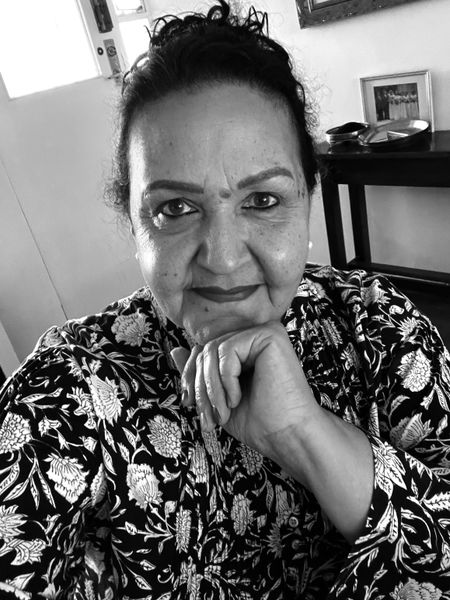
My mother, born in 1923, was a maverick and an anomaly, gloriously skating through the narrow confines of the conservative northern Natal hamlet, Washbank, in which she grew up.
She always surprised me, moving seamlessly from strictly observing social mores to flouting the rules when she thought them unfair, and making up her own.
Norma Maharaj was hellbent on breaking through the strictures imposed on her sex, and so, in the very early 1940s, when all the women around her were marrying young and starting families, she fought for a university education.
Learning, she told my sister and me, freed you from the bondage of “the stove” and opened up a world where work, independence, real personal choice and freedom were actually possible.
And so, this determined teenager cried and sulked and argued and demanded that she be sent to university until grudgingly, my working-class grandparents gave in.
Four years later, armed with a degree from Fort Hare University in the Eastern Cape, my indomitable mother committed to pass it forward, to educate young women like herself, becoming one of the most influential teachers of her time.
She didn’t know it, and would have balked at the very suggestion, but my ma was a feminist in that she believed wholeheartedly in equality between the sexes. Just go and ask my brothers.
Retro trend
I wonder what she’d have made of this new “tradwife” (traditional wife) trend that has gripped social media, which limits women’s capacity, taking away much of their freedom, including financial freedom, and categorising them into a narrowly defined role that ties them to “the stove”.
If you’re new to this concept – I myself have just happened on this burgeoning trend, apparently a thing since the start of Covid – tradwife philosophies are mostly played out on TikTok.
Videos show these women depicting themselves as housewives, expressing a preference for a return to a 1950s-style stay-at-home lifestyle. In this version of their universe, they are the homemakers, the cooks and cleaners, responsible for taking care of the home and rearing the children. What of the men? They are the breadwinners, the sole providers.
These women are not ashamed to accept that this role requires them to be submissive, deferring to the man of the house. After all, many say, he who earns the money deserves the respect of those who do not.
My open-mouthed reaction to my first video was that tradwife-ism and Trumpism share a conservative mid-century view of the patriarchal family. It encourages women to be tied to the kitchen sink, pregnant, barefoot and pretty. Femininity is displayed in dresses and frocks, in coiffed hair.
Women in these videos say they are prioritising family, homemaking and nurturing roles over career.
The mostly American right-wing media have amplified this movement. Feminism, in this shadow world, is denounced as causing a decline in 21st-century morals.
Here’s the rub: women have fought so hard to be recognised as “adults” – I use that term advisedly – that it seems inconceivable that anyone would want a return to a dark time.
To unpack our recent history, in South Africa, married women only gained the legal right to open their own bank accounts and manage their own financial affairs – including having a chequebook – without their husband’s consent in 1984.
Before that, married women were often considered legal minors under their husband’s guardianship. I remember my university-educated mother needing my father’s signature to open a bank account that her salary went into. And the house they built (my mother’s parents gave them the deposit) had to be registered in
Dad’s name.
Under apartheid laws, black women were forbidden from holding land tenure rights or purchasing property, with ownership restricted to male “heads of the family”.
Why, then, would women willingly go backwards when the struggle to win equal rights for men and women was so strenuously waged?
It’s a question I have grappled with. Of course, the desire to be a tradwife could be a fad, exacerbated by the insidious influence of social media where the portrayal of the joys of homemaking are painted with a rosy tint... But I think it’s more than that.
Too tired to have it all
Many women are rejecting the “have-it-all” way of life that feminism sold to them and modern work culture demanded. It’s no secret that work burnout is real.
Add to that the out-of-balance work-life ratio. A UN survey found that, globally, women spend an average of three times more on daily unpaid care work, including childcare and housework. While they work, women have to juggle family life, the raising of children and the balancing of budgets.
Tradwives probably see this homemaker role as a relief from decision-making, where they can take things at a slower pace and where they can raise their children in person rather than farming the task out to a nanny.
Also, imagine the pressure this places on the man who is called to provide. One-salary living is hardly sustainable in these times. Besides which, the romanticised versions of the glorious domestic life don’t give the full picture: the monotony of cooking, baking, gardening, being a mom-taxi, dealing endlessly with a toddler…
The stylised dips into the world of social media influencers could be AI-generated for all their authenticity.
It’s not unreasonable to want to be taken care of. We all long for that. I live on my own and crave having another person to share the responsibility of my life. When the car needs to be serviced, the burst geyser fixed, the monthly shopping done, the job is mine and mine alone.
But making exclusive domesticity fashionable comes at a real cost, a particularly steep one for women.
The (red) pill
Enter the likes of online influencer Andrew Tate (39), a reality TV misogynist who promotes toxic hypermasculinity. His beliefs alone should make the tradwife want to throw away her apron.
Tate thinks women are inferior, lazy and should be considered the property of their husbands. Men must be aggressive and dominant – and, of course, very rich.
Here’s a scary statistic: this man who promotes unkindness has a growing, highly influential presence among young men and adolescent boys globally, with 60% of boys aged six to 15 in some areas having heard of him. His popularity is driven by content promoting extreme wealth, along with traditional masculinity. And misogyny.
Here’s another new (to me) term: the “red pill” ideology. Derived from the 1999 film The Matrix, taking the red pill means waking up to the supposed reality that feminism has created a society skewed against men.
This is a set of beliefs among those in the manosphere – a network of online forums and blogs – which asserts that feminism dominates society and men are oppressed. It promotes the idea that modern society disadvantages men and women hold hidden power. It advocates a return to traditional, patriarchal gender roles.
Here’s my final thought on the matter: Young (all) people are at liberty to choose however it is they want to live their lives. But it is my fervent hope that those choices are based on careful and long-term consideration, and not on the hyped-up rhetoric of influencers whose social media posts may or may not even be real. DM
Charmain Naidoo is a journalist and media strategist.
This story first appeared in our weekly DM168 newspaper, available countrywide for R35.
/file/attachments/2991/DM-24042026-001_488954.jpg)
Comments
Scroll down to load comments...