



/file/dailymaverick/wp-content/uploads/2025/09/label-Opinion.jpg)
Walls invite attention.
I spent the first 18 years of my life in Berlin, Germany, and have lived most of my adult life in Cape Town, South Africa. Robert Macfarlane (2015) writes about how we landmark and how we are landmarked.
Both Berlin and Cape Town are significant landmarks and places in my unfolding, my identity and my being. Cape Town, where I currently live, is a city renowned for its simultaneous beauty, violence and inequality – a place where we can’t think of beauty as separate from violence (Gillespie, 2018). It is an enormous responsibility and honour to live and work in this unique and complex context of deep historical woundedness.
In both places and countries, I found myself part of a massive and, until then, unthinkable moment. I quickly understood that something special was happening, that history was being written and that I was really witnessing “history”. The night the wall came down in Berlin, I attended a music concert. When I had walked into the music concert, the city was one place, when I emerged a few hours later it was already somewhere else – the world cracking open.
Similarly I was in South Africa the day Nelson Mandela was released, another starburst moment. These experiences taught me about uncertainty, flux, precariousness, movement and change and that the very structures that can appear so fixed to safeguard spots in a difficult world shift despite plots and striving for permanence, fixture and safety.
Witnessing and experiencing both these moments – in a sense an undoing of a former story of certainty – and subsequently living in places where the rules were being hammered out from scratch had a profound impact on me. Perhaps it is no surprise that walls (or the fantasies of walls) and boundaries have become very prominent in the ways I think about the world.
More than just demarcation of territory, walls alienate and do unconscionable, inconceivable things; they exclude, they other, they can protect, they postpone intimacy, and they certainly invite attention. Puzzling over all of the boundaries that seemed strange and questioning perceptual and conceptual boundaries and boxes became part of my outlook.
Paradox of the Berlin Wall
I’ve always wrestled with the paradox and fascinating irony of the Berlin Wall. It is hard to comprehend and almost unbelievable that it was both erected and demolished for the same reason.
The wall was designed to prevent people from escaping to the West from East Berlin and the wall came down 28 years later with exactly the same intention – to prevent people from escaping to the West. There were just too many people escaping so it was better to tear the wall down so that people would stay. Contexts and logic shifts. Integrity is a shared process, inter-relational and contextual… and borders don’t hold.
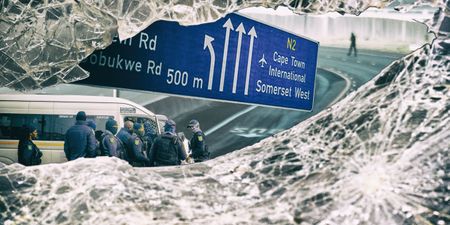
When I first heard of the wall to be constructed along the N2 highway in Cape Town, I have to admit that I thought it was absurd or an April Fool’s joke… I was in denial. I couldn’t believe this was a genuine suggestion and project that had the go ahead and approval.
And perhaps it is worth noting that I’m sharing this disbelief from the point of view of an urban planner – it is my work and practice to think about urban challenges and troubles so I am familiar with and preoccupied with Cape Town’s multidimensional crises, thinking about the question of how to live together better.
We face a convergence of escalating, interlinked crises that I think about all the time with the hope of contributing to creating more liveable settlements and futures.
At present many of our efforts to create a more equitable and liveable urban fabric have resulted in a sustained anomaly in which social fragmentation, segregation, inequality and ecological degradation are all worsening and sustaining abnormality (we’ve normalised the abnormal). Why does the exhausted, dominant and reigning logic just continue to roll on when we need new visions and attitudes? I’m writing this article as an invitation to reconsider the stories that are.
The project was introduced with a narrative to make Capetonians safer – “the N2 Edge safety initiative”. Many people have asked whose safety is included, and whether such an approach can contribute to lasting safety.
Critics see the wall as anti-poor, demeaning and dehumanising and as a symbol of division rather than protection, warning that it could deepen and entrench existing inequalities. It abstracts criminality instead of tackling crime at its source – it hides that the impoverished and violent conditions of social life that are the result of South African colonial and apartheid history animate much of post-apartheid criminality. We cannot forget and bury the past and risk the arrogance of historical amnesia.
New forms of segregation
Erecting walls painfully echoes, fortifies, entrenches and concretises (literally) the painful legacy of apartheid spatial planning and risks normalising new forms of segregation in a democratic South Africa. It seems obvious that a host of stories don’t get told because they rock the boat, discomfort the powerful, and unsettle the status quo. We either avoid them or are unable to see them yet we can’t avoid this messy work of staying with the trouble.
I would like to disturb conventions of storytelling that preclude the recognition and restoration of interdependencies across people, places and times. Safety concerns are part of the enduring effects of apartheid-era spatial planning. These injustices damage all our humanity which no wall can keep away.
In South Africa, in particular, we need to respond to history and centre our uneven inheritances and demand new forms of accountability. We need to centre the historical woundedness, rehumanise our praxis and prioritise people over partitions.
Most institutions and organisations privilege the question, “What can we do about the troubles?”
Such a question risks to occlude and displace what we are already doing, the doings we’re immersed in. We must invite all parties to acknowledge the past, especially those with overprivilege, to work together towards repair through both symbolic and material actions. The motive is our shared humanity, and the goal is a restored personhood of all involved. I believe the future lies in the capacity to understand and respond to interdependency.
Budget outrage
There is outrage with regards to the budget prioritised for this project, and there have been many suggestions for better investments contributing to lasting safety along the N2. Initiatives and acts of repair need to address the roots of our troubles; they require integrated development and a broader people-centred approach.
Working on youth development initiatives; job opportunities; priority lanes for commuter traffic out of town (not just into town); sports and recreational facilities (keeping our pools open); better lighting; strengthened community policing; and efforts to rebuild trust and cohesion in affected areas are a few examples.
For the last five years I have been involved in a collective of women and non-binary people, the After8Sistahood (formerly Women Walk at Midnight), moving through our city at night on foot and by public transport, reclaiming space, refusing fear, challenging surveillance and protection logics. Together we keep each other safe and bring back joy into the night.
This example of joyful organising and relationship building is work of repair – we need to organise with care, joy and love. This to me plants alternative possibilities structurally much better than any wall.
Nora Bateson, whose life and work is about increasing perception of the interrelationality that creates life, would say “tone matters”. The tone of action in context alters possibility. Anti-apartheid reconstruction cannot address the symptoms of criminality with a wall and militarised responses. In a time like this, joy is an act of resistance.
“The stories we tell ourselves are everything.” DM