



On Monday, 2 February, the sun sat high and unforgiving over the University of the Western Cape (UWC). By mid-morning, the courtyard outside the ResLife building had already turned into a waiting room of despair.
Students stood with their lives packed into bags. Parents hovered nearby, tired, anxious, protective. The heat clung to skin and tempers alike. One by one, they waited for a moment with an administrator, a few minutes to explain their poverty, to translate hunger, overcrowding, unsafe homes and broken roofs.
At the end of each conversation sat a decision: residence or no residence, stability or uncertainty, dignity or another night without a place to sleep. This continued until late evening. There was little information, little movement, and even less comfort. What was hardest to ignore was not just the exhaustion, but the pattern — almost all the faces in that courtyard were black.
The residence crisis at the University of the Western Cape is not simply an administrative failure. It is a political question. It is a racial question. And it is a mirror reflecting how institutions that once stood on the right side of history can slowly drift into reproducing the very exclusions they once resisted.
UWC is often remembered, rightly so, as a radical institution. During apartheid, it earned the name “the university of the left,” a space where black intellectual traditions were nurtured, where critical scholarship challenged power, and where the university did not shy away from aligning itself with the oppressed.
That history matters. But history alone cannot house students. Progressive legacies mean little when current policies quietly punish those whose lives are shaped by the unfinished business of apartheid.
60km radius clause
At the centre of the residence crisis is the university’s housing policy, particularly the 60km radius clause. On paper, the rule may appear neutral, even practical. In practice, it is deeply discriminatory. It disproportionately affects black students who come from Cape Town’s townships, excluding them from residence on the assumption that living “close enough” to campus means living under conditions conducive to learning.
This assumption collapses the moment one steps outside the policy document and into lived reality.
The 60km radius includes Khayelitsha, Nyanga, Gugulethu, Bishop Lavis, Mitchells Plain, Delft and many other townships. These areas were never designed for learning, safety, or stability. They were designed to warehouse black labour far from economic opportunity and political power. They are products of deliberate spatial planning meant to marginalise, control and exhaust black lives.
To suggest that proximity to campus equals privilege is to ignore history, geography, and daily life.
Cape Town’s townships are marked by overcrowding, unsafe public transport, gang violence, shack fires and a lack of basic services. Many students travel hours each day, often leaving home before sunrise and returning late at night.
Others live in informal settlements built on flood plains or near hazardous infrastructure, where winter rains wash away belongings and summer heat turns shacks into ovens. Studying in such conditions is not just difficult — it is an act of resistance.
There are more than 150 informal settlements in Cape Town, most inhabited by black working-class families. These are not accidents of poverty; they are the direct outcome of apartheid spatial planning, aggressively protected and reproduced by post-apartheid governance. The City of Cape Town has consistently relied on by-laws and court processes to maintain this spatial order, often criminalising the poor for surviving in conditions they did not choose.
University housing policy cannot pretend to exist outside of this context.
Broader land and housing crisis
The question of student accommodation cannot be separated from the broader land and housing crisis in Cape Town. The face of that crisis has always been black. From forced removals to backyard dwellings, from overcrowded flats to informal settlements, black people have borne the burden of spatial injustice. When universities ignore this reality, they effectively side with it.
What is most troubling is how the 60km clause turns structural inequality into an individual failing. Students are asked to prove that their homes are “bad enough”. Poverty becomes something to perform, to narrate convincingly in front of an administrator. Trauma is reduced to paperwork. And even then, there are no guarantees.
This process is humiliating. It teaches young people, fresh out of high school, that access to education requires not just merit or effort, but the ability to make suffering legible and believable to authority.
Worse still, the policy unintentionally pushes students toward dishonesty and risk. Faced with exclusion, many are forced to falsify proof of address in order to qualify for residence. This is not because they are immoral, but because the system leaves them with no real alternatives. A policy that encourages survival through deception is a failed policy.
Let us be clear: this is not an argument against prioritising students from outside Cape Town. Many of them also come from deeply disadvantaged backgrounds and deserve accommodation. The problem is not prioritisation — it is the basis on which prioritisation happens.
A fairer measure: Class, history and conditions
Distance from campus is a blunt and lazy measure of disadvantage.
What should matter is class, history, and material conditions. Prior disadvantage, not geography, must be the guiding principle. A student living 20km away in an overcrowded shack with no electricity is not more privileged than a student living 200km away in a stable household. Treating them as such is not neutral — it is unjust.
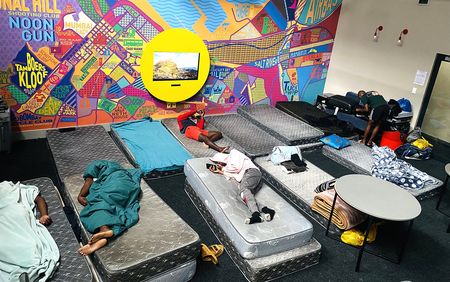
The consequences of exclusion do not end at inconvenience. They spill into violence. Students who are denied residence often end up couch-surfing, squatting or occupying abandoned buildings. In doing so, they expose themselves to crime, police harassment, eviction and gender-based violence – all for simply wanting to study.
This is not resilience. It is desperation.
Recent scenes of CPUT students protesting outside the District Six campus with their bags tell a similar story. These are not isolated incidents or institutional anomalies. They are symptoms of a higher education system struggling — and often failing — to respond to structural inequality. Across the country, black students are made to carry the cost of a housing crisis they did not create.
For many black families, education is not about prestige or social mobility in the abstract. It is about survival. It is about breaking cycles of poverty. It is the one tool available to poor people to change their lives. When access to education is undermined by housing insecurity, the promise of democracy itself is weakened.
Universities like UWC have both the intellectual capacity and the moral responsibility to do better. This means revisiting residence policies with honesty and courage. It means acknowledging that apartheid did not end in 1994 — it lives on in space, in policy, and in whose suffering is normalised.
The 60km clause should be abolished. In its place must be a housing framework rooted in social justice, historical awareness and lived realities. Anything less turns residence into a privilege for the already advantaged and a test of endurance for everyone else.
If UWC is to remain true to its radical legacy, it must listen to the students standing in its courtyards with bags in their hands and uncertainty in their eyes. Their presence is not an inconvenience. It is a message.
And it is long overdue. DM
Sibusiso Xabangela holds an honours degree from UWC's Institute for Poverty, Land and Agrarian Studies and is a social justice activist, researcher and popular educator based in Cape Town.