



The first time I saw fear organised into a system, it was painted blue and escorted by the police.
I was a boy standing on the side of a dusty road in Elandskop, Pietermaritzburg, watching a bus leave Sevontein prison. It did not belong to us. It carried the children of white wardens.
The bus moved through our villages like a foreign object, SAPS vehicles in front and behind, rifles visible through the windows. It did not stop. It passed us on its way to town, carrying a small group of children toward well-resourced schools while the rest of us walked to underfunded classrooms with broken windows and too few books.
We chased that bus sometimes, not because we believed we would catch it, but because children run after what looks like opportunity.
Before 1994, that bus was an unmistakable symbol of exclusion. Its passengers were uniform. Its destination was privilege. Its escort was the state.
After 1994, the colour changed, but the structure remained. Today, there are a few raisins in the barrel of flour — a few black faces now sit in the bus — but the bus still passes the village. A small elite moves toward security, mobility and quality education while the majority watches it disappear in a cloud of dust.
Democracy opened the door of the bus. It did not redesign the route.
What I saw as a child was mobility with escort — safety for some and exposure for others. I thought that system ended. I now see that it multiplied.
The logic is unchanged
Today, the escort vehicles are private. The bus has become the security convoy. The route runs through gated estates instead of prison roads, but the logic is unchanged: protected movement for a few through a landscape of exclusion.
Drive through Johannesburg, and you count electric fences instead of trees. Boom gates divide streets that once connected neighbourhoods. Guardhouses stand where front doors once faced the road. Armed response signs have replaced the idea of a neighbour.
South Africa does not only have inequality. It has spatial anxiety.
There are more than 2.7 million registered private security officers in this country and roughly 150,000 police personnel. Armed response often arrives faster than ambulances. Middle-class families budget for electric fencing before they budget for books. We trust panic buttons more than we trust one another. We now employ more people to guard property than to form citizens.
Fear has become an industry.
This is not only about crime. It is about structure. South Africa remains one of the most unequal societies in the world, with a Gini coefficient above 0.6. Wealth and poverty occupy different transport systems, different schools, different hospitals and different futures. The wall is not only a security feature. It is an economic border.
When citizens no longer encounter one another, they no longer imagine one another. The gardener becomes a risk. The delivery driver becomes a threat. The young man walking becomes suspicious. A locked gate keeps danger out, but it also keeps society apart.
Rituals of avoidance
I see this every week in Braamfontein. Students arrive with curiosity and hope. Within months, they learn the rituals of avoidance: do not walk after dark, do not take out your phone, do not trust anyone. Movement becomes calculation. Public space becomes contested territory. We are forming a generation that experiences its own country as a hazard.
I do not read this as an outsider. I have worked as a chartered accountant in the Office of the Auditor-General, where every allocation is measured not by intention but by outcome. A budget is a moral document. It reveals what a nation chooses to protect and what it is willing to postpone. You see schools that exist on paper but not in brick, infrastructure that is funded but not completed, programmes that are extended but not evaluated. Over time, a pattern emerges: we are efficient at funding response and inconsistent at funding formation.
This year’s Budget confirms that pattern. Education remains the largest area of public spending, but debt-service costs are now among the fastest-growing items and will consume about 16.5% of total expenditure. That is money that builds no classrooms, runs no trains and employs no young people.
We continue to expand allocations for policing and security, while early childhood development, school infrastructure and youth employment programmes struggle to meet demand. We are paying to manage fear rather than investing to remove its causes. Response has a budget. Prevention has a speech.
The 2026 Budget Speech speaks of a fiscal anchor and debt stabilisation, reassuring markets that the numbers will hold. But a stable balance sheet is not the same as a redesigned society.
Safety cannot be privatised at scale.
A country in which millions are unemployed while others live behind electric fences will never feel secure, no matter how many cameras are installed. Technology can monitor movement. It cannot produce belonging.
Belonging is produced through encounter.
Fear becomes routine
The bus in Elandskop taught me that fear, when institutionalised, becomes routine. Children grow up around it without questioning it. The electric fence has become part of our landscape. The boom gate has become a normal street feature. We no longer ask what it does to our imagination.
What does it mean for a child to grow up believing that safety requires separation?
What does it mean for a nation when suspicion becomes the default posture?
We cannot wall our way out of this. We cannot police our way out of this. A society cannot outsource its moral life to a security company.
Safety is a social achievement. It requires functioning schools that form citizens, not only candidates. It requires local economies that give young people a reason to protect rather than prey on their communities. It requires shared public spaces, reliable transport and institutions that create regular contact across lines of class and race.
It requires us to see one another again.
The most dangerous thing about a locked gate is not the metal. It is the story it tells: that your safety depends on your separation from others. Repeated often enough, that story becomes a national psychology.
The bus still passes the village.
A few more children are on it now. Many more are still running behind it.
Until we redesign the route — not only open the door — we will remain a country of escorted mobility and fenced belonging.
I no longer run after it. I am asking who designs the road.
We cannot build a future behind electric fences.
We have to build it with one another. DM
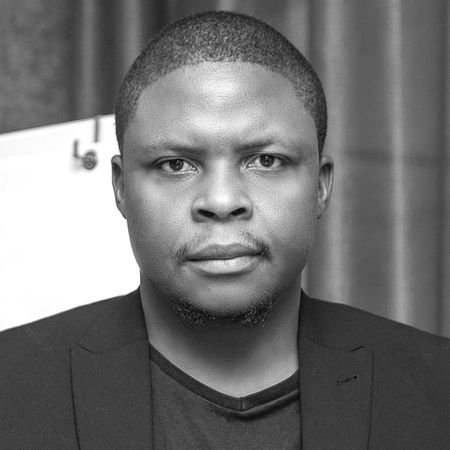
Themba Dlamini is a husband, father of four, pastor and chartered accountant who loves South Africa — warts and all. He is the author of Village Boy: A Memoir of Fatherlessness, and writes to wrestle with hard truths, stir hope and help build a country in which his children can thrive.