




/file/dailymaverick/wp-content/uploads/2025/09/label-Opinion.jpg)
On a mid-winter morning off the Cape coast, the sea is grey and glassy, a welcome respite between the north-west-driven storms.
Sitting on a boat, well beyond the backline, there is a stillness that you don’t get in summer. The beaches are empty, gone are the holidaymakers, the yellowtail have moved offshore and the howling south-easter has died down for the winter.
While this quiet is natural, existing long before we arrived and probably long after we are gone, it reminds me of a much more disturbing absence.
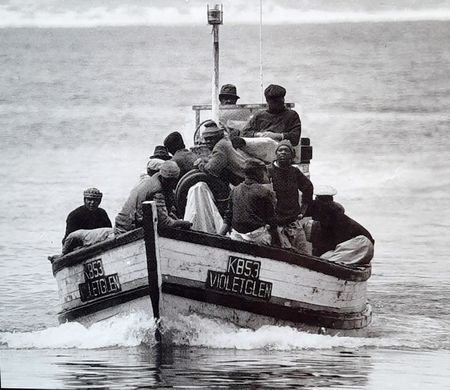
In South Africa’s small fishing harbours, many fishers describe a quiet shift in what comes off the line – trips that once yielded kob, yellowtail and hake are increasingly unpredictable, and in some areas they report much sparser catches and a broader mix of smaller, less commercially targeted fish.
Sardine shoals – once the lifeblood of coastal food webs nearshore – have thinned dramatically, their arrival delayed or absent, and even veteran netters shrug at what they’re seeing. Cape fishers are vocal about these shifts, describing an unprecedented absence of baitfish that disrupts line fisheries and coastal food webs.
Lived, observed ecological signals
These are not seasonal anecdotes. They’re lived, observed ecological signals – the weather, ocean state and fish behaviour in real time. Policy models assume predictable seasonal abundance and the return of key forage species, but recent years have taught many fishers that reality is far less certain.
For most people, the prospect of being on a boat in the Cape winter is a miserable idea – the seeping drizzle, an often rolling sea and a cold that penetrates deep into your bones.
For small-scale fishers, this is a way of life, year round. These people hold knowledge and insights gathered from years of hands-on engagement with the environment.
Snapshots
Yet the official fisheries policy that governs these same waters – the Small-Scale Fisheries Policy (2012) and the Marine Living Resources Act before it – is built largely on data collected sporadically, often in summer cruises and monitoring of landing slips that provide snapshots rather than lived ecological rhythms.
The result? Planning that assumes consistency in species abundance and distribution across seasons, even as local fishers and ocean users report seasons that look nothing like the historical baseline.
In 2025, small-scale fishers staged harbour-wide protests demanding an overhaul of the fishing rights system, citing prolonged delays, exclusion from quota allocations and an opaque rights regime that has left coastal communities economically insecure.
These are people who spend every season on the water, but feel sidelined by a policy architecture that rarely reflects their year-round reality.
SA’s small-scale fisheries policy – intended to redress historical inequities – was promulgated more than a decade ago, yet many fishers report uneven, disputed implementation and governance failures that have deepened mistrust.
SA has about 147 small-scale fishing communities, and an estimated 29,233 small-scale fishers. Typically, these fishers harvest resources for household consumption or sale to local markets.
Development and poverty alleviation
About 30% of SA’s population lives within 60km of the coast, meaning that sustainably harvested, shared ocean resources could feasibly be a valuable tool in national development and poverty alleviation.
However, the current quota allocations do not reflect these facts. Recently, the Department of Forestry, Fisheries and Environment reduced the TAE (total allowable effort) for small-scale cooperatives to just 77 vessels.
In comparison, the commercial sector received a total of 378 of the 455 allocated vessels. While commercial fisheries certainly contribute more towards the GDP than small-scale fisheries, GDP contributions do not reflect the distribution of that income.
Both industries lead to similar levels of direct employment, and many of the indirect employment opportunities, such as sales and processing, could be as applicable to small-scale fisheries if they had more of the market share.
The argument here is not about the value of commercial fisheries, nor is it about the effectiveness of marine resource estimations and modelling, both of which could be the subject of extremely interesting academic papers. The argument here is to advocate for the voices of those with experience.
More importantly, it’s inherently an argument for respect. By marginalising communities with experience, knowledge and a long history of engagement with an area, be it marine or other, we are telling them that they are not valuable, that what they know is not valuable.
That is not, and cannot, be the case. DM
Dr Michael Brown is a strategic consultant specialising in NGO and government engagement in developing countries, with a particular interest in environmental issues, agriculture and the blue economy.