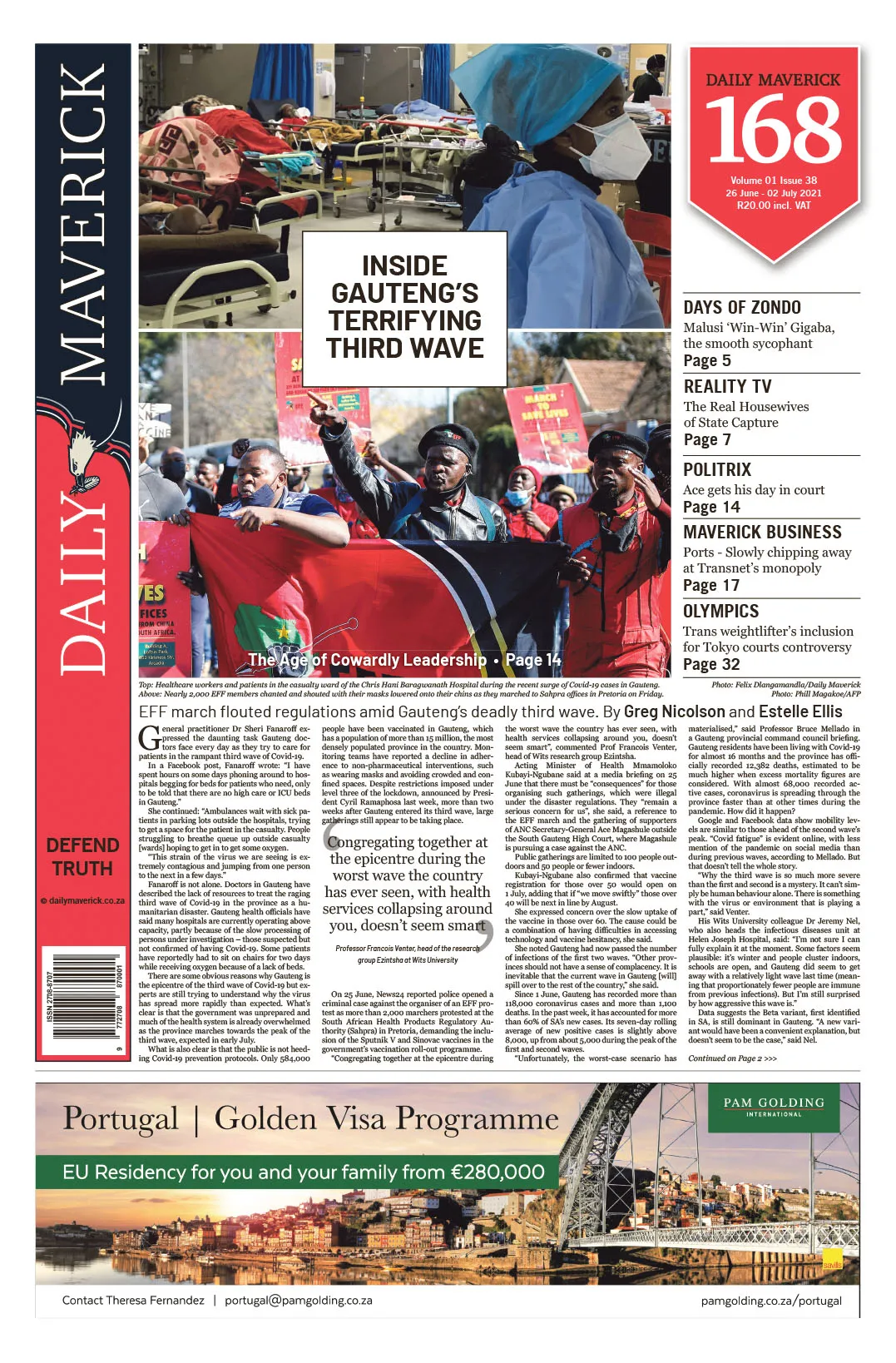
First published in the Daily Maverick 168 weekly newspaper.
Addressing the full Bench of the Johannesburg High Court, Mpofu argued that the ANC’s Rule 25.70, which the party used to suspend Magashule, was inconsistent with the country’s Constitution. He anchored his main argument on the 2012 Ramakatsa v Magashule court case – where he ironically represented the applicant Mpho Ramakatsa in his legal fight against the Free State ANC as led by Magashule at the time. In that case the Constitutional Court ruled that decisions of political parties were invalid if they were not in line with the country’s Constitution.
He further argued that the contentious “step aside” resolution adopted at the ANC’s 53rd national congress at Nasrec has been amended by the party to target political opponents of President Cyril Ramaphosa. The party’s National Executive Committee, argued Mpofu, does not possess the necessary powers to change a resolution of conference.
In this case the court will have to decide whether Magashule had been treated unfairly by the governing party and whether its processes – leading to his suspension – were in violation of the principles of natural justice.
At the start of his argument, Mpofu already seemed to be hinting at a possible appeal, should Magashule lose. He took umbrage at the court expressing itself on the issue of the powers of Deputy Secretary-General Jessie Duarte. In dismissing an application by businessman Mutumwa Mawere to intervene as an interested party, Judge Jody Kollapen contended that the ANC’s constitution empowered the deputy secretary-general to “deputise [for the secretary-general] when necessary”. Mawere had argued that Duarte did not have the authority to serve Magashule with a suspension letter. The same argument is contained in Magashule’s main application. Mpofu told the court that the judge’s comments had left him uneasy because they suggested that the matter of Duarte’s powers had been prejudged.
Although the case is playing out in court – with Advocate Wim Trengove representing the ANC – it is more political than it is a legal fight.
Basically, according to Magashule, Ramaphosa is abusing ANC processes and conference resolutions to sideline his political opponents. If Magashule is to be believed, then Ramaphosa is leading a market-friendly capitalist agenda, whereas Magashule leads a pro-transformation faction.
Magashule’s court case is important for various reasons but not least because of what it indirectly accentuates.
Here is Ace Magashule, a man who has been dismissive of the courts and their crucial role in our democratic dispensation, turning to those very courts to adjudicate his case.
Against the wisdom, or lack thereof, of his supporters, Magashule is pushing ahead. Umkhonto weSizwe Military Veterans’ Association leader Kebby Maphatsoe told the Mail & Guardian that they had advised Magashule against taking the ANC to court, but he pressed ahead.
“That has been our call long before he was given a suspension letter. After he took this decision, we did not say anything... We said to him that he must exhaust all internal processes and let’s find an amicable solution,” Maphatsoe was quoted as saying.
Magashule – like his political godfather, Jacob Zuma – has previously questioned the supremacy of the Constitution. He told journalists earlier this year not to “worry too much about the Constitution” and also told this writer that the Constitution “is not sacrosanct”. He said this as he defended Zuma’s defiance of the Constitutional Court.
He is now in court challenging the constitutionality of the ANC’s Rule 25.70. Oh, the irony!
But it would be foolish to believe that Magashule has now had a Damascene moment and suddenly believes in the supremacy of the Constitution.
He is in court because he is desperate. His political back is against the wall.
Given how dangerous his statements and those of various ANC leaders are, Magashule’s dragging of the governing party to court is a good thing. Not because I support him. But it is important to show the South African public that the courts exist so that the rule of law is upheld and to resolve disputes. These dangerous messages by political leaders have diminished the image of the courts in the eyes of the general public.
Whatever the outcome, the Magashule case is good for the image of the courts. DM168
This story first appeared in our weekly Daily Maverick 168 newspaper which is available for free to Pick n Pay Smart Shoppers at these Pick n Pay stores.