



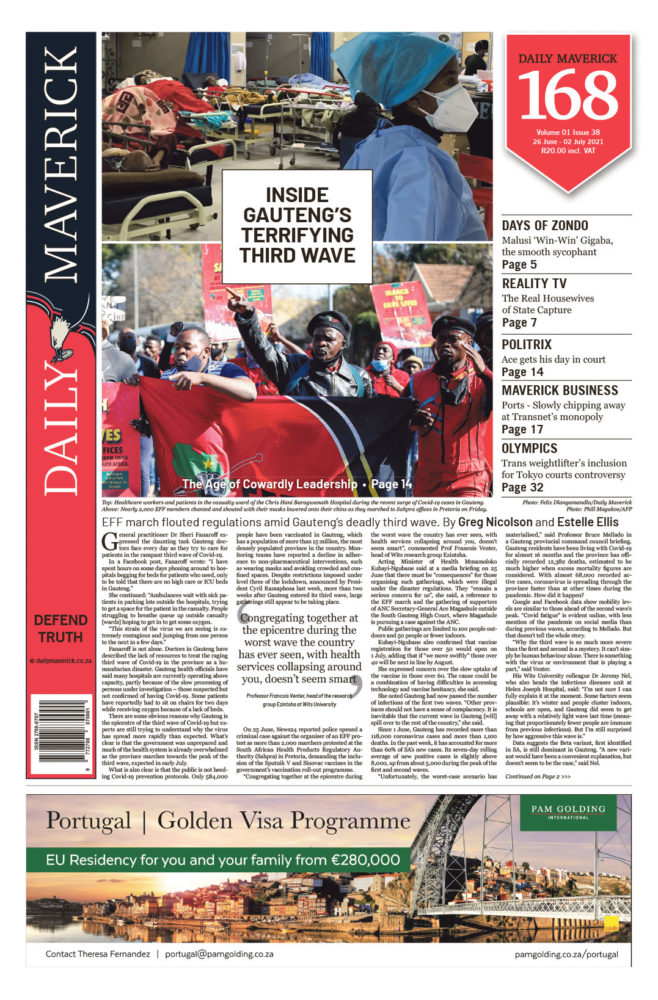
First published in the Daily Maverick 168 weekly newspaper.
Many of SA’s elders and healthcare workers have been vaccinated and, within months, teachers and the over-50s will be too. This offers hope that there is a path back to normality.
But, while we wait for our turn, the reality is that the third wave is overwhelming hospitals. Achieving herd immunity is imperative, but the pace is too slow. We risk facing a fourth wave before that is achieved – at enormous cost to the country.
With this in mind, the Department of Labour has published a directive that makes it possible for employers to implement a mandatory vaccination policy at their workplace. This does not mean that vaccinations will become mandatory across the board; the directive comes with a raft of provisions that require employers to evaluate their own particular risks and circumstances.
Employers will have to weigh up individual rights against their statutory obligations to provide a safe working environment for all employees and those they come into contact with.
English philosopher John Stuart Mill wrote that the sole ground for the use of state coercion (and restriction of liberty) is when one individual risks harming others. But the mere mention of a mandatory vaccination policy has many people protesting that individual rights are being trampled.
The controversy over vaccines has long been simmering. In fact, it did not take long for opposition to Edward Jenner’s smallpox vaccine, invented in 1796, to surface. And when it was made compulsory in the UK in 1853, the resistance became greater.
Despite the opposition, there is no denying that vaccinations have made an enormous contribution to global health. Two major diseases – smallpox and rinderpest – have been eradicated. The number of children paralysed by polio has been reduced by 99.9% over the past three decades and measles is a target for eradication.
But Covid-19 has rekindled many of the debates around vaccines. Beyond the general vaccine sceptics and those who buy into conspiracy theories, there are genuine fears and anxieties about the Covid-19 vaccine that employers may want to be sensitive to.
The most obvious is the concern that testing has been rushed and the vaccine may not be safe or effective. Although the technology being used in many of the Covid-19 vaccines has been successfully used in other vaccines, this is the first time a vaccine has been produced against a coronavirus. So, yes, we are in uncharted territory.
Also, the vaccines have been developed unusually fast (yes, with unprecedented global collaboration and funding), but one has to acknowledge that no vaccine can be said to be 100% safe. I could also argue that no medical procedure is risk-free either.
And, last, let’s accept that it may take time for some side effects to manifest – simply because sufficient time has not elapsed.
This is not to support the anti-vaccination movement. Vaccines are a cornerstone of public health. And while there are many unknowns around Covid-19 vaccines, their development had to comply with robust testing procedures (in most jurisdictions) to ensure that they are effective and safe.
The problem is that vaccine hesitancy grows when public trust is eroded. So, it is not helpful when the SA government chooses to ignore the advice of the medical specialists on its own Ministerial Advisory Committee, or when experts choose to ignore the existence of vaccine risk.
Let’s not paper over the fact that there are risks. Instead, let’s spend the time quantifying how big those risks are.
When it comes to mandatory vaccinations there is an ethical balance to be struck given the economic, social and health catastrophe of the various pandemic measures, in particular the lockdowns.
There is considerable pressure to ensure that the majority of the adult population is vaccinated as soon as possible. Companies, too, are battling high levels of absenteeism that limit efforts to return to normal work.
Any mandatory vaccination programme would need to make a value judgement on when the benefits to the collective outweigh the rights of the individual. Right now, just kickstarting our economy and preventing the sheer collapse of our healthcare services seem like valid justifications. DM168
Sasha Planting is an associate editor at Business Maverick.
This story first appeared in our weekly Daily Maverick 168 newspaper which is available for free to Pick n Pay Smart Shoppers at these Pick n Pay stores.
Comments
Scroll down to load comments...