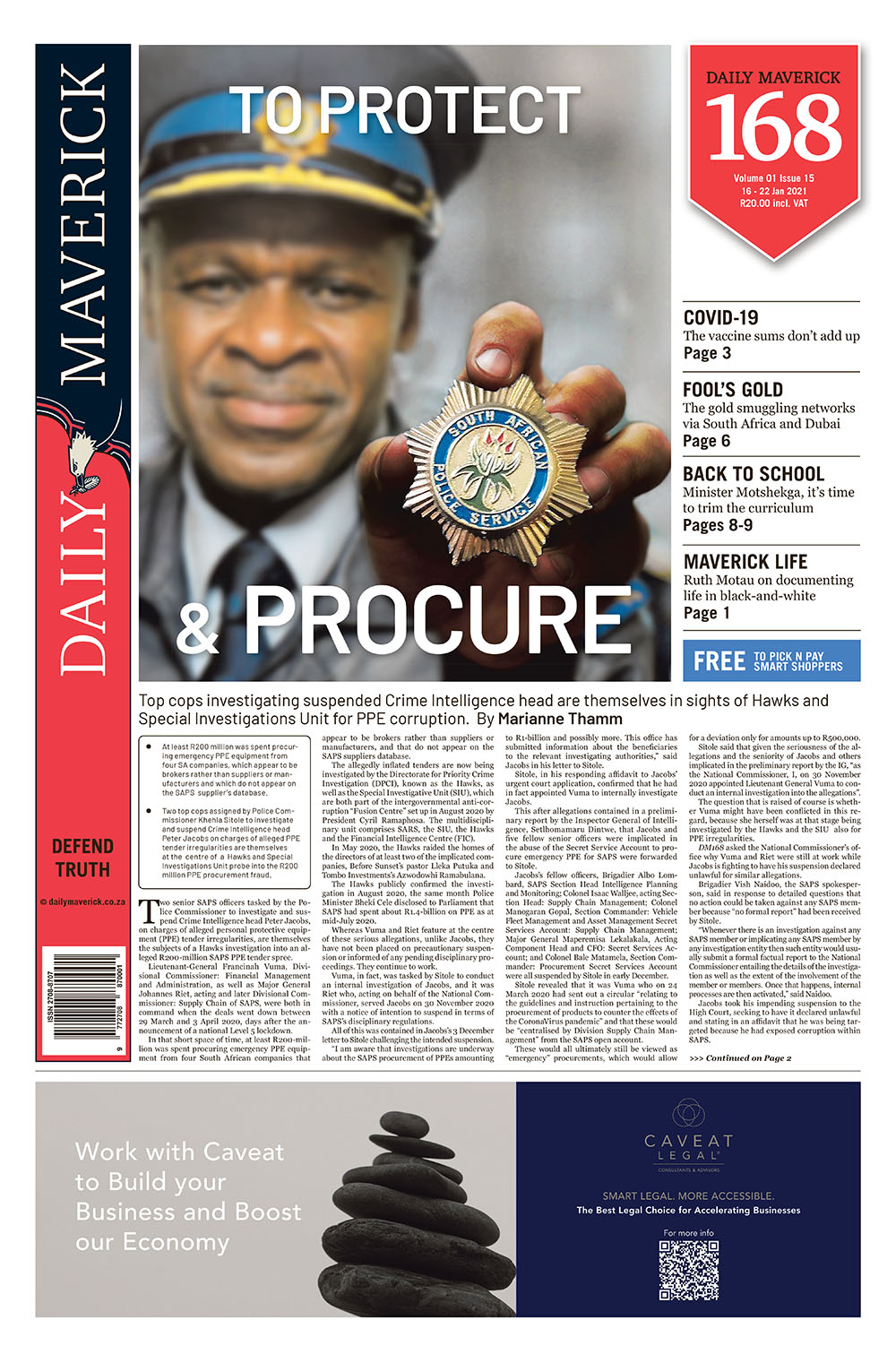
First published in the Daily Maverick 168 weekly newspaper.
The contorted process of getting and paying for vaccines says an enormous amount about the state of government in South Africa today, both good and bad. Well, let’s be honest, mostly bad.
It also raises another issue: the constitutional and transparency issues involved in the new rapprochement between business and government symbolised most recently by the establishment of the Solidarity Fund.
I should put my cards on the table. Unlike many in the SA commentariat, I actually like the idea of the respectable side of business and the respectable side of government working together, even if this takes place in a constitutional grey area.
Is this the ideal solution? Absolutely not. Given SA’s State Capture history, it’s understandable that citizens are goosey about decisions between business and government taken in the proverbial smoke-filled rooms. There are of course constitutional issues about government outsourcing to business functions it should be performing, like organising Covid-19 vaccines.
Dysfunctional government
The recent review by the National Planning Commission (NPC) shows large swathes of government to be dysfunctional. Jobs have been juniorised, accountability systems are non-existent, people in senior positions are clueless about what they’re meant to do.
One example was the plan to connect government buildings to a digital network. The initial plan, called SA Connect, was approved in 2013. Five years later, essentially the same plan was approved as the National e-Government Strategy. It set targets.
Great.
“Phase 1 of the plan was initiated in 2017/18 and was meant to connect 6,135 government buildings and, to date, has actually connected 970 government sites – mainly clinics and schools. It is not clear whether these sites are operational,” the NPC report notes, a touch sardonically.
A further 35,211 government sites still need to be connected to achieve SA Connect. “It is estimated that doing this would cost a minimum of about R30-billion and potentially up to R80-billion ...”
What is behind this dysfunction? The report doesn’t explicitly tread into this marshland, but it’s kinda obvious. The ANC faces no real threat at the ballot box, so the need to demonstrate performance to the electorate is obviated. That has wormed its way into the administration, and SA’s stringent labour laws mean it’s impossible to hold anyone to account. Layer on top of that a corrupt tendering system and financially needy political parties, and you have a full-on crisis of administration.
The private sector engages
President Cyril Ramaphosa knows this. He has experienced first-hand the accountability systems of the private sector, which can be tough. Incentives, negative and positive, are key. Early in Ramaphosa’s presidency, there was an accord between business and government. In some ways, the Solidarity Fund grew from that.
In the matter of vaccines, the Health Department tried to get Treasury to pay for SA’s Covax membership and an initial set of vaccines but was rebuffed. So it went to the Solidarity Fund, comprised of donations, mainly from business and individuals.
The department itself was behind the curve on this but, with the help of the fund, sourced an initial batch of vaccines. From this was born the idea that medical schemes could subsidise the broader population on a one-to-one basis.
Treasury then found its voice, saying it would provide most of the R20-billion required to vaccinate the nation.
So it’s a crazy mix of plans and counter-plans, but the general idea is more-or-less sensible: the government will procure the vaccines, sell them to the private sector at double the price, and the surplus will be handled by the Solidarity Fund, and that will be used to pay for free distribution. Production and logistics will be managed largely by the health companies.
Is this really a constitutional problem? Generally, I’m glad the private sector is engaged. This is how South Africans get things done: public schools declined but private schools blossomed; public hospitals failed but private hospitals grew.
And those who have constitutional qualms, please refer to the government digital rollout above. DM168
This story first appeared in our weekly Daily Maverick 168 newspaper which is available for free to Pick n Pay Smart Shoppers at these Pick n Pay stores.