



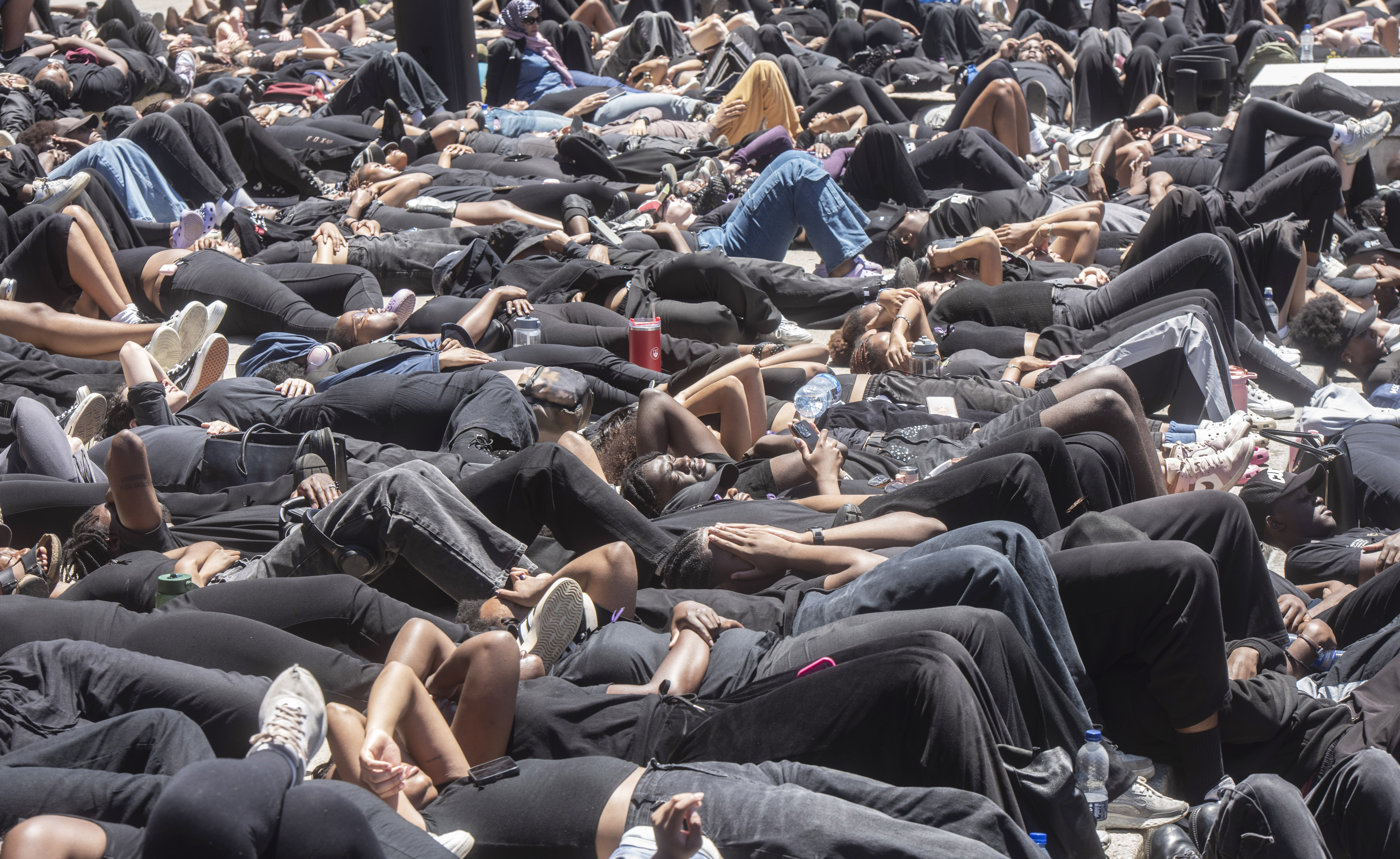
 More than 1,000 students and staff lay down for 15 minutes in protest against gender-based violence and femicide at the University of Cape Town on 21 November 2025. (Photo: Brenton Geach / Gallo Images)
 Movement of the Year
The collective force that captured the world’s attention or drove meaningful change.
Over the past month, social media turned purple thanks to a grassroots movement that brought South Africa to a standstill. Its protests cast an international spotlight on South Africa’s alarming rates of femicide and gender-based violence. This action, named the G20 Women’s Shutdown, is the reason Daily Maverick readers have voted for Women for Change as the Movement of the Year.
Women for Change has become a leading voice in bringing attention to cases of gender-based violence and femicide in the country, broadcasting survivor stories to more than 400,000 followers on Instagram and more than 200,000 on TikTok.
The shutdown, hosted on 21 November, called for women to abstain from work and economic participation. Supporters were urged to change their social media profile pictures to purple, wear black and take part in one of the designated 15-minute lie-ins in honour of the victims of gender-based violence.
The movement gained widespread local and international attention, and its petition to have gender-based violence declared a national disaster attracted more than one million signatures. On the day of the protest, President Cyril Ramaphosa did officially declare it a national disaster.
From a running club to activism
Behind this achievement was a grassroots movement organised by just five people. Women for Change was cofounded in 2016 by Sabrina Walter, who has a marketing background and settled in South Africa from Germany in 2010.
Walter said the movement began in 2014 as a running club for women named Catch Me If You Can. It started in Cape Town and spread nationally to include more than 25,000 women.
Then, in 2016, 16-year-old Cape Town resident Franziska Blöchliger was raped and murdered by Howard Oliver while running in Tokai Forest, an area residents considered safe. This prompted Walter to host a run through the forest in Franziska’s honour.
“A week after Franziska was murdered, 4,000 women, men, children, horses and dogs showed up and walked in memory of her and all the other women,” Walter said.
“By that time, I had researched and was pretty much aware of the femicide and gender-based violence, but many of us were not. So I decided to not just do it for Franziska, but to do it for all the women. And that’s how Women for Change was born.”
The movement initially used the Catch Me If You Can network to focus on running events, but the 2020 Covid-19 pandemic forced a change in strategy. So it pivoted to social media to raise awareness by posting statistics about femicide and gender-based violence. Soon after, survivors of these crimes began to send messages.
“It took a couple of months before the social media space turned into a safe space and women would start messaging me, asking for help and asking if we can share their stories on the page,” Walter said.
“By now, we have covered more than 1,600 women on our social media. And for the past two years, we haven’t picked up cases from the media. It’s the families coming to us.”
In addition to social media advocacy, Women for Change offers support services to survivors, including acting as a point of first contact and redirecting victims to support organisations and pro bono counselling services.
‘Keep the movement going’
Women for Change’s campaigns have employed various methods, including marches and petitions. One notable protest in April involved presenting an unburied casket holding 5,578 purple beads at the Union Buildings. Each bead symbolised a woman killed in one year. This accompanied the movement’s initial petition demanding that gender-based violence be declared a national disaster.
However, Women for Change also attracted criticism and widespread harassment for bringing attention to prominent men accused of gender-based violence, such as the late rapper AKA, R&B artist R Kelly and podcaster Andrew Tate.
A key action in late 2024 was a petition calling for the boycott of artist Chris Brown, who has a history of violence, including pleading guilty to assaulting his then girlfriend, Rihanna, in 2008. He has subsequently also faced a number of abuse and assault allegations.
The petition against his concert in Johannesburg resulted in widespread criticism, threats and harassment directed at Women for Change.
The movement has also attracted criticism for a lack of transparency. Walter said she addressed these concerns by publishing its annual financial statements.
“I do not pay myself a salary, which everyone can see in our financial statements, and I’m doing this for purpose and for nothing else,” she affirmed.
The organisation is focusing on expanding its victim support services, which includes growing its full-time team.
But most of all, Women for Change is focused on continuing to raise awareness about gender-based violence and urging its followers to do the same.
“I think what is really important is to keep this movement going, keep speaking up and keep educating each other,” Walter said. DM
Runners-up
/file/attachments/2985/P10MovementOTYNalediM_177621.jpg)
This story first appeared in our weekly DM168 newspaper, available countrywide for R35.
/file/attachments/2986/DM-19122025-001_613320_d2f06eb566b3d566ff7615022a5c63b9.jpg)