



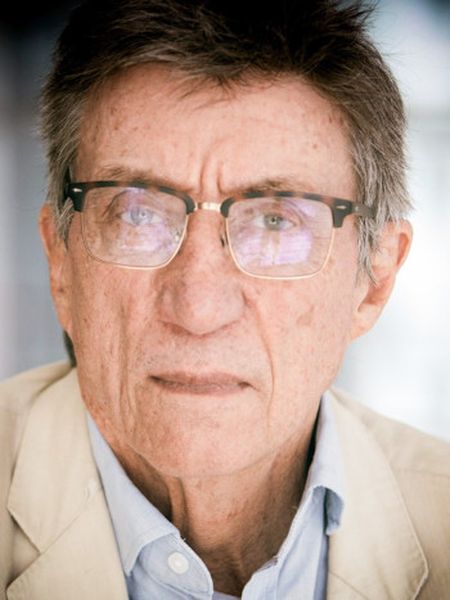
 Economist Iraj Abedian has lashed out at the South African government for not taking a stronger stance on Iran. (Photo: Felix Dlangamandla)
 The crisis in Iran must be seen not as a geopolitical risk, but as a humanitarian crisis, says Iran-born South African economist Iraj Abedian.
It is “the crisis of a nation oppressed, suppressed, and mutilated by its own governing regime for 47 years,” Abedian told the Cape Town Press Club on Friday, 13 March.
Abedian said that since the outbreak of the war, two polar views had been presented in limited public discussion in South Africa. The first view was essentially external, “driven in large part by the Iranian regime itself and its sympathisers — namely that the attack on Iran was unprovoked, illegal and a pure violation of international norms by the United States and Israel.”
The second view was primarily internal — put forward by 80% to 90% of the Iranian population, he said — that the destruction taking place was the result of the Iranian ruling regime’s attempts since 1979 to establish an Islamic Republic at all costs.
/file/attachments/orphans/Panel-2-09_523959_307647.jpg "Dr Iraj Abedian speaks during The Gathering 2024 Election Edition. (Photo: Shelley Christians)")
Abedian said in trying to understand the current crisis, one should ring-fence three “elephants in the room”: US President Donald Trump; Israeli Prime Minister Benjamin Netanyahu; and “the legacy of contemporary American attempts at regime change – namely, Iraq, Libya, Afghanistan – none turned out as planned”.
He noted that Trump was a controversial figure and that “The question of Iran’s socio- political malaise is becoming intertwined with his personality, but that should not distract us from the humanitarian crisis facing 90 million people…”
He said that President Jimmy Carter, supported by the UK, France and Germany, had in 1979 helped to install the exiled Shia leader Ayatollah Ruhollah Khomeini to replace Shah Mohammad Pahlavi as Iran’s leader, and that all US presidents had since stood by the Iranian regime against the people of Iran.
“President Trump has turned out to be different, aligning himself with the people against the tyranny of a fully armed and murderous state. I am also under no illusion that in aligning himself with the people of Iran, he may well have his own self-interest at heart too,” Abedian said.
/file/attachments/orphans/GettyImages-2253961477_810959.jpg "Israeli Prime Minister Benjamin Netanyahu speaks to the media on 29 December 2025 as US President Donald Trump welcomes him to his Mar-a-Lago club in Palm Beach, Florida. (Photo: Joe Raedle / Getty Images)")
He was particularly critical of former US President Barack Obama for doing the deal with Iran in 2016, whereby Tehran agreed not to develop nuclear weapons in exchange for the lifting of Western sanctions against Iran. He said Obama had also appeased Iran by providing it “with a plane load of cash”.
He said Iran had used the proceeds from lifted sanctions to finance its regional proxies and to fast-track the development of missiles.
CNN reported in 2016 that US officials had confirmed that the Obama administration had secretly arranged a plane delivery of $400-million worth of cash on the same day Iran released four American prisoners and formally implemented the nuclear deal.
The report said Obama had announced the transfer in January 2016, which was the first instalment of a $1.7-billion settlement resolving claims at an international tribunal at The Hague over a failed arms deal during the time of the Shah.
The report added that the $400-million had been paid in euros, Swiss francs and other currencies because US sanctions against Iran prevented it from being paid in dollars.
Abedian said Israel’s actions under Netanyahu’s leadership were understandably problematic for many. Netanyahu had a 30-year mission to confront Iran, “which he sees as the head of a hostile and determined octopus with tentacles in Iraq, Syria, Lebanon, Gaza and Yemen.”
But, he added, Israel’s “existential confrontation” with Iran “should not distract from the Iranian population’s quest for freedom and social liberties.”
Abedian said the third elephant in the room – America’s failed attempts at regime change in Iraq, Libya and Afghanistan – was “understandably” raised whenever the Iran conundrum was discussed. Yet it was tragic how many analysts quickly concluded, therefore, that it was best to sit aside “and in effect side with the Iranian regime”.
He noted there had been several protests over the years, all of them brutally suppressed. The latest erupted in December 2025 when the collapse of the currency precipitated a mass uprising, initially by the business community protesting against economic hardships.
This protest rapidly grew into a nationwide revolution of millions across the country.
“The regime's response: in under 48 hours, an estimated 32,000 killed — shot in the head.”
Trump has claimed 32,000 people were killed in the protests. The Iranian government put the death toll at just over 3,000, while human rights groups have estimated that at least 6,500 people were killed.
Amnesty International has reported that on 21 January, Iran’s Supreme Council of National Security issued a statement that 3,117 people had been killed during the uprising.
“However, on 16 January 2026, the UN Special Rapporteur on Iran, Mai Sato, said in a media interview that at least 5,000 people had been killed, noting that according to information she received from medical sources, the death toll might be as high as 20,000,” Amnesty said. It added that because of the internet shutdown and reprisals against families who spoke out “the true number of those killed is likely higher”.
The Guardian has quoted a network of Iranian medical professionals who treated the wounded in the January protests as estimating that the death toll could have exceeded 30,000. The professionals also told the newspaper that as the protests grew, injuries became more severe, with many “close-range gunshots and severe stab wounds, typically to the chest, eyes and genitals. Many were fatal.”
The upshot of this response was that the regime lost its legitimacy and its credibility. It then faced three enemies: not only Israel and the US, but the majority of its own 92 million people.
Ground forces
Many analysts have concluded, though, that no regime change has ever been possible anywhere without putting boots on the ground, and yet Trump has vowed that he would not send ground forces to Iran. How then could the Iranian regime be replaced – and furthermore, with a humane, secular, democratic government?
Abedian said there were two important differences between Iran on the one hand and Iraq, Libya and Afghanistan on the other. One was technology. The other was that the majority of the Iranian population was ready to kill or die to get rid of the regime.
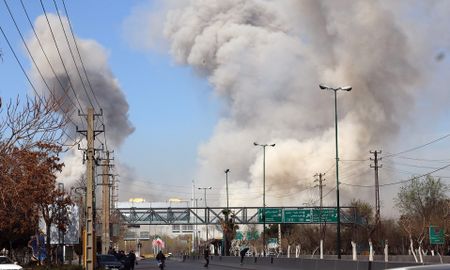
/file/attachments/orphans/GettyImages-2265402840_509939.jpg "Smoke billows after overnight airstrikes on oil depots in Tehran, Iran, on 8 March 2026. (Photo: Majid Saeedi / Getty Images)")
On the military technology side, Abedian said the US and Israel had largely destroyed the Iranian regime, and had “pretty much wiped out” the all-powerful Iranian Revolutionary Guards Corps (IRGC), a force of about 400,000.
But, he said, even more lethal for the Iranian people was the Basij, a voluntary militia of some 200,000 within the IRGC, which he likened to the Gestapo because he said it operated within communities, hunting down and killing regime opponents.
Abedian said the Israelis had begun hunting down the Basij with mini-drones guided by AI and US satellites, and within four to six weeks, he expected they would eliminate half of the Basij and thereby break its backbone.
He added that he believed the US would send special forces to Iran to seize and ship out the 400-plus kilograms of enriched uranium the regime had processed, which posed a threat to Israel and the region.
The US has announced the dispatch of 2,500 Marines to the Middle East, though it has not revealed their mission.
Abedian was asked if he saw Reza Pahlavi, the exiled son of the last Shah of Iran, Mohammed Pahlavi, as a possible leader of a new government. He said Reza Pahlavi had risen suddenly to prominence after the brutal suppression of the 8 and 9 January 2026 protests, “simply because symbols are important in religion and in politics”.
/file/attachments/orphans/12828909_688266.jpg "Prince Reza Pahlavi, son of the late Shah of Iran, Mohammad-Reza Pahlavi, addresses reporters at a press conference hosted by the Geneva Association of United Nations Correspondents at the European headquarters of the United Nations in Geneva, Switzerland, on 17 February 2025. (Photo: EPA / Salvatore Di Nolfi)")
“If you want to show a red flag to a mullah, mention the name of the Shah,” he noted. But Pahlavi also had a power base simply because there was no other known leader among opposition parties, Abedian said.
He noted, though, that Pahlavi had made it clear that he didn’t want to be a shah or president, but to be the leader coordinating the transition to a democratic, secular order.
He said that the opposition had suddenly got its act together because it had decided the present regime was on its way out, and had formed an association, which included Pahlavi as well as communists, socialists and populists, which would meet in London this week.
SA’s ‘silence’
The title of Abedian’s talk was “Why won’t we condemn the Iranian regime’s brutality? Moral ambivalence or selective silence?” He was critical of all sectors of South African society for failing to condemn the Iranian regime.
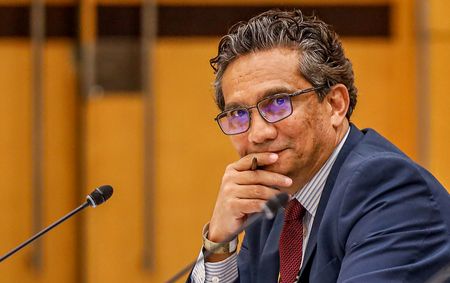
“Where is South Africa’s voice — not on Trump, not on Netanyahu — but on 32,000 people shot in the head in 48 hours?” he asked, referring to the government’s suppression of protests in January. “On families charged for the bullets used to kill their children? On over 220,000 detainees and missing people since late January 2026? On Nobel laureates, writers and social activists in prison in their tens of thousands? On women beaten, or blinded, for showing their hair? On a nation denied the right to live?”
He said South Africa had one of the most progressive constitutions on the planet – incorporating explicit commitment to human rights; the right to life, equality and human dignity; freedom of assembly, association, belief, opinion and expression.
“Yet almost none of our social stakeholders have chosen to engage seriously with the blatant abuses of the Iranian regime and its documented transgressions – not government, not social activists, not any of the think tanks, and not even the media.
“More troublingly, our government has not merely remained silent – it has in some cases actively, and in others passively, aligned itself with the very regime I have described.” DM
Disclosure: Iraj Abedian sits on the board of Daily Maverick's non-profit company, Inkululeko
Comments
Scroll down to load comments...