




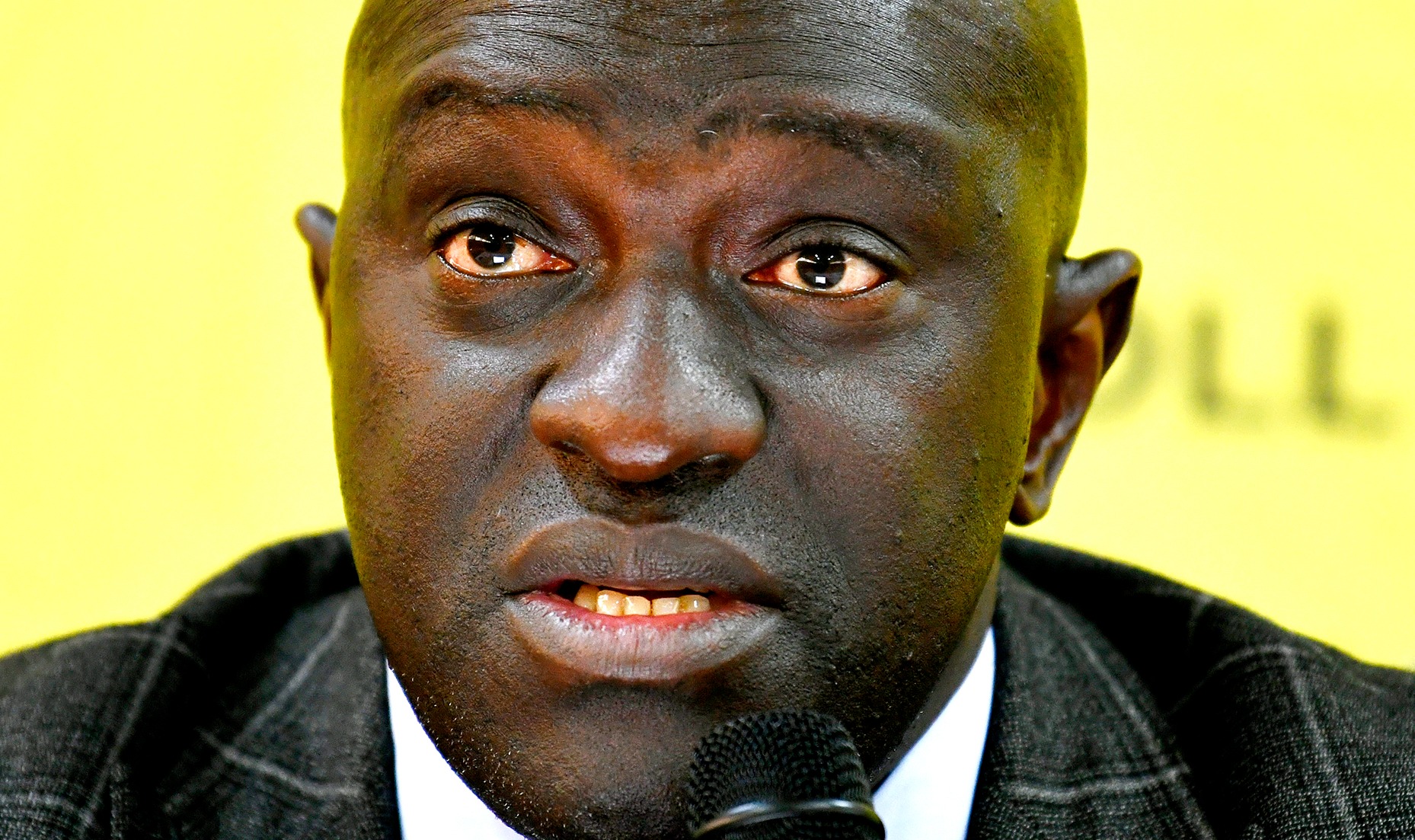
 MEC for Education in the Eastern Cape Fundile Gade. (Photo: Gallo Images / Die Burger / Lulama Zenzile)
 The Eastern Cape’s National Senior Certificate (NSC) results have slipped, although not drastically, for the first time in four years, prompting education experts to urge a closer examination of the province’s schooling pipeline amid signs of deep-rooted language, psychosocial and systemic pressures affecting learner performance.
The provincial pass rate for the Class of 2025 edged down from 84.9% in 2024 to 84.17% in 2025 – a modest decline of 0.7 percentage points – interrupting a remarkable post-pandemic recovery that had lifted the province from 73% in 2021 to above 84% last year.
Nationally, the pass rate was 88% with the Eastern Cape pass rate the lowest.
The department had set an ambitious target of an 87% pass rate for 2025, which it ultimately fell short of achieving. Bachelor’s pass rates also declined.
“The decline in the Bachelor’s passes I don’t think is insignificant,” said Professor Shervani Pillay, deputy dean of education at Nelson Mandela University. “Even though the overall pass rate does differ from 2024, the number of Bachelor’s has definitely come down, and I think quite significantly.”
For Pillay, the issue was not merely about the headline percentages, but the underlying signals.
“This should give us some pause about how we need to go forward,” she said. “A lot of effort has been put into supporting students and supporting teachers. With all that support, there should actually have been an increase in the pass rate. The fact that there wasn’t is very telling; it indicates that we need to sit up and take note of why this is happening.”
/file/attachments/orphans/Performance_839787.jpg "(Graphic: Google Gemini)")
Language remains a foundational barrier
Pillay said the ongoing debate about which language schools should teach in is still holding back performance.
“One of the biggest problems is the language issue – the language of teaching and learning – which significantly impacts on students’ ability to understand at a deep conceptual level,” she said.
“The matric exam is not just about information; it’s about a deeper understanding. For that deeper understanding, you need to be able to conceptualise in the language you are strong in, which is your mother tongue.
“If that mother [tongue] language is not developed sufficiently from the foundation phase, and developed consistently through to matric, that becomes a major barrier.”
Pillay warned against South Africa’s persistent focus on Grade 12 as the moment of crisis intervention. She emphasised that matric was the culmination of a development journey.
She said: “Matric is actually just the end, when you assess the quality of your entire journey. We need to do more reflection on what is happening in the foundation and intermediate phases as well.”
It is for this reason that Pillay suggests that the sector should consider introducing standardised, or as she puts it, “high-stakes” exams earlier in the schooling cycle.
Pillay recommends these kinds of exams at the intermediate phase, “so that by the time students go into the senior phase, we already know what problems we need to address”.
Meanwhile, Eastern Cape Education MEC Fundile Gade raised the alarm at a press conference in East London on Tuesday over what he called a growing gap between basic and higher education in South Africa.
“The country keeps demanding results in basic education, but no one is asking about higher education. That is a problem,” Gade said. “[Between 2021 and 2025], 392,527 learners have been phased out by the basic education system. Where are these children? We need higher education institutions to answer this question.”
Gade warned that universities had to innovate to keep pace with the number of learners finishing school.
He said the mismatch between school output and tertiary capacity could become a serious crisis.
“We could announce the 2025 results while children from 2024 are still not absorbed anywhere. We need to look at how many learners from the past two years have been enrolled in universities and TVET colleges, and compare that with the throughput from basic education.”
Gade added: “They need to assess whether they can handle the pace at which basic education produces learners, and how they can respond to this challenge.”
The Bachelor’s pass bottleneck
Despite popular assumptions, a Bachelor’s pass alone does not guarantee placement at university.
“A Bachelor’s pass does not guarantee access into university,” Pillay said. “It is a good indicator of whether you qualify, but it doesn’t guarantee it.”
/file/attachments/orphans/Qualification_397343.jpg "(Graphic: Google Gemini)")
The reality of tertiary admission was often misunderstood.
When learners were in Grade 11 and matric, they should first identify what they wanted to do, then check the prerequisites and the points they needed to get into university, and then aim for that, she said.
Pillay emphasised that conditional acceptance could create false expectations.
“They might have been conditionally accepted, but it doesn’t mean they are automatically accepted because the university only has so many places. The number of applicants by far exceeds the number of places we have, and we tend to take the top students in,” Pillay explained.
/file/attachments/orphans/Distinctions_750460.jpg "(Graphic: Google Gemini)")
For universities, academic readiness is not only about knowledge, but also the level and mode of learning.
“The modus operandi at university is very different,” she said. “There is very little spoon-feeding. You have to think at a different level – more critical thinking, more independent thinking.
“Otherwise, you are going to be at a disadvantage. It’s really for the students’ own good,” Pillay said.
Gade praised teachers for driving the turnaround. He said teachers in the province “are capable of producing something out of nothing”.
Eastern Cape Education Department head Sharon Maasdorp said, “We have educators who have resilience. Educators who will go beyond the call of duty for our learners. Our educators will at times sleep at the school to make sure they give our learners the necessary support.”
Some, she said, did so despite personal risk.
“Some of our educators during this year were subjected to robberies, but they have remained faithful to our learners,” she said. DM