




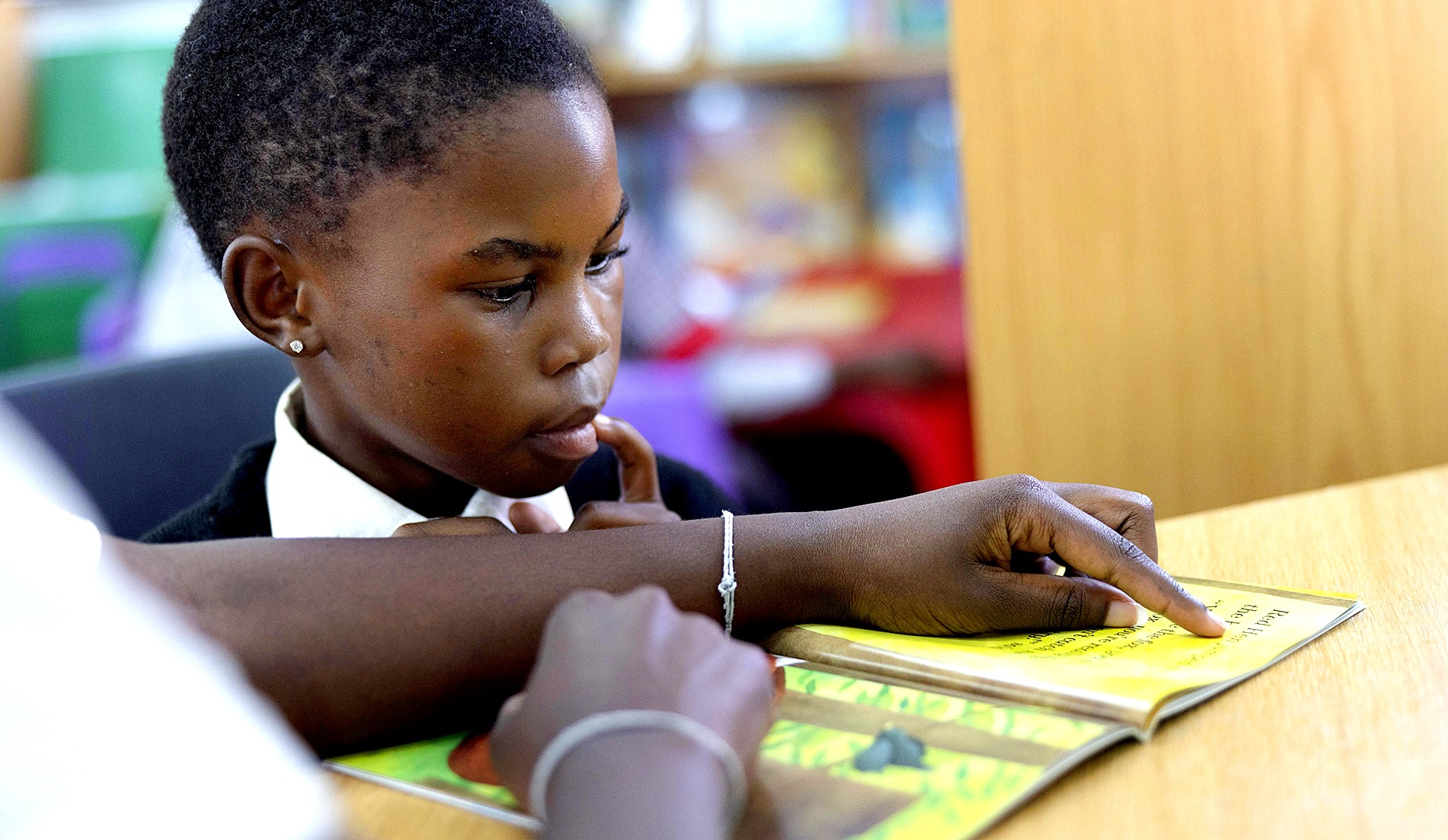
 The nonprofit help2read focuses on literacy development and community strengthening by involving young adults in tutor programmes. (Photo: Supplied / help2read)
Imagine sitting at a scuffed wooden desk, staring down at an open textbook. The teacher is speaking, pointing to the page, expecting you to follow along. But to you, the letters are not words. They are just a tangled sea of black ink, meaningless squiggles, sharp angles and disconnected circles that look more like broken twigs than a story. So, you sit there in silence, pretending to read, hoping the teacher doesn’t call your name.
For hundreds of thousands of South African children who have spent three years in a classroom, this isn’t a bad dream – it’s their everyday reality.
/file/attachments/orphans/ONlinereadingformeaning1_322169.jpg "Graphic: Jocelyn Adamson")
Across the country, only about 30% of pupils in grades 1 to 3 are performing at grade level in their home language. The depths of this crisis are staggering: across the system, 15% of Grade 3s scored zero on reading assessments. This means they are unable to decode even a single word by the end of their third year of formal schooling. In some languages, this figure skyrockets, with up to 25% of Grade 3 pupils unable to read a single word.
/file/attachments/orphans/Figure3_PercentageofGrade3learnersreachingtheHLbenchmarkbylanguage_438144.jpg "The percentage of Grade 3s who are meeting the benchmark by language. In this grade, the largest proportion of English HL pupils (48%) meet the benchmark. Positively, the next-best-performing languages are Tshivenda (33%) and isiZulu (31%).")
The 2030 Reading Panel’s 2026 Background Report, released on 24 February, reveals a system in crisis but not without hope. Drawing on nationally representative data on foundational reading skills across all South African languages, the report analyses data from the Department of Basic Education’s newly released Funda Uphumelele National Survey (FUNS). For the first time, this survey has measured reading outcomes in grades 1 to 4 in all home languages against national benchmarks.
/file/attachments/orphans/Figure1_Percentageoflearnersreachinggrade-levelHLbenchmarkspergrade_104138.jpg "In grades 1 to 3, only 30% of pupils are meeting grade-level benchmarks in their home language.")
While 48% of Grade 3s tested in English reach the required reading benchmark, the numbers collapse for African languages. A child writing in English is more than four times more likely to meet the standard than a child learning in Sepedi, where a dismal 11% reach the benchmark. Similarly, only 14% of isiNdebele pupils and 16% of Xitsonga pupils hit their required targets by the end of Grade 3.
“These are not abstract statistics,” said Sipumelele Lucwaba, who leads the panel’s secretariat. “They represent millions of children in our system without the ability to read in any language. As a country, we have analysed this crisis from every angle, but diagnosis is no longer enough – the point now is to change it. Without urgent intervention, these children have no pathway to educational success.”
/file/attachments/orphans/SipumeleleLucwaba2_913234.jpg "Sipumelele Lucwaba, who leads the panel’s secretariat, said that reading for meaning by the age of 10 is not one priority among many. It is the foundation on which every other educational outcome rests. (Photo: Supplied / Palesa Mokitle)")
Provinces take the wheel
Provincial education departments are refusing to wait for a national rescue, rolling up their sleeves to tackle the reading crisis head-on. The shift in momentum is undeniable: in 2022, not a single province was implementing a large-scale response to foundation phase reading or maths. In 2026, six of South Africa’s nine provinces are rolling out evidence-based interventions.
/file/attachments/orphans/onlinereadinglikelihood_946431.jpg "Graphic: Jocelyn Adamson")
The Eastern Cape, Free State, Gauteng and Mpumalanga are anchoring their efforts in proven strategies:
- Structured lesson plans;
- Sustained teacher training; and
- Delivering a defined minimum package of high-quality reading materials to classrooms.
In the Eastern Cape, the R89-million “Mabafunde Bonke” programme targets 1,652 poorer schools across four rural districts. Focusing on grades R to 3, it provides rigorous termly training and comprehensive isiXhosa and Sesotho materials at a highly cost-effective R465 per pupil.
The Free State’s R82.3-million “Operation Tharollo” will reach 433 schools. Targeting Grade R to 3 pupils speaking Sesotho and Afrikaans, it arms teachers with 32 intensive training days over two years.
Gauteng is aggressively targeting Grade 3 across 588 schools, reaching more than 88,000 pupils with three years of home language training, followed by mathematics and English.
Mpumalanga strikes at the root of the crisis with its R100-million Grade R Capacity Building Programme, equipping 965 quintile 1-3 schools to build school readiness before Grade 1.
To ensure these new millions are well spent, these provinces are looking to the Western Cape which began its large-scale reform in 2021. The province successfully added two additional hours per week to the foundation phase timetable for home language instruction, one hour for mathematics, and introduced standardised baseline assessments within the first 10 days of each school year.
The 2030 reality check
This brings us to the ultimate question: can South Africa achieve the presidential injunction of ensuring all 10-year-olds can read for meaning by 2030?
/file/attachments/orphans/ONlinereadingformeaning2_120098.jpg "Graphic: Jocelyn Adamson")
“We certainly are not achieving the goal of every child reading for meaning by the age of 10, and that is shown in the DBE’s two assessments, South African Systemic Evaluation and FUNS,” said Professor Mary Metcalfe, who is on the panel.
The report candidly admits that these goals were overly optimistic from the outset, since education systems simply do not shift that quickly. To put it into perspective, the famous education turnaround in Sobral, Brazil, took more than 20 years to achieve near-universal reading comprehension.
Metcalfe said that achieving the goal requires provincially based plans to address reading, because the resources to improve reading are located at provincial level.
“If you look at the factors that restrict the ability of children to read, it has to do with very large class sizes, the lack of availability of reading material, as well as the lack of real support to teachers,” she said.
For these hard-won provincial victories to become a permanent national reality, the 2030 Reading Panel’s core recommendation remains crystal clear:
- Universal standardised reading assessments to be implemented at primary level to track progress and enable early intervention;
- Ring-fenced funding for reading interventions to prevent dilution with broader education spending;
- Minimum reading resources including workbooks, readers and teacher guides guaranteed in every foundation phase classroom; and
- Improving teacher preparation and deployment by strengthening pre-service and in-service training, aligning specialisation, language and placement with classroom needs. DM
Comments
Scroll down to load comments...