




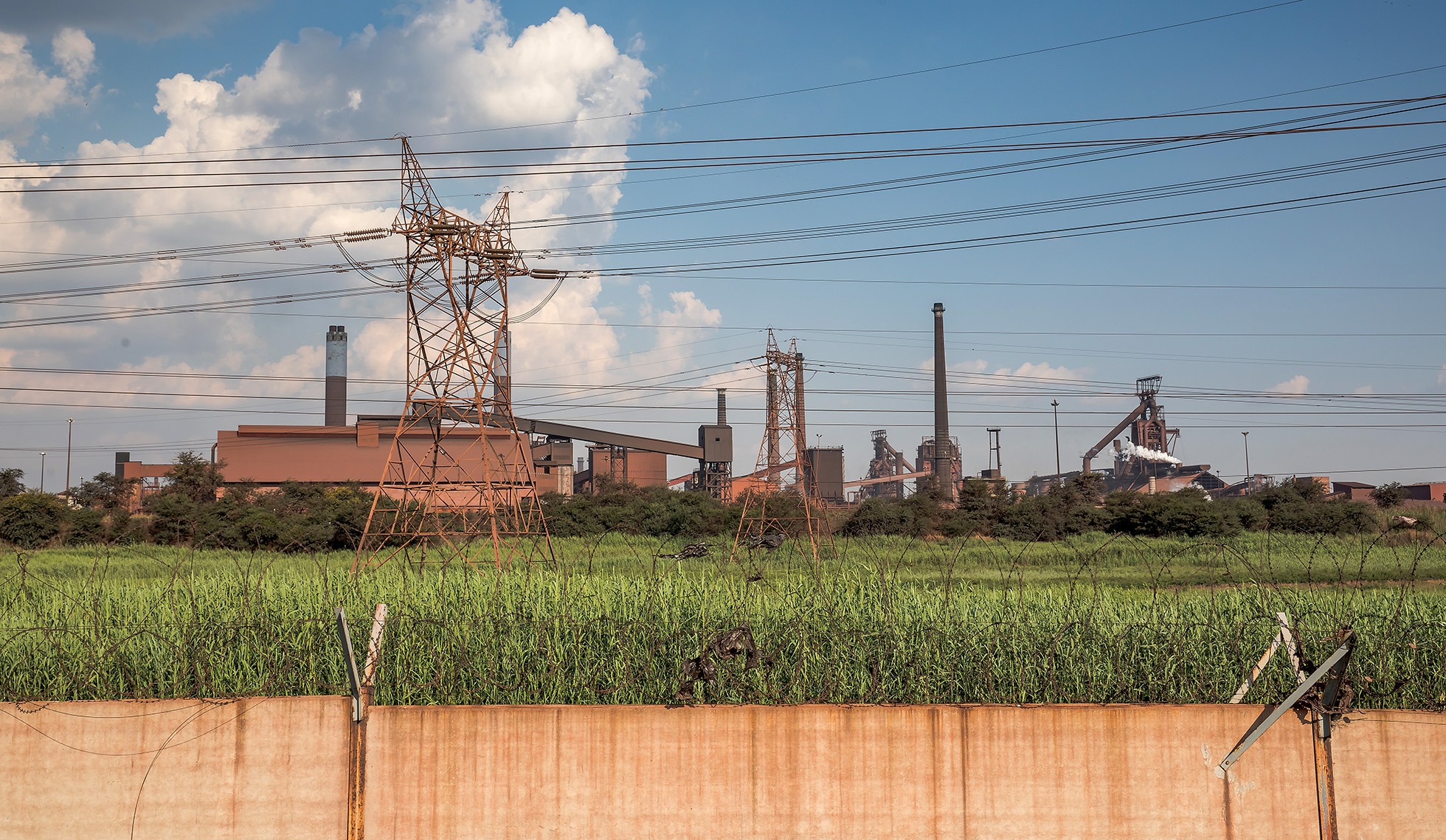
 ArcelorMittal in Vanderbijlpark. (Photo: Nathalie Bertrams)
 Sebokeng, Gauteng – Cold November day and Toto Street is going to mud. A Seventh Day Baptist Church at the east end of the one kilometre street, a T-junction at the west. Township houses, some with brick walls, others with wire fences. General dealer at an intersection where rocks threaten tyres and rain dilutes sewage. A block north, Kgokare Secondary. The school’s concrete slat fence is topped with broken razor wire.
Maselo Lemphane’s backyard house on Toto Street is dark, electricity being expensive. Pot of pap on an old stove. Her baby daughter stares from a bedroom doorway.
“Can’t say it was a nice job. You’re working with water eight to five,” Maselo, wrapped in a red bathrobe, says about her former job as a valet at a panelbeater.
“Doesn’t matter which season it is, you see the weather conditions, it’s raining. But if the clients want the car, they’re like ‘Gou, gou. Kom, kom! Roer julle gat!’ You have to work no matter what. You have to.”
The panelbeater went into liquidation in 2024.
“Everything changed,” Maselo says of her retrenchment. “The food, the insurance. My policies lapsed. Then my mother died. After, we even struggled to give her a simple, dignified funeral. Like, yoh, it strained a lot. Everything changed. Everything.”
/file/attachments/orphans/SA_NEP_0315_397943.jpg "Maselo Lemphane was retrenched in 2024 and cares for her two children and three siblings. (Photo: Nathalie Bertrams)")
Her voice softens a tone or two as she says “everything” one more time.
Almost 30 years old, single and searching in vain for a job, she’s raising two kids and looking after her three siblings. About the social grant lifeline, Maselo says “it is there to help and it does assist. It can only afford a portion of food. That cannot even take up to the whole month till we wait for another payment.”
Asked about life on Toto, she looks to the left as if she was standing in the middle of the street. “Yoh, there’s a lot of social problems here. There is a lot. People are struggling, especially here in Sebokeng. There’s a lot of struggles behind all, most of the closed doors. Most of them.”
/file/attachments/orphans/SA_NEP_0278_339571.jpg "Toto Street in Sebokeng turns into mud when it rains. (Photo: Nathalie Bertrams)")
Toto isn’t just some heartache road in Zone 7. It is Sebokeng, one of the main townships in South Africa’s rusting industrial heartland, the Vaal Triangle. All that Sebokeng is, Toto embodies.
“There’s always retrenchments in the firms, in the companies,” Maselo says of the Vaal’s future. “So, we’re going to struggle more. That’s what I see. More. This unemployment thing that we’re crying about now, it is definitely going to get worse.”
/file/attachments/orphans/VAAL9924_542817.jpg "Houses on Toto Street in Sebokeng, a large township near Vereeniging. (Photo: Nathalie Bertrams)")
The official unemployment rate for the Emfuleni Municipality – which has a population close to a million spread across the industrial cities of Vereeniging and Vanderbijlpark and the large townships of Sebokeng, Evaton, Boipatong, Bophelong, Tshepiso and Sharpeville – is 56.2%. For young people it’s more than 60%.
And it’s not like life is easy for those with work. Vincent Ndemande, born in 1981, also lives on Toto Street. A black-and-white photo of his father (Vincent credits a lot to his father’s stern upbringing) stares down from his living room wall. Vincent’s position as a chef isn’t permanent and his employer has just lost a big client.
“We are asking ourselves that when we're waking up in the morning, going to work, what will happen?” he says.
/file/attachments/orphans/VAAL9930_617062.jpg "Vincent Ndemande, who lives on Toto Street, works as a chef, but the job is precarious – his employer recently lost a major client. (Photo: Nathalie Bertrams)")
His posture shifts when he says: “I want to tell you straight-up. You see all of this... this is torment, guys. I wake up each and every morning. I don’t want to look like someone who’s just going to work to help others to work and end up with nothing. There’s never been enough.
“But there’s enough in our government. They told themselves there’s never been enough in their pockets.”
Vereeniging, established in 1892, sits 11.5km to the southeast of Toto. The city is on the Gauteng bank of Vaal River. The Lethabo coal-fired power station dominates the skyline from the Free State side. ArcelorMittal’s Vereeniging steelworks were set to close at the end of December 2025 and 3,500 people faced losing their jobs.
Delta Marine, a couple of blocks from Vereeniging’s crumbling main drag, is as dark as Maselo’s small house. Pleasure boats, the kind used to fish the Vaal River, rise up from the showroom floor’s deep shadows. A generator throbs in the workshop where boats are built and repaired. The municipality decided to end the dispute over meter readings and unilaterally cut the power.
/file/attachments/orphans/NEP_1574_369556.jpg "Sonja Theron, co-owner of Delta Marine in Vereeniging, has panic attacks over the state of her business and prays to God ‘for an outcome’. (Photo: Nathalie Bertrams)")
Sonja Theron (68), the co-owner of Delta Marine, has spiky black hair, nail art and a tattoo around her wrist. She stands behind the counter with a pile of paperwork and her despair over the water and power problems radiates.
“I’ve come to a point,” she says, “where I want to say to the municipality, you know what, stick your stuff up your, wherever, in your ear. I feel they are still stealing... I just think that the corruption is sky, sky, sky-high.”
The company is a family affair. Sonja and her husband bought Delta Marine in 1996 and orders flowed. Their son designs the boats. But business in 2025 has been the worst in 28 years and Sonja’s depression and panic attacks won’t go away.
“We are,” she says, “literally living from hand to mouth.”
The downturn started in the 2000s when the allure of boating on the Vaal diminished because of sewage pouring into the river. Apartheid-era infrastructure run down in seemingly nihilistic greed. Things went to hell the city over after Covid.
Delta Marine used to employ 25 people before the pandemic, today 15 and tomorrow is uncertain.
“If we make it, I don’t know,” Sonja says as two customers listen in to the conversation. “I hope so because we’ve sold our caravan, we’ve done this, we’ve done that to try and just keep going for our son’s sake. But we are going to come to a point where we haven’t got much more to sell.”
And what of the Vaal Triangle’s future?
“I say my knees have got patches on already from praying and asking God, please just give us an outcome. Give us an outcome on this whole situation that we are in. It’s gone down to ground level.”
It was never supposed to make money
To get to the Vaal Teknorama Museum in Vereeniging, you turn off the main road, past an open piece of land piled with building rubble and right into the museum’s long, tree-lined driveway. Some of the guardhouse’s windows are papered over.
Once through the gate, there’s ample parking, take your pick. A couple of old artillery pieces rust on the huge front lawn, along with an ancient tank and a steam engine from 1938. At the museum entrance there’s an ox wagon and a plaque informing that the last apartheid president, FW de Klerk, inaugurated the Teknorama in 1990 as a celebration of the Vaal’s industrialisation.
/file/attachments/orphans/SA_NEP_9462_403524.jpg "The Teknorama, a museum to showcase South Africa's industrialistion and opened by FW de Klerk in 1990, is dilapidated. (Photo: Nathalie Bertrams)")
Inside, the museum is dark and not much is going on. The staff won’t talk on record but do allow us access to the archive.
Chaos, shambles. A book of original photos from the South Africa War rests haphazardly on a shelf. Random reports on pre-1994 government events. There doesn’t seem to be much in the way of chronological ordering. Somewhere along the way someone took some kind of a stab at documenting the liberation Struggle in the region. The card catalogue itself belongs in a display case.
But the Teknorama isn’t just yet another government building neglected to long ruin. The wave of heavy industrialisation that really kicked off from World War 2 to the 1980s, what the museum is supposed to display, is exactly what makes the Vaal different from all the other areas in South Africa where local government has collapsed.
Since the early 1900s the Vaal has been an engine of wealth and job creation. The place where things are manufactured and minerals beneficiated. What happens in the Vaal matters for the entire country. Where the Vaal goes, the country follows.
/file/attachments/orphans/SA_NEP_9414_921350.jpg "Old photos in the chaotic archive of the Teknorama Museum document South Africa’s once-thriving steelworks. (Photo: Nathalie Bertrams)")
Much of the industrialisation of the Vaal Triangle comes down to one man, Hendrik van der Bijl. In 1922, and as the founding chairperson, Van der Bijl was pivotal to the formation of Escom, which had the dual mandate of providing cheap electricity to industry and breaking the stranglehold of the Victoria Falls Power Company, a subsidiary of a Cecil John Rhodes company. The Victoria Falls Power Company was expropriated with compensation in 1948.
Van der Bijl also founded the state-owned South African Iron and Steel Industrial Corporation (Iscor) in 1925 and a ferro-alloys company, the African Metals Corporation, in 1937. He was heavily involved in the 1940 creation of the Industrial Development Corporation.
What Van der Bijl laid the foundations for was a state-owned industrial nexus in the Vaal Triangle that wasn’t driven towards profit but rather the distinct political goals of uplifting Afrikaners and solidifying Christian nationalism. The steel, mines, power and petrochemicals were strategic enterprises rather than companies obsessed with the bottom line.
The original and partial privatisation of Iscor came about in 1989, four years after De Klerk’s government defaulted on sovereign debt. Iscor’s captive iron mines were split from the steel side in 2001 and became Kumba Resources, which Anglo American now owns. Iscor was sold to the global steelmaking giant ArcelorMittal in 2004.
Kabelo Ramkgathadi has been in the metals sector for almost 25 years. He started as a general worker and then became a drill operator. After 10 years as a shop steward at MacSteel (last year, the company issued a Section 189 notice of retrenchments) he moved into local organising and eventually became the Numsa regional secretary for Sedibeng.
“When I joined the industry in 2001,” Kabelo says from across his desk at Numsa’s Vanderbijlpark office, “I must say now the rate of unemployment was very low. And it was not difficult for any individual to get a job at that time. You would resign or be dismissed from one company and get the job next door. At that time, we also, as workers, had to make a choice: which company do we prefer?”
The choice is no longer there and Kabelo is busy trying to deal with the ongoing wreckage. Above and beyond the Vereeniging steelworks’s impending closure, ArcelorMittal has given notice of retrenchments at its Vanderbijlpark steel mill: coking ovens are shuttering and many formerly full-time workers are on shifts.
Kabelo points out that Numsa’s membership across companies and industries in the Vaal has, since Covid, dropped from 25,000 to about 17,500.
“ArcelorMittal now, their main objective is to maximise profit,” Kabelo says. “So they have moved away from that objective of Iscor. Because Iscor, their sole intention was not necessarily to maximise profit, but to ensure that there is stability... ArcelorMittal does not care about what the community is going to benefit, the economy of the Vaal.”
/file/attachments/orphans/NEP_0920_282927.jpg "Kabelo Ramkgathadi has been in the metals sector for almost 25 years. He moved into local organising and eventually became the Numsa regional secretary for Sedibeng. (Photo: Nathalie Bertrams)")
ArcelorMittal strenuously refused Daily Maverick’s request for an interview.
Solidarity’s office is 9km down the road from the Vanderbijlpark steel mill. Both Willie Venter, the deputy general secretary of the union, and Johan Venter, a network organiser, came up through the ranks, working their way across the steel industry and into labour relations. Johan has lived in the Vaal his whole life and is just about to retire.
Solidarity used to have 67,000 members in the Vaal Triangle, back when the state owned the mills. Today, membership is down to 6,000, with 1,500 of those at the Vanderbijlpark mill. Johan started working in the industry in 1981 and distinctly remembers the mid-1990s and 2000s.
“Ja, the infrastructure was well, water supply was well,” he says. “ArcelorMittal employed much more people than they employ now. And then afterwards it just tumbled. You can see how the town looks now. I mean, you came through it. You can see how the roads look and everything.”
Willie points out that the long steel that has come out of ArcelorMittal’s Newcastle and Vereeniging plants – the high-quality kind necessary for railways and the automotive industry – is a strategic commodity, a position that Kabelo and Johan share.
“It makes sense,” Willie says, “that in years gone by, places or companies like Iscor had to produce without necessarily having the expectation of making huge profits.”
When Numsa and Solidarity are in alignment, you know something is up. For Numsa, the only way to save the long steel industry is for the government to nationalise it. For Solidarity, the industry has to be taken out of the hands of a multinational interested only in profit and taken over by patriotic South Africans.
Both unions warn of horrific downstream implications, a widening ripple of unemployment and loss of skills. They are equally frustrated with the government.
“Because, while they are wasting time,” Kabelo says of the government, “the moment they wake up there will be no ArcelorMittal. Because the speed that ArcelorMittal is moving is actually more than 100km/h, while the government is moving with 10km/h.”
For Johan, the government is “talk and talk and talk and in the end nothing happens”, while Willie stresses: “Don’t forget about the urgency around these matters. I think that’s also one thing that government forgets about. We don’t have decades to find solutions.”
Non-unionised workers also don’t have time for the government to get itself in order.
The Sebokeng train station was looted to nothing during Covid. Even though the line still doesn’t run and workers remain without affordable transport, the station’s been revamped. Weeds push up from the paving stones.
Thirty-seven-year-old Bongani Mokoena* worked at a garage for 11 years before joining a steel manufacturer as a general worker. Later he was able to, as he puts it, set the broom aside and become a specialist machine operator earning R51.80 an hour. With overtime that’s R8,000 to R10,000 a month. Unfortunately, his relationship with the company has ended.
“I’ve done some asking around,” he says, “with a couple of friends from around the metal industry and they’re telling me that, dude, we don’t get jobs any more.”
/file/attachments/orphans/SA_NEP_0349_998597.jpg "Toto Street in Sebokeng is unpaved, like most in the township. (Photo: Nathalie Bertrams)")
As for those recently matriculated, Bongani states that “it’s bad. You’d be very lucky if you get a spot in retail.”
Like the unionists over at Solidarity and Numsa, he has problems with the government’s behaviour.
“You find countries where you see that people are living on a template. That you go to school, you get a job, you earn a living so that you can pay Mr Who who sells bread and Mr Who can pay Miss Who who sells veggies. It goes around the community like this and everybody is safe. But here in South Africa we don’t have that. We are being ruled by corruption.”
After 1994 and on a wider level, the Vaal Triangle has experienced a massive clash of economic philosophies. Down at the foundation of the National Party’s industrialisation project was a form of economics now long forgotten: volk socialism.
The basic premise of the economic philosophy is that the state bends the entire economy to uplift the volk (i.e. Afrikaners) and doesn’t shy away from using protective tariffs, exploitation of non-volk labour and high levels of subsidisation to enable industry to meet the state’s totalitarian social goals. Volk socialism isn’t communism or capitalism, it’s a contra-revolution to both.
When De Klerk blessed the Teknorama, it was the successful implementation of volk socialism that was extolled.
Instead of using a largely state-owned or state-controlled industry to achieve the social end of uplifting the entire country, the ANC decided after liberation to privatise the industrial base. What used to exist in a highly protected and subsidised industrial ecosystem now had to be profitable in a competitive globalised marketplace. The government’s role was to provide good governance and basic infrastructure like electricity, roads, water and schools.
The ANC made a large bet: if the privatisation of heavy industry succeeded, downstream businesses would flourish and jobs would be created. The wager was lost and downtown Vereeniging knows it.
/file/attachments/orphans/SA_NEP_9914_558410.jpg "Union Street in Vereeniging. Potholes scar the road, dirt obscures what remains of the tarmac. Once-thriving shops now struggle to survive. (Photo: Nathalie Bertrams)")
Union Street
Faatema Patel, a pharmacist, used to work at the Sedibeng hospital 20 years ago and is now at Taxido Chemist on Union Street in Vereeniging. The street is severely potholed and dirt obscures the tarmac. Pavement stones missing en masse. The taxi rank is about a two-minute walk from Taxido and just beyond the Jika Ma Jika Sports Bar. Finalisation of the rank’s upgrade remains delayed.
Six weeks to go before the steel mill closes.
Over coffee in a nearby mall, Faatema explains that most of Taxido’s business is cash, it also has medical scheme clients and many are from ArcelorMittal and downstream businesses. Chronic illness is common among her clients.
“January is a big month for pharmacies because that’s when your medical (scheme savings) are all reinstated,” Faatema says. She’s worried that Taxido will take a hit in January 2026.
/file/attachments/orphans/NEP_0399_249043.jpg "Pharmacist Faatema Patel used to work at Sedibeng Hospital 20 years ago and is now at Taxido Chemist on Union Street in Vereeniging. (Photo: Nathalie Bertrams)")
Come the new year, Faatema foresees that many of the soon-to-be retrenched workers are “going to find themselves in the public health system, which really is struggling. I mean, we see it every day. We see patients from public health every day that come to us looking for medication that is just not available in the public health sector.”
The education system is also likely to suffer. The loss of income means that children will move from private and semi-private schools to overcrowded public schools where the possibility of falling through the system is very real.
“You already have children seeping through the cracks. That’s where your drugs come in,” Faatema points out.
From township to affluent suburb, Vaal residents complain about drugs – nyaope in particular – and how they are tearing the social fabric apart. Selina Marilitsi has lived in the same small house on Toto Street for her entire 44 years. She used to be a cleaner at the Samancor smelter north of Vereeniging.
The smelter provided manganese alloys for the steel industry but closed down in 2020 and Selina hasn’t had a job since. Grants and selling snacks like chips and disco pops somehow get her husband, ailing mother and children through the month.
When industry closes, working-class jobs go and don’t come back. This is not a world where cleaners are upskilled to coders. The fallout is intergenerational.
/file/attachments/orphans/SA_NEP_9168_372393.jpg "The entrance to Samancor, which closed in 2020. (Photo: Nathalie Bertrams)")
Selina predicts that life will be difficult for the retrenched mill workers. She says “the money you are going to get is not going to be enough. You can start a small business but it’s not going to be enough.”
Her greatest concern is her two boys, both at school.
“We don’t want drugs,” she says as the rain continues and damp seeps through. “Drugs are killing our kids. We want our kids to go to school and get education and work for their parents. We ask that this gets fixed.”
/file/attachments/orphans/VAAL9869_635735.jpg "On Toto Street, Selina Marilitsi has not had steady work since retrenchment in 2020, surviving on government grants and by selling snacks outside her home. (Photo: Nathalie Bertrams)")
Taxido Chemist has stopped selling over-the-counter codeine meds because of a constant stream of teenage boys wanting to buy, often with the excuse that their younger brother is ill.
“When socioeconomic circumstances degrade or worsen,” Faatema says, “it is one of the things that come out of that. You have a higher level of alcohol dependency coming out of it, drug dependency coming out of it.”
Vereeniging feels forgotten, the buildings shabby. Muhammed Desai* has a small fabric shop, another downstream business. He’s been open for 35 years.
“On a day like Friday, at 11 o’clock, we are standing and chatting,” he says. “It was never like that before. I had six staff, and (now) I have one. That one I can do without too because there (aren't) any customers. Lack of money coming to the workers has spiralled so badly that there just, frankly, isn’t money on the streets.”
Property owners along Union Street and across the CBD have been hurled into a trap worthy of the devil himself. Buildings were bought as long-term investments when the local economy thrived. The subsequent and intertwined curses of companies shutting down and municipal services evaporating resulted in a collapse in rents and property prices, leaving building owners no way to recoup their investments.
Muhammed says his landlord has “been nice to me and given me a reduction basically to keep my doors open”.
Sonja Theron and her husband are in the same predicament. Back when times were good, they bought a building, a block and a half east of Union Street, to house Delta Marine and earn an income from renting out the upper sections. Now, no one wants to buy the property, their asset has become retirement-destroying debt and renters aren’t ever going to come. Sonja lets her remaining workers stay in the building for free.
/file/attachments/orphans/NEP_1548_511660.jpg "Union Street in Vereeniging. Potholes scar the road, dirt obscures what remains of the tarmac. Once-thriving shops now struggle to survive. (Photo: Nathalie Bertrams)")
The issue of debt isn’t limited to business owners. It falls on the working class. Falls hard. Vincent Ndemande, the chef living on Toto Street, explains what’s happening to households as the Vaal’s economy shrinks:
“A lot of people now, they’re working days. Others, they’re working short shifts. You used to get the salary that will provide your family and pay some debts and whatever. And now, you can’t. Now you end up (taking) some loans. And now you’re always in deep debt at the end of the month.
“Because that debt, guys, I want to tell you that to feed your family is a hard thing. As a father, as a mother. Sometimes we end up looking at each other like a bad person, as enemies towards our children.”
ArcelorMittal’s Vereeniging steelworks closed at the end of December 2025 and, two months later, Faatema has her answer: January for Taxido Chemist was terrible, down 20%. Her husband’s pharmacy in Vanderbijlpark has a strong middle-class base, a lot of folks belonging to medical schemes and many from ArcelorMittal, and his business plummeted by 30%. Faatema’s father-in-law is an egg wholesaler, 80% of his customers are township retailers, and December was his worst single month to date.
Klasie Havenga Street
A man dressed in workman blue with reflective stripes marches out of the November rain and into the Emfuleni municipal building on Klasie Havenga Street in Vanderbijlpark. He’s way pissed off. The municipality hasn’t paid electrical workers and, just to the right of the entrance to the building, an official is trying to talk to a room full of workers. Ten different types of unholy hell going on in there.
The CBD is on the other side of Klasie Havenga – named after the leader of the Afrikaner Party, which went into coalition with the National Party in 1948 – and the city centre could double as the set for a post-apocalyptic film, if the end of the world had struck in the late 1970s.
/file/attachments/orphans/NEP_0967_876681.jpg "The Emfaleni municipal building on Klasie Havenga Street in Vanderbijlpark. (Photo: Nathalie Bertrams)")
Emfuleni now has a coalition and members of the DA caucus figure the mayor’s office is the best place for a chat. Beyond the topic of the day, the decline of the Vaal and the municipality, the composition of the meeting participants is interesting in and of itself.
In attendance are Duncan Mthembu, the head of the DA caucus, Tumelo Mashigo, the caucus’s researcher, and Dalene Venter, a ward councillor. There seems to be a shift, like the Vaal just might make the DA a bit more representative of the nation.
“I know that the decline,” Duncan says, “of Emfuleni in particular started from the year 2002. That was the decline of the institution itself where it kept on going down.”
Dalene is hyper-focused on the local. She speaks of daily water reports on the Vaal Dam and a vital water pipeline. Of sewage bubbling up in a hospital theatre and closing a school for a week. Of an exploding substation. When a major pothole appeared in an intersection, Dalene wheeled out in her chair and made a video. Exactly the kind of attention to detail you want from a ward councillor, which is probably why her constituents have kept her in power for the past quarter of a century.
Duncan speaks to broader issues.
“I think the most important thing for us,” he says, “is to look at the relationship between the decline of the economy as well as the decline of the municipality. Because when you speak about the decline as well, it is caused also by national factors.”
The national decline, according to him, kicked off around 2009 and ArcelorMittal’s problems began in 2012.
Load shedding started in 2007 and was a product of former president Thabo Mbeki’s botched privatisation drive. Mbeki made a rare apology at the end of 2007: the lack of investment into Eskom, which was slated for privatisation, was the root cause of the outages.
When combined with State Capture, the result was constantly decreasing electricity supply and ever-increasing prices. According to the Energy Intensive Users Group of Southern Africa, Eskom's average electricity price in 2008 was 19.9c/kWh. In 2024, it rose to 165.43c/kWh.
At the heart of Van der Bijl’s industrialisation project was cheap electricity, dedicated rail transport, protected markets and captive mines for the likes of Iscor. Knock those things out, either via privatisation or simple neglect, and the inherited industrial nexus becomes uncompetitive as Chinese imports flood in.
Over the past two decades, manufacturing and heavy industry sectors have been contracting and the South African economy is simplifying to raw materials exports, services and agriculture. The job losses in manufacturing have been enormous.
“From 2008 until 2015,” writes Andrés Fortunato, a Harvard Growth Labs researcher, “the industry of fabricated metal products lost around 34,500 jobs at an annual rate of -6%, while structural metals lost 21,000 jobs at a -4% annual rate.”
/file/attachments/orphans/SA_NEP_9672_532889.jpg "A street sign in Vanderbijlpark. (Photo: Nathalie Bertrams)")
Twenty percent of all manufacturing jobs were lost during Covid and employment in heavy industry remains below pre-Covid levels. The metals, metal products, machinery and equipment sectors continue to contract: metals production shed 40,000 jobs (a 15% decline) from 2024 to 2025. During the last three months of 2025 another 61,000 jobs were lost in the manufacturing sector overall.
From 2008 to date, close to 600,000 have been lost in the manufacturing sector. More losses are coming: for example, Transalloys, which operates the country’s last remaining manganese smelter, issued retrenchment notices at the end of 2025, citing prohibitively high electricity costs.
Given the state of the economy and the condition of the Emfuleni Municipality, Duncan and Tumelo smell blood in the water. They reckon the DA can get enough votes in the 2026 local elections to control whatever coalition comes up. So, naturally, there is a fair amount of electioneering in the conversation.
Best, then, to speak to the ANC. To a Struggle stalwart who was in positions of power in the Vaal throughout a fair chunk of the decline. He’s living in the most unusual of suburbs, a place at odds with the national standard, over in Vereeninging.
Roshnee
The Teknorama, located in the Vereeniging suburb of Duncanville, was built upon a crime scene. While museum displays were filled with photos and artefacts celebrating volk socialism’s industry, the building’s bricks rejoice in the Group Areas Act.
Duncanville used to be Top Location, a 16,000-strong multicultural community of Africans, Indians, Coloureds, whites and Chinese. The first recorded Chinese immigrant to South Africa was the convict Wancho in 1660 and Chinese immigrants entered the Transvaal in the late 1800s. When Mahatma Gandhi took on the government, the Transvaal Chinese Association threw their lot in with him. Association members were subjected to mass arrests in 1909.
The government began forced evictions in the 1950s. Africans went to the newly created township of Sharpeville. Coloureds to Rust-Ter-Vaal, just north of Vereeniging. Of the eighty Chinese in Vereeniging, most lost their businesses when people were moved to Sharpeville. The relocations finished in 1974 with the Indian community being moved to Roshnee, established in 1967.
Roshnee is 13km from the centre of Vereeniging, and it is a complete anomaly: houses don’t have fences.
/file/attachments/orphans/SA_NEP_0080_744723.jpg "Roshnee is a suburb on the edge of the Vaal developed under apartheid as a segregated area for Indian South Africans. (Photo: Nathalie Bertrams)")
Palestinian flags fly and there’s a house with a huge mural depicting a young boy, keffiyeh around his neck, gazing at what looks like the Al-Aqsa mosque. Affluent Roshnee is a tightly knit community that decided to take matters into its own hands. Residents fix potholes and look after their own security and education. If a pipe bursts, they repair it. Within its boundaries, Roshnee has no crime.
Mosque and Friday lunch are Roshnee sacrosancts. Yunus Chamda puts out biriyani and cooldrink. From 1996 to 2000 he was the mayor of the Lekoa-Vaal Metro, the predecessor to Emfuleni. After that he was the speaker of the municipality and then went into administration. Eventually, in 2016, the powers that be asked him to take on the position of Emfuleni municipal manager for eight months.
He left after three months because “you tried your best to run a clean government, but eventually, once you know your influence is not there, then it was time to move forward”.
Problems within the Vaal became apparent to him from 2000. “It was very evident that the economy was declining. I mean, rapidly. I mean, month to month, all the signs of unemployment, of great unemployment, were there.”
He and his team were “running helter skelter” to impress on national and provincial government to intervene, to make serious investments or at least soak up some of the unemployment. The response from national, according to Yunus, was: “Everybody agrees with you. Nobody says, ‘no, no, no, we don’t think it’s a priority’. Everybody agrees with you. Everybody concurs with your data. But it never translated into any real major investments.”
/file/attachments/orphans/NEP_1675_394132.jpg "Yunus Chamda was mayor of the Lekoa-Vaal Metro, the predecessor to Emfuleni, from 1996 to 2000. (Photo: Nathalie Bertrams)")
Yunus has a personal regret about his time in politics.
“It’s a pity,” he says “that in my time as the mayor of the Lekoa-Vaal Metro we didn’t see the warning signs at that point, because I would have definitely intervened and had this engagement with Mandela at the time, to seriously look at getting some investments into this area.
“I never enjoyed much of a working relationship with the presidents that followed. I would have been able to approach Mandela in a far more engaging way.”
Asked if he’s left the ANC, he replies: “Well, I just didn’t renew my membership.”
‘I feel lonely’
Perhaps the greatest commonality across the Vaal’s people is a sense of betrayal. That the Vaal had so much potential, the government squandered it and now there’s naught but misery. As Vincent says of the R370 Social Relief of Distress grant: “We ain’t even supposed to get the grant. Instead of getting jobs, we are getting a grant that can just only buy milk and bread.”
Kabelo from Numsa stresses that “even if you have played a part in defeating apartheid, but if you have done something wrong, you should account. It cannot be an excuse that I have done this because of apartheid. So that’s basically it. As the working class, we have been failed.”
He predicts “there will be an uprising at some point where people will say, no, away with the government. I don’t know how they are going to do that. But you can see it going slowly but surely. It’s going there.”
Willie at Solidarity also points to a working class that has been failed, saying that “if I do my part and government does not do theirs, then I feel betrayed. And I think there’s a lot of employees out there that’s lost their jobs the last number of years that should feel betrayed. Their taxes have gone to the salaries of government officials that we are supposed to entrust with finding solutions.”
Over on Union Street and in his fabric shop, Muhammed says: “I feel betrayed because I’m a citizen of the county and I feel that my government hasn’t looked after me. Because they say it’s linked to ANC and mayoral structures and people filling their pockets. And, I mean, I gave my life to this place.”
“I know what they promised,” Bongani says, with Sebokeng’s useless train station mocking from behind his back, “and I know what they still promising and none of that is happening. And it’s scary because I have kids in this broken country.”
But two people, from different ends of the generational spectrum, on Toto Street really encapsulate the righteous fierce wind blowing across the Vaal.
Pizzo Rapudungwane is 68 and his last job was with a garden services company, which maintained the grounds of the steel manufacturer Cape Gate. As a loyal member of the ANC, he was part of the uprising against Bantu education in the Seventies. He was part of the stayaways and boycotts of the Eighties and organised strikes and protests after 1994.
/file/attachments/orphans/SA_NEP_0272_513322.jpg "Pizzo Rapudungwane, 68, spent much of his life involved in ANC politics but votes for the DA now. (Photo: Nathalie Bertrams)")
Of the ANC’s 1994 jobs, jobs, jobs campaign, Pizzo says: “Yes, I did believe that they can make jobs. But when time goes on, I see that, no, these people, they are playing with people. There is no jobs. In terms of jobs, we get this thing of retrenchment, company of retrenchment.”
He’s talked politics with people of his generation, and according to him the old are the only demographic still voting ANC. “They said to me, ANC have given them grant. ANC have given them houses. I said, ‘no, those things, they’re supposed to be there’.”
In 2010, he left the ANC because of violence within the party. “If you are talking too much, like me,” Pizzo explains, “because I was an activist of making strikes at the company, then I saw them killing people inside. But it was an internal thing that they didn’t want people to see it. So I said, no, let me get out from this.”
Now he votes DA.
And how does it feel to leave the ANC?
“I feel lonely,” he answers, “because everything that I do for them, I was doing with great impact so that the country must be in a good state. But now I see that the country is falling down, you see, because everything is not correct.”
On the other side of the street, Maselo relates how she used to be the deputy secretary of the EFF for Ward 37, which encompasses Zone 7. She left the party because “I saw myself that I’m running for nothing. There’s no better change at all.”
She points out that young people are plugged in via social media; they see the news and know what’s going down.
/file/attachments/orphans/SA_NEP_9627_683403.jpg "ArcelorMittal in Vanderbijlpark. (Photo: Nathalie Bertrams)")
“What we’re noticing,” she says, “is that all the political parties seem like they are fighting against each other, not to improve South Africa, but for their personal own benefits and stuff. From one party to another, I see no difference. For me, like, they’re all the same.”
Young people, according to her, don’t take voting seriously anymore. “Because whenever a person goes and votes, we only vote for a better future. You see, a better government and stuff. But is it happening? No.”
Will she vote? There’s force in her voice. “I haven’t given up on voting. What I gave up has being an active member of politics. But I’m always practising my right, which is to vote. That one I will never, never let go.” DM
This story was supported by the Henry Nxumalo Foundation and the Pulitzer Center.


Comments
Scroll down to load comments...