




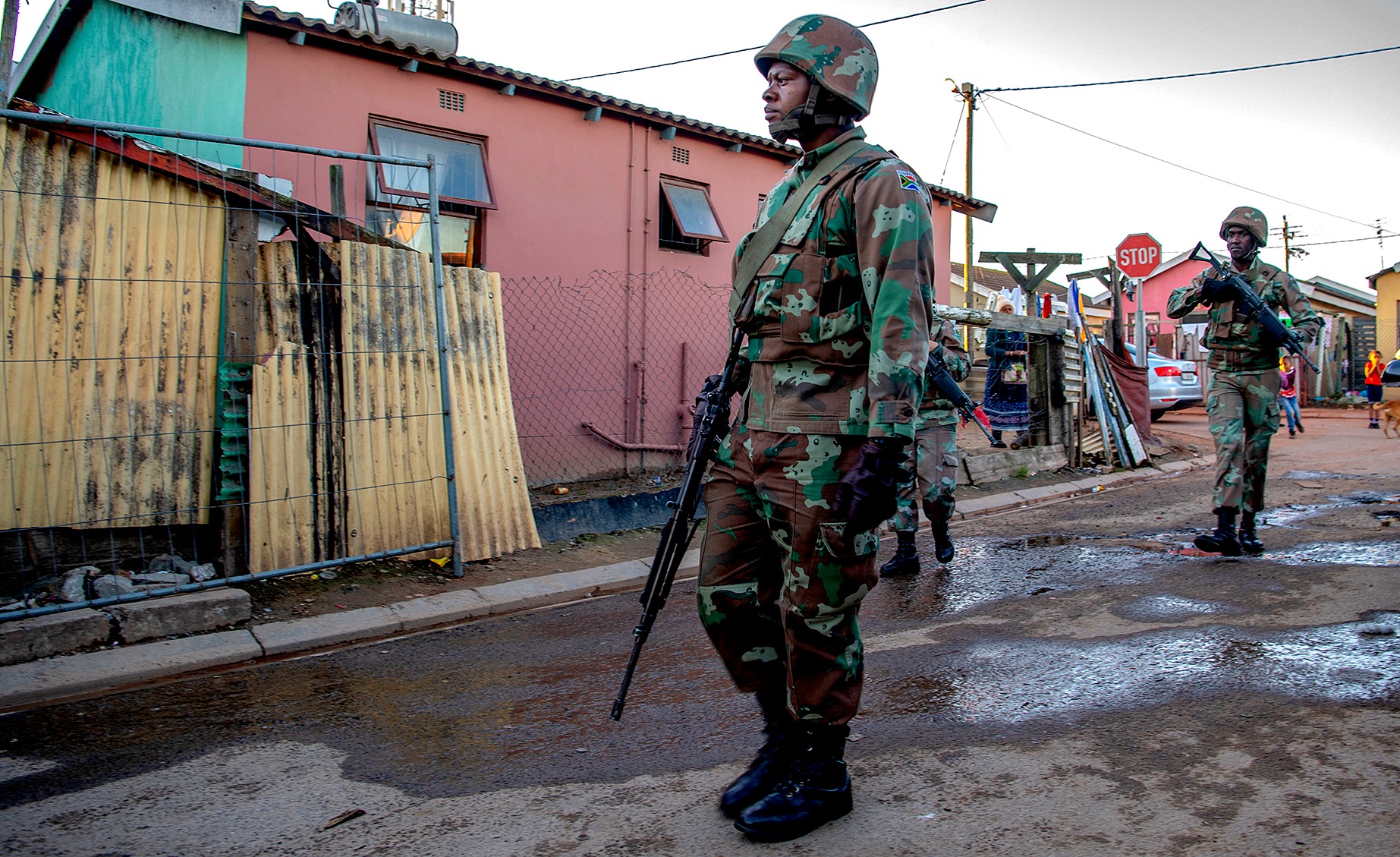
 Members of the SANDF patrol the streets of Kraaifontein, Cape Town, during Operation Prosper on 20 July 2019. (Photo: Jaco Marais / Gallo Images / Netwerk24 )
When President Cyril Ramaphosa announced in the State of the Nation Address (Sona) 2026 that he was “deploying the South African National Defence Force to support the police”, he framed it as a targeted response to two pressures the state can no longer manage through ordinary channels: gang violence in the Western Cape and illegal mining syndicates in Gauteng. He ordered a “tactical plan” within days and promised to inform Parliament of the “timing and place” of the deployment and “what it will cost”.
On one level, this is a practical move: South Africa’s organised crime complex has outgrown the capacities and credibility of ordinary policing. Reuters records Ramaphosa calling organised crime “the most immediate threat to our democracy” and linking it directly to economic damage and institutional fragility — language designed to legitimise extraordinary measures ahead of municipal elections later this year. AP adds the grim substrate: a country averaging 63 killings a day in 2025, illegal mining that drains billions, and a criminal justice system facing investigations into corruption and syndicate infiltration.
/file/dailymaverick/wp-content/uploads/2023/11/ED_394064.jpg "Police crack down on illegal miners during a raid in Krugersdorp on 3 August 2022. (Photo: Fani Mahuntsi / Gallo Images)")
But the deeper story is not just about violence. It is about how states govern when civilian law enforcement loses legitimacy, and about what happens to a constitutional order when the executive repeatedly reaches for military capability to compensate for civilian institutional decay. The announcement therefore raises a stark question: is this deployment a bounded operational patch — or another step in the long substitution of military presence for civilian security reform?
Repeating a pattern
A useful starting point is to reject the comforting fiction that South Africa is choosing between normal policing and a new exceptional militarised turn. The country has a long record of sending the SANDF into the domestic security space.
Since the late 1990s, domestic deployments have recurred in cycles under different names and political administrations (Operation Recoil, 1997; Operation Slasher, 2001; Operation Combat, 2012; Operation Thunder, 2018; Operation Prosper, 2019), and the practice itself has deeper roots in the apartheid-era security architecture. The state’s playbook has been consistent: when violent crime spikes, when communities experience visible loss of control, or when police capacity is judged insufficient, soldiers are placed alongside police for time-bound stabilisation and support operations.
/file/dailymaverick/wp-content/uploads/2022/08/Nonku-SANDF-hotspots1.jpeg "An SANDF troop deployment during a law-enforcement operation in Durban on 13 January 2022 to clamp down on errant truck drivers. (Photo: Darren Stewart / Gallo Images)")
That history matters because it changes the analytical frame. The issue is not whether the SANDF can reduce crime in the short run; it sometimes can. The issue is what the recurrence reveals: a civilian policing system that repeatedly reaches a point of incapacity, followed by a politically legible escalation to military force. South Africa’s civil-military boundary in practice is already porous, and the question is whether this deployment will deepen that porosity into a governing norm, especially in an era of coalition vulnerability and declining police legitimacy.
The governance dilemma
Two weeks before Sona, Ramaphosa reportedly ruled out troops for Cape Town, saying soldiers are trained for combat, not community policing, and then changed course without explanation amid calls for action. That pivot is not merely rhetorical. It captures a structural tension that almost every democracy confronts when insecurity becomes politically unbearable. The executive knows the professional truth: soldiers are not trained to do community policing. The executive also knows the political truth: fear demands visible force.
Comparative experience is clear that militarised domestic deployments are politically expedient because they are legible, dramatic and immediate, even when the underlying drivers of violence remain untouched, and that once the line between soldier and police blurs, it is notoriously difficult to redraw. South Africa’s reversal reads as a textbook example of how insecurity converts professional caution into executive escalation. That is precisely why the deployment’s institutional design — mandate, duration, accountability chain and oversight — is not a bureaucratic detail. It is the democracy question.
Serious trade-offs
The most dangerous debate is the simplistic one: “Will the army stop the gangs?” The honest answer is: possibly briefly, under strict conditions, with serious trade-offs.
Evidence from previous high-density surge operations indicates that any reduction in violent crime tends to be strongest when operations translate into concrete enforcement outcomes — priority arrests, sustained disruption of hotspot networks, and significant seizures of illegal firearms — rather than mere visibility patrols. Where those conditions are absent, deployments often behave like pressure applied to a balloon: violence displaces, syndicates adapt, and the state claims action while criminal markets reorganise.
/file/dailymaverick/wp-content/uploads/2022/08/Nonku-SANDF-hotspots3.jpeg "SANDF soldiers patrol the streets of Alexandra, Johannesburg, on 15 July 2021. (Photo: Sharon Seretlo / Gallo Images)")
More importantly, when the state introduces soldiers into policing space without simultaneously strengthening investigative capacity, prosecutions, intelligence integrity and witness protection, it risks treating organised crime as a visibility problem rather than a governance problem. The current probe into corruption and criminal infiltration in the criminal justice system is therefore central. If the system responsible for case-building and accountability is compromised, then more force can create the appearance of state recovery while leaving the extraction networks intact. A military deployment can therefore produce a paradox: stronger street presence alongside a persistently captured criminal justice pipeline. That paradox is how a state becomes harsher without becoming more capable.
This is not ‘support’
Ramaphosa used the politically soothing word “support.” But “support” is not a stable operational category in joint deployments. The moment soldiers are visibly patrolling, setting cordons, securing zones, and accompanying high-intensity operations, command authority becomes ambiguous at the point of contact: whose rules govern escalation, who owns the scene, and who records and reports use-of-force decisions?
Responsibility also becomes diffused, because when abuses or failures occur, institutions can blame “jointness”. And civilian institutional competence can be inadvertently delegitimised, because communities experience real authority as military presence, reinforcing the idea that police are insufficient without soldiers.
Comparative evidence warns that militarisation often weakens civilian police by diverting resources, eroding trust and creating the perception that civilian institutions are incapable of solving society’s problems — effects that persist even after soldiers leave. South Africa already carries this risk at scale.
Recurrent deployments send a repeated message: the state’s credible coercive instrument is the SANDF, not the SAPS. That may temporarily reassure frightened communities, but it also trains the polity to see military visibility as normal governance.
Rights risk
The central mismatch is simple: soldiers are trained for combat, not the subtleties of policing. Domestic deployments therefore carry a predictable rights risk, particularly in dense urban environments where split-second judgment, calibrated escalation and procedural discipline are the difference between a lawful intervention and an abuse. South Africa has already seen how quickly domestic enforcement contexts can produce allegations of excessive force and rights violations when soldiers are inserted into civilian life at scale, particularly during the hard lockdown period.
/file/dailymaverick/wp-content/uploads/2022/01/h_56047493.jpg "Members of the SANDF on patrol during a joint operation in Johannesburg with the SAPS on 26 April 2020, day 31 of the national Covid-19 lockdown. (Photo: Kim Ludbrook / EPA-EFE)")
This isn’t an abstract civil liberties point. In gang-affected environments, the state’s legitimacy is not generated by “strength”; it is generated by discriminating power — precision, due process, reliable intelligence and predictable accountability. Militarised presence tends to produce the opposite incentives: sweep, saturation and visible domination.
Experience elsewhere shows a familiar pattern: emergency deployments become normalised, executive power expands, civilian oversight degrades, and abuses rise because soldiers operate without the constraints and institutional habits that govern civilian policing.
Institutional risk
Ramaphosa’s most important sentence may be the procedural one: he says he will inform the National Assembly and the National Council of Provinces about the timing, place, and cost, “as is required by the Constitution”. That commitment matters — but only if informing Parliament is not treated as the end of democratic control.
The institutional risk is subtle. In many systems, domestic deployment becomes democratically corrosive not because it is illegal, but because oversight becomes formalistic. Legislatures get memos; executives get discretion; and the real decisions — mandate creep, operational secrecy, intelligence standards, use-of-force policies — escape meaningful scrutiny. DW’s reporting captures the governance context that makes this especially delicate now: South Africa’s coalition era, potential appeasement dynamics with coalition partners, and the reality that troops may need additional training for this role. The political economy is straightforward: a fragile executive facing elections benefits from visible demonstrations of control. That incentive structure is exactly how “exceptional measures” become routine.
If South Africa wants to avoid this arc, the key question is not “Can the President deploy?” but whether Parliament can compel specificity on mandate, duration, rules of engagement, complaint pathways, investigative jurisdiction, reporting cadence, and measurable success criteria tied to civilian policing strengthening rather than substitution.
Normalisation by recurrence
Comparative experience shows a consistent pattern: temporary responses to emergencies rarely remain temporary; militarised involvement becomes normalised; executive power concentrates; civilian institutions weaken; liberties erode; democracies hollow out slowly.
South Africa’s risk is not a dramatic leap into authoritarianism. It is a quieter institutional evolution: deployments become routine in high-crime metros, policing failure becomes structurally tolerated because soldiers can be sent in, accountability becomes harder because joint operations diffuse responsibility, and public expectations shift so that force becomes the language of governance rather than a last resort. The deployment can therefore reorganise democratic culture — what citizens expect the state to be, how the executive learns to demonstrate power, and how oversight institutions adapt to emergency logic.
Does it work?
If “work” means reducing shootings next month, the answer may be yes in specific zones, particularly if the deployment is tightly targeted and yields concrete enforcement outcomes — high-value arrests, firearm seizures, and sustained disruption of violent networks — rather than being used mainly for symbolic presence.
If “work” means dismantling the gang and illegal mining political economy, then troops are at best a temporary suppression tool unless the state simultaneously restores the civilian pipeline: credible intelligence, clean chain-of-evidence, protected witnesses, effective prosecution and disciplined policing. Systemic corruption and infiltration is the tell: South Africa’s organised crime problem is not just violent actors; it is a compromised enforcement system.
So the deployment’s success metrics cannot be “patrols conducted” or “visibility”. They must be firearms removed, priority suspects arrested, cases successfully prosecuted, assets seized and police integrity strengthened. Otherwise, the state purchases temporary calm at the price of institutional dependence on military presence.
What realism requires
If this move is to strengthen South Africa rather than quietly deform its institutions, four conditions must be articulated and enforced.
First, there must be a narrow, public mission definition. What exactly will the SANDF do — perimeter security, infrastructure protection, joint operations only? Will soldiers engage in searches, arrests, crowd control? Vagueness is where mandate creep lives.
Second, there must be a strict sunset and renewal standard. Duration must be finite, with renewal requiring parliamentary engagement and evidence of progress on civilian system strengthening, not just continued claims of need.
Third, there must be a unified accountability architecture. Clear complaint pathways, independent investigation of abuses, transparent reporting, and clarity on jurisdiction are essential so “jointness” does not become a route to impunity.
Fourth, there must be a binding civilian reform “exchange rate.” Every week of SANDF presence must correspond to measurable SAPS capability gains: detectives, forensic throughput, anti-corruption enforcement, firearm tracing, and prosecutorial coordination. Soldiers must buy time for reform, not replace reform.
These conditions are not technocratic. They are how you prevent the executive from learning that it can govern insecurity primarily through force projection.
Conclusion
Ramaphosa is right about one thing: organised crime is a threat to democracy. But the method chosen to confront it can either restore civilian authority or teach the state to lean on military authority as a substitute for fixing the civilian core.
South Africa’s danger is not an overnight militarised state. It is a quieter institutional evolution: repeated deployments slowly normalising a governance style in which the executive demonstrates control through soldiers because civilian policing has lost the capacity, and public trust, to do so alone.
That is why the decisive question is not whether the SANDF arrives in the Cape Flats. It is whether, when the SANDF arrives, civilian institutions become stronger or whether they become the permanent weak partner that must always be “supported”. DM
Lindani Zungu, a political science graduate from New York University, is a Mandela Rhodes Scholar with a master’s in political studies. He is the editor-in-chief of a youth-oriented publication (Voices of Mzansi) in South Africa.
Comments
Scroll down to load comments...