




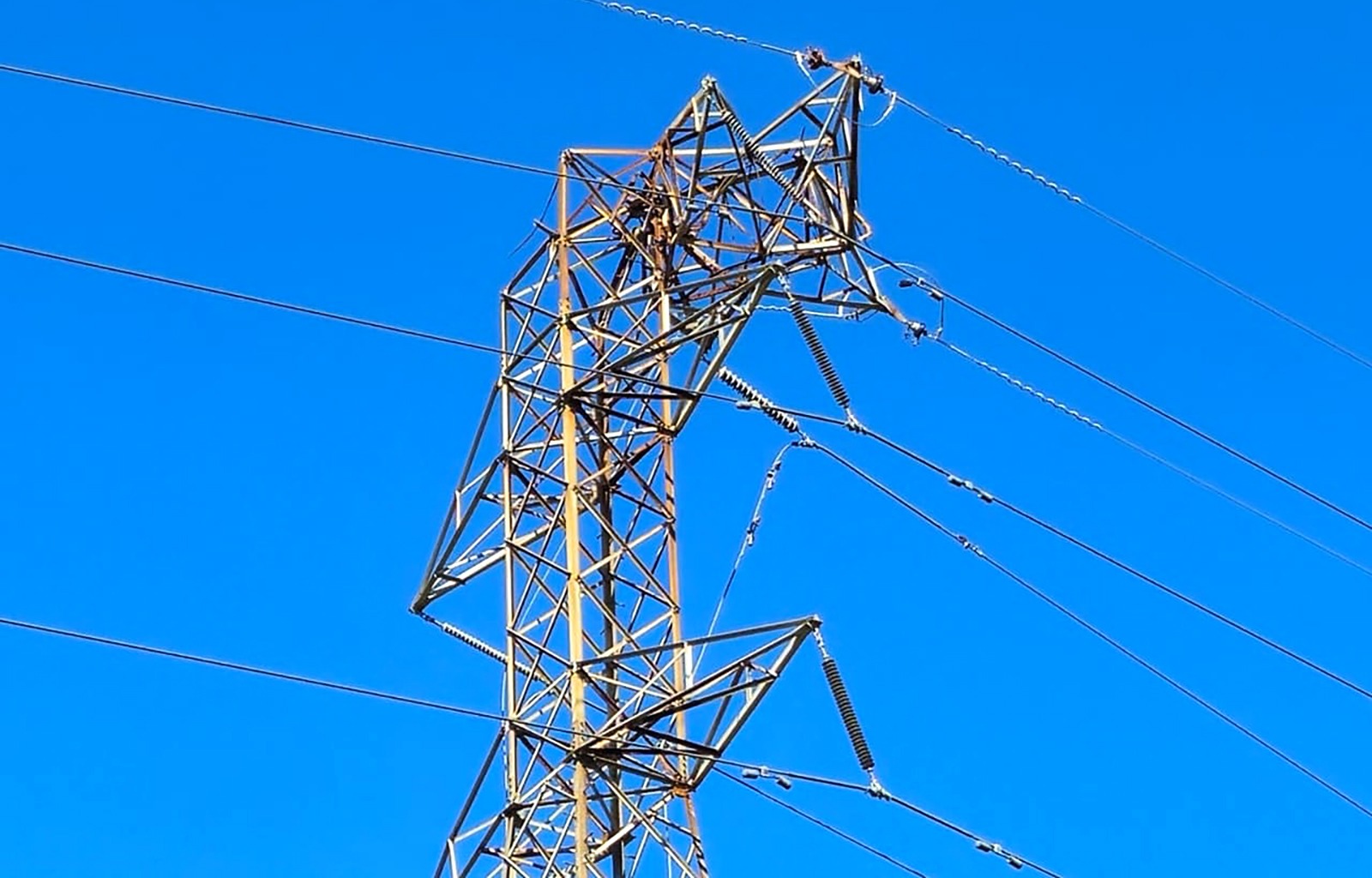
 The top of a pylon on the Summerstrand/ Arlington 132kV line snapped on Thursday, triggering a widespread electricity outage for the third time this year. (Photo: Andisa Bonani)
 As high-voltage electricity transmission pylons continue to topple like dominoes in Nelson Mandela Bay, it has emerged that the metro has budgeted just R11.9-million to repair them this financial year.
According to a report seen by Daily Maverick, R35-million is needed, leaving a R24-million shortfall.
With large parts of the metro now bracing themselves for up to three weeks without power – after the critically corroded Summerstrand/Arlington-Walmer 132kV line collapsed on Thursday – the scale of the city’s infrastructure crisis is becoming even more transparent.
The Nelson Mandela Bay metro has also set aside a measly R1-million for the upgrading of the Summerstrand-Arlington-Walmer 132kV line, where rusted pylons keep collapsing, causing widespread electricity outages.
The remainder of the R11.9-million is earmarked for the upgrading of a high-voltage 66kV line and a 132kV line in an unspecified area – R8-million is allocated for these lines – and a further R3-million for the Chatty to Bloemendal and Rowallan Park lines.
Municipal spokesperson Sithembiso Soyaya said that since the 2024 collapse of four transmission pylons, the municipality had spent a total of R17.3-million on repairs and recovery, including R4.1-million for the Chelsea-Arlington-Walmer-Summerstrand line, R8-million for the Chatty-Bloemendal-Rowallan Park line, and R5.2-million for the 2024 incident.
Funding for these emergency repairs was not drawn from a dedicated budget for pylon repairs, but reprioritised from other projects to ensure urgent work could proceed, he said.
Infrastructure upgrades and pylon replacement had already been identified in forward planning, but budget allocations for such upgrades could be released only once formal contracts were in place, Soyaya said.
The last pylon fault occurred on the Chelsea/Arlington/Summerstrand to Walmer line, which includes some of the city’s tourist attractions, big businesses and a wide range of residential areas.
The outage was caused when the top section of a pylon snapped. In the previous incident, just last week, a pylon collapsed in the Arlington/Summerstrand area, plunging large swathes of the city into darkness for five days.
On Wednesday, Volkswagen Group Africa CEO Martina Biene said the cost of doing business in South Africa has been driven up in part by infrastructure failures affecting operations. Biene was speaking during a parliamentary portfolio committee visit to the Volkswagen Group Africa plant in Kariega.
“What is also part of cost competitiveness needs to be managed at municipal level, for example, through a stable electricity supply,” Biene said.
“We acknowledge that load shedding is over, but we had already invested in generators, which added to our costs when outages were still occurring. Now, with decaying electricity infrastructure and the recent pylon collapse, these unplanned power outages make production even more difficult because they are largely unpredictable.”
/file/attachments/2989/WhatsAppImage2026-03-19at175221_569172.jpeg "Volkswagen Group Africa CEO Martina Biene. (Photo: Andisa Bonani)")
Biene said the electricity infrastructure in the metro was in a dire state and required urgent maintenance.
“In the body shop, when it’s unplanned, 587 robots stop at different times, so even a 20-minute outage can take up to four hours to restore full operations,” she said.
“That means we lose about 220 cars, so we had to install a UPS system to ensure operations can continue in a controlled manner.”
Nelson Mandela Bay Business Chamber CEO Denise van Huyssteen said the pylon issues highlighted the gravity of the very serious infrastructure management crisis affecting the metro in the areas of electricity, water and sanitation.
/file/attachments/2986/Screenshot2025-12-15at145307_748755_485995.png "Nelson Mandela Bay Business Chamber CEO Denise van Huyssteen. (Photo: Facebook)")
“These failures stem from a lack of adequate, routine maintenance over many years, with serious consequences for communities and the local economy,” Van Huyssteen said.
“To date, little progress has been made on promises and commitments from more than two years ago to reconstruct facilities and maintain key electricity structures to avoid prolonged outages. The ongoing unreliability of electricity, reflected in frequent unplanned outages and power dips, directly impacts business viability and the ability to sustain much-needed jobs in a metro with an official unemployment rate of 27.1%.”
She added: “Businesses across sectors, from small to large, continue to bear the brunt of the metro’s failing electricity, water and sanitation infrastructure.
“This results in lost sales, cancelled bookings, damaged equipment, production delays, unmet customer demand and export orders, and higher operating costs. The broader consequences include reputational damage to Nelson Mandela Bay as an investment destination.”
Newly appointed general manager of the Boardwalk Hotel and Casino Sisulu Madondo said utilities in Gqeberha had become an ongoing challenge that cost the business dearly.
“Municipal services in general are a challenge, specifically electricity in recent weeks. We have become dependent on diesel to run generators for backup power, and that is a very costly exercise,” Madondo said.
Regional representative for the Federated Hospitality Association of Southern Africa (Fedhasa) Glenn Pappin echoed Madondo’s sentiments.
Businesses burn up to R15,000 in diesel a day
“The hospitality industry is bleeding money. Those running on generators are burning up to R15,000 in diesel daily. And these generators were not meant to run day and night, so the pressure on these emergency measures is also costing us money.”
Pappin explained that many businesses installed generators to counter load shedding. They were never intended to run for extended periods.
Some generators need to be serviced at regular intervals – about every 250 running hours – which are becoming more frequent due to extended power outages.
“Guests are paying for services that some guesthouses or hotels cannot provide because the generators don’t have the capacity to power all facilities. These recurring electricity outages are causing our city irreparable reputational damage.”
He called on the municipality for better crisis communication to enable local businesses to put plans in place and provide their clients with more accurate information.
Continued failure to maintain infrastructure
ACDP councillor Lance Grootboom said the pylon failure raised urgent questions about the state of maintenance and the refurbishment of high-voltage electricity infrastructure in the city.
/file/attachments/orphans/LanceGrootboom_133737_382791.jpg "ACDP councillor Lance Grootboom raised concerns about the timing of the support by Cogta. (Photo: Deon Ferreira)")
“This is not an isolated incident, but the result of ageing infrastructure and the municipality’s continued failure to prioritise maintenance and refurbishment of critical electricity networks,” Grootboom said.
“It is a matter of serious concern that the municipality requires at least R35-million in the current financial year to address urgent pylon refurbishment, yet only R11-million has been allocated, leaving a R24-million shortfall.
“Of this amount, only R1-million was allocated to Ward 1, where these pylons have collapsed, while the remaining funds have been distributed across other wards with similar infrastructure needs. This clearly demonstrates that funding is insufficient and spread too thin to address the scale of the problem.”
An assessment report on the state of the pylons revealed that extensive structural corrosion posed serious risks, including weakened load-bearing members, reduced wind-loading tolerance, compromised conductor clearances and the potential for tower collapse during extreme weather.

EFF councillor Ziyanda Mnqokoyi, the MMC for Electricity and Energy in Nelson Mandela Bay, conducted an oversight visit with several departmental officials, accompanied by the contractor.
/file/attachments/orphans/WhatsAppImage2026-03-11at173641_912508.jpeg "EFF councillor Ziyanda Mnqokoyi, MMC for Electricity and Energy in Nelson Mandela Bay. (Photo: Andisa Bonani)")
“Equipment is being mobilised, with repair work already under way and expected to take approximately 21 days. The municipality continues to prioritise the restoration of electricity supply while also accelerating infrastructure upgrades and reinforcement measures across the metro to improve network resilience.”
Mnqokoyi said work began on Thursday afternoon after a contractor assessed the pylons.
“This affected tower is part of the phase two work we were meant to start with, but [due to] unforeseen circumstances, they have to prioritise the restoration of the electricity.
“We will boost the team so that the work is done in a shorter period because we know the estimated 21 days is a long time, especially for businesses that will suffer great losses.”
Businesses are counting the cost of operating in the Bay as production is delayed, while contemplating the huge amounts spent to keep generators running for days, and this time, for three solid weeks. DM
Comments
Scroll down to load comments...