




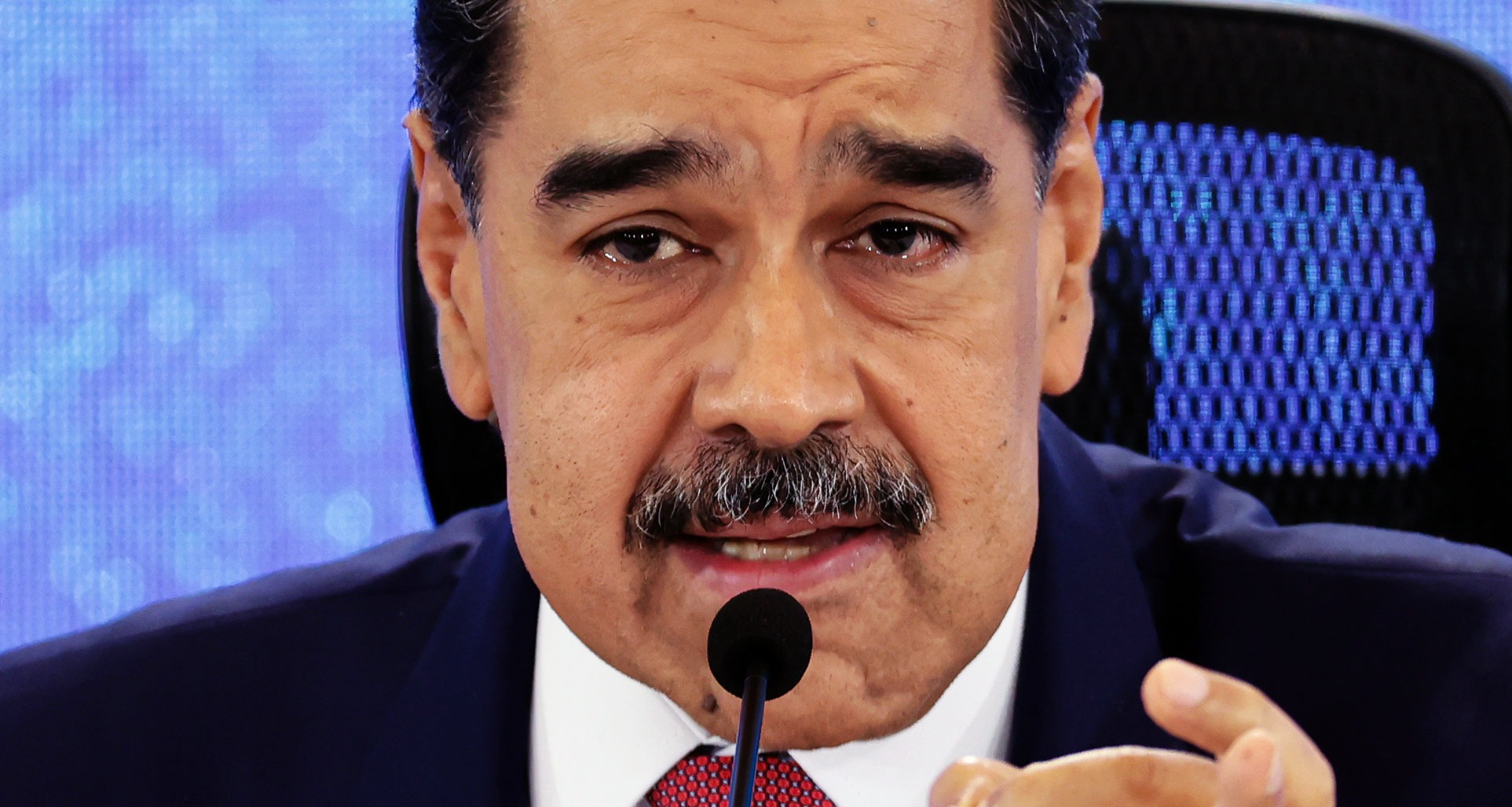
 Venezuelan President Nicolas Maduro was captured in a US special forces raid in the early hours of Saturday morning, 3 January 2026. (Photo: EPA / Miguel Gutierrez) Reuters-Venezuela-Maduro-US
 The image of the 63-year-old Venezuelan leader Nicolás Maduro blindfolded and handcuffed en route to the US has stunned Venezuelans and was Washington’s most controversial intervention in Latin America since the invasion of Panama 37 years ago.
Maduro, who wished his captors a “Happy New Year” on arrival, is due to appear in a Manhattan court on Monday.
‘There is fear and uncertainty’
At home, his allies were still in charge and denounced their leader’s “kidnapping” as part of an imperialist oil grab.
Streets were far quieter than usual on Sunday as Venezuelans anxiously discussed what would come next. Some stocked up on essentials, but many simply sheltered indoors.
“I’ve just taken the dog out and it feels like an abandoned city, people are shut inside,” said Alejandra Palencia, 35, a psychologist in the city of Maracay.
“There is fear and uncertainty.”
/file/attachments/orphans/Reuters-Venezuela-Maduro-US_160859.jpg "US President Donald Trump addresses the media on Saturday, 3 January 2026 at Mar-a-Lago, Palm Beach, Florida, United States, after the capture of Venezuelan President Nicolás Maduro. (Photo: EPA / Nicole Combeau)")
With memories of painful US interventions in Iraq, Afghanistan and elsewhere, many world leaders were staggered at Trump’s move, even though Maduro’s standing was low given his autocratic rule and substantial evidence of vote-rigging.
Trump said the US would, for now, manage the South American nation of about 30 million people plus its oil reserves, the largest in the world. But he gave few details of how.
“We will run the country until such time as we can do a safe, proper and judicious transition,” he told a press conference at his Mar-a-Lago resort, hailing the extraordinary extraction of Maduro just as he was at the door of a safe room.
/file/dailymaverick/wp-content/uploads/2024/10/12583984.jpg "Venezuelan opposition leader and Nobel Peace Prize winner Maria Corina Machado (left) and her ally Edmundo Gonzalez Urrutia. (Photo: EPA-EFE / Miguel Gutiérrez)")
To the disappointment of Venezuela’s opposition and diaspora, Trump has given short shrift to the idea of 58-year-old opposition leader and Nobel Peace Prize winner Maria Corina Machado taking over, saying she lacked support.
Machado was banned from standing in Venezuela’s 2024 election and has said her ally Edmundo Gonzalez Urrutia (76) who overwhelmingly won that vote, according to the opposition and some international observers, should now take the presidency.
Once one of the most prosperous nations in Latin America, Venezuela’s economy nosedived further under Maduro, sending about one in five Venezuelans abroad in one of the world’s biggest exoduses.
/file/attachments/orphans/Reuters-Venezuela-Maduro-US-panama_605705.jpg "Venezuelans living in Panama City, Panama, celebrate the capture of President Nicolás Maduro. (Photo: EPA / Gabriel Rodriguez)")
The diaspora was largely jubilant at the exit of Maduro, whose security forces repeatedly crushed opposition protests. The former union leader, bus driver and foreign minister was the dying Hugo Chavez’s handpicked successor as president in 2013.
“We are all happy that the dictatorship has fallen,” said Khaty Yanez, who lives in Chile.
‘Only one president: Maduro’ — interim president Rodriguez
Trump says Maduro masterminded the flow of drugs into the US and was illegitimately in power due to vote-rigging.
He denies those claims.
/file/attachments/orphans/Reuters-Venezuela-Maduro-Delcy-US_114310.jpg "Venezuela’s Executive Vice President Delcy Rodriguez. (Photo: EPA / Miguel Gutierrez)")
“There is only one president in Venezuela, and his name is Nicolas Maduro,” said Delcy Rodriguez, who took over Venezuela’s interim presidency, in a defiant message to the US despite Trump’s assertions that she was open to working with them.
“We will never again be a colony of any empire.”
Interior minister Diosdado Cabello, who is close to the military, urged Venezuelans to stand firm and emphasised Trump’s repeated comments about sharing in oil prosperity.
“We are outraged because in the end everything was revealed – it was revealed that they only want our oil,” Cabello said in audio shared by the ruling Socialist Party.
US Special Forces swooped in on helicopters to seize Maduro and his wife, Cilia Flores, under darkness in the early hours of Saturday after strikes on military installations in Caracas and elsewhere.
/file/attachments/orphans/Reuters-Venezuela-Maduro-US-San-Fransisco_404209.jpg "Demonstrators in San Francisco, United States, march down Market Street to United Nations Plaza to take part in a protest against US President Trump and the US military actions in Venezuela. (Photo: EPA / John G. Mabanglo)")
While many Western nations oppose Maduro and say he stole the 2024 election, there were many calls for the US to respect international law and resolve the crisis diplomatically.
There were also questions over the legality of seizing a foreign head of state. Democrats said they were misled at recent Congress briefings and demanded a plan for what is to follow.
Oil revival?
Trump said major US oil companies would move back into Venezuela and refurbish badly degraded oil infrastructure, a process experts said could take years.
“We’re not afraid of boots on the ground,” the US president said.
A plane carrying Maduro landed near New York City on Saturday night, and he was taken by helicopter to the city before being taken to the Metropolitan Detention Center in Brooklyn.
Indicted in 2020 on charges including narco-terrorism conspiracy, Maduro is expected to make an initial appearance in Manhattan federal court on Monday.
The UN Security Council planned to meet on Monday to discuss the US move, which Secretary-General Antonio Guterres described as a dangerous precedent. Russia and China, both major backers of Venezuela, criticised the US.
Opponents of Maduro in Venezuela have been wary of celebrating. Security seemed, if anything, lighter than usual on Sunday. Despite the nervous mood, in some places cars were moving, bakeries and coffee shops were open and joggers and cyclists were out, as on a normal Sunday morning.
“Yesterday I was very afraid to go out, but today I had to. This situation caught me without food, and I need to figure things out. After all, Venezuelans are used to enduring fear,” said a single mother in a working-class neighbourhood in oil city Maracaibo. She bought rice, vegetables and tuna.
It is unclear just how Trump plans to oversee Venezuela.
His comments about an open-ended military presence in Venezuela echoed the rhetoric around past invasions in Iraq and Afghanistan, both of which ended in American withdrawals after years of costly occupation and thousands of US casualties.
A US occupation “won’t cost us a penny” because the US would be reimbursed from “money coming out of the ground,” Trump said, referring to Venezuela’s oil.
Trump’s focus on foreign affairs fuels Democrats’ criticism and also runs the risk of alienating some supporters, who have backed his “America First” agenda and oppose foreign interventions. DM
