




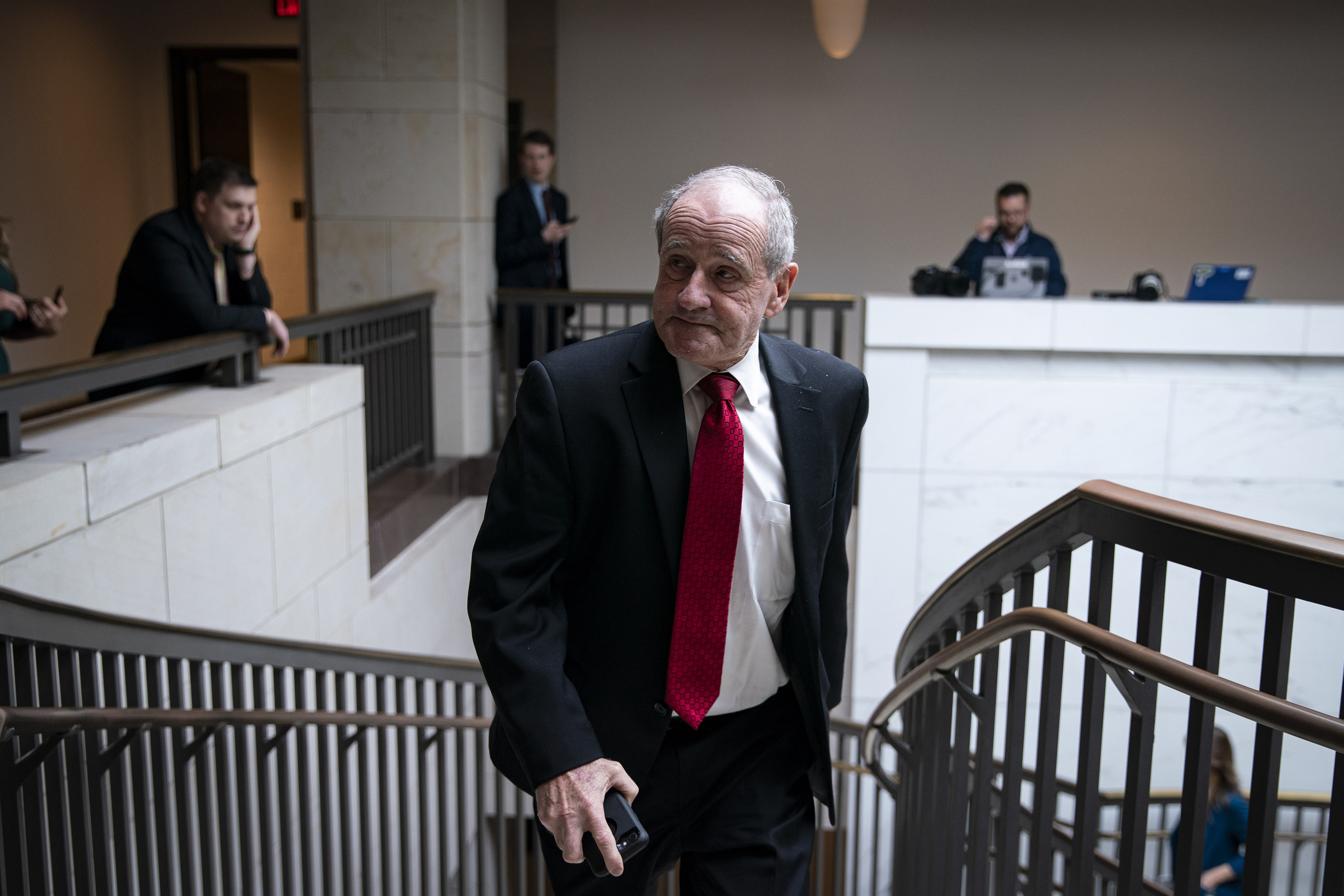
 Senator Jim Risch of the US Senate Foreign Relations Committee departs a closed-door intelligence briefing on Capitol Hill in Washington, DC, US, on 9 February 2023. (Photo: Al Drago / Bloomberg via Getty Images)
Washington has, for the first time, publicly criticised Russia’s controversial Antarctic oil and gas surveys through Cape Town, South Africa, as a violation of international law – a shift that may hold legal and diplomatic weight.
Unreported until now, the accusation emerged as US Senate Foreign Relations Committee chair Jim Risch spoke during a 12 February nomination hearing for senior State Department posts.
The move signals that this long-standing and technically complex issue has finally cracked the highest levels of American policymaking. But it also exposes a basic problem: Washington does not yet appear to have a strategy on how to respond.
The Trump administration also appears unclear about whether Russia has breached the 1959 Antarctic Treaty itself or its 1991 Environmental Protocol.
Risch, the committee’s senior Republican, delivered the rebuke during a nomination hearing that included Wesley Brooks – President Donald Trump’s assistant secretary of state nominee for oceans as well as international environmental and scientific affairs.
Risch told Brooks that Russia’s mineral resource activities, documented by Daily Maverick since October 2021, had to be among his top “enforcement” priorities.
“You will also oversee Antarctic Treaty cooperation and enforcement, as well as US research engagement in Antarctica,” Risch said. “Both Russia and China have long been suspected of conducting military and intelligence activities under the guise of research, and Russia has reportedly conducted commercial resource exploration, all of which violate the Antarctic Treaty.”
Before handing Brooks the floor to deliver his testimony, Risch threw down a gauntlet: “I look forward to hearing how you will push back on these illicit activities in your role.”
Brooks, an official at the Environmental Protection Agency, used his testimony to advocate legal seabed mining outside the treaty area.
Yet he addressed Risch’s questions only symbolically by citing Antarctica as one of his priority areas. He did not respond to Daily Maverick’s questions about how he would resolve potential conflicts between his seabed advocacy and his mandate to “push back” against Russia’s Antarctic seabed activities.
/file/attachments/orphans/brooks_930027.jpg "Wesley Brooks, Environmental Protection Agency. (Photo: LinkedIn)")
Fact check: Has Washington accused Moscow of the wrong crime?
The US is the architect of the treaty, a nuclear disarmament pact also signed by the Soviet Union, South Africa and nine other founding consultative signatories. Governing the only continent never to see a human war, the treaty, its protocol and the protocol’s mining ban have thus served as linchpins of US long-term foreign policy in Antarctica for decades.
But the Foreign Relations Committee chair seems to have accused Moscow of a graver crime than it may be guilty of, says Professor Alan Hemmings of New Zealand’s University of Canterbury.
A leading proponent of eliminating legal possibilities to mine Antarctica for oil and gas, Hemmings is a recognised expert in the region’s laws. He personally observed the 1991 mining ban negotiations in Madrid, where Washington insisted on a walk-out clause that allows a signatory state to abandon the non-expiring ban from 2048.
Unlike Risch’s claim, Russian activities are not “exploration” because they do not appear to include exploratory seabed drilling and excavation. Instead, they can be described as “prospecting”, argues Hemmings. That is, “identifying areas of mineral resource potential for possible exploration and development”.
“That’s what the Russians are doing,” says Hemmings, noting that “exploration” and “prospecting” are clearly defined in an abandoned 1988 Antarctic mining pact signed by the US, the Soviet Union and 17 other states, including South Africa.
Russia’s activities do not violate the treaty, Hemmings explains. They violate the protocol, whose ban outlaws “any activity relating to mineral resources, other than scientific research”.
/file/attachments/orphans/RussianEAntarcticsurveyareas_265589.jpg "Russian oil and gas seismic surveys on East Antarctica's Southern Ocean since the mining ban entered into force in 1998. (Graphic: Tiara Walters / Righard Kapp)")
The governance expert says there is “weak” evidence that China and Russia have flouted treaty law through dual-use military intelligence gathering.
“Yes, there are such allegations, but nearly all of them come from right-wing think-tanks, the empirical evidence has been weak and exactly the same suspicions exist in relation to some US research activities some decades ago,” he says. “These casual accusations need supporting evidence — otherwise they just look like generalised abuse of other states.”
The US has no public counter-mining strategy for Antarctica
The remarks materialise after Daily Maverick first sent questions to the Foreign Relations Committee in September about the potential implications of abandoning its Antarctic duties while Rosgeo, the Kremlin’s mineral explorer, has been combing the bottom of the world for hydrocarbons.
At the time, the US had just cancelled the contract for its Antarctic research icebreaker — the Nathaniel B. Palmer.
As Trump attempts to dominate strategic focal points in the Western Hemisphere, Risch’s intervention also comes at a geopolitically loaded time for West Antarctica in an area counter-claimed by Argentina, Chile and the UK.
Russia has conducted at least six oil and gas surveys in this counter-claimed territory since 2011. It also claims to have identified 70 billion tons (500 billion barrels) of hydrocarbons off East Antarctica’s sedimentary basins.
In June, Westminster published "commercial mining" recommendations for its Foreign Office characterising the surveys as a strategic threat London must counter. London has now codified those recommendations into the UK’s first public Antarctic strategy, which describes prospecting as an illegal activity.
Washington is now, at least publicly, aligned with a version of that view. But it lacks a counter-mining strategy of its own.
The Hiroshima test: Can Washington afford to ignore this?
Russia has not suddenly expanded seabed prospecting in Antarctica.
Using Cape Town’s Table Bay Harbour as a launchpad, Daily Maverick has established that Russia's state mineral explorer has been leading ongoing mineral surveys in Antarctica and its Southern Ocean since the protocol entered into force in 1998.
When first questioned by Daily Maverick in October 2021, Rosgeo offered us a detailed statement – it argued that the decades-long activity, often couched in commercial terms, was legal science.
/file/attachments/orphans/AkademikAlexanderKarpinskyWIDEcopie_549943.jpeg "The Akademik Alexander Karpinsky, Rosgeo's seismic survey vessel, in Table Bay Harbour, Cape Town, August 2020. (Photo: Tiara Walters)")
For its part, Washington has not been ignoring the issue.
In June 2023, the US State Department led a project to reaffirm the mining ban at the Antarctic Treaty Consultative Meeting (ATCM) in Helsinki, Finland. The ban was reaffirmed by 27 other treaty signatories and, ironically, Moscow.
While the reaffirmation was intended to hold Moscow to account, it yielded a hard problem — allowing the Kremlin to use the ban it reaffirmed as a fig leaf for unchallenged prospecting.
Just over six months later, the State Department placed Rosgeo’s Antarctic survey vessel, the Akademik Alexander Karpinsky, under energy sanctions. These sanctions were the first top-tier state acknowledgement of the more-than-science nature of these surveys.
And yet no state — including the US through its Antarctic division, the State Department — has formally tabled these concerns at the treaty’s annual midyear governance forum.
Now that Risch has flagged the issue, it in effect forces the State Department – which unusually turned up at the 2025 ATCM with zero discussion papers – to take a more assertive message to the May 2026 meeting in Hiroshima, Japan.
‘Managing’ Moscow is Washington & co’s hard problem
How Washington and Westminster, despite the latter’s counter-mining strategy, would actually “tackle” Russia’s determined mineral search is another hard problem that could leave both states looking weak.
At the UK-chaired meeting of the Commission for the Conservation of Antarctic Marine Living Resources (CCAMLR) in Hobart, Tasmania, Ukraine made an extraordinary announcement.
/file/attachments/orphans/Marinebiologistprofilephoto_715877.jpg "Detained Ukrainian CCAMLR scientist Leonid Pshenichnov. (Photo: Supplied)")
Russian authorities had arrested Ukrainian delegation member Leonid Pshenichnov in Crimea just ahead of the CCAMLR meeting, held in October. The marine biologist had been charged with high treason for, among others, drawing up marine park proposals that would threaten Russia’s banned hydrocarbon activities in Antarctica.
“Implementation of these plans would ... result in the loss of opportunities for Russia to exploit hydrocarbon resources on the continental shelf of Antarctica,” notes an alleged translated copy of the original Federal Security Service charge sheet seen by Daily Maverick. This alleged copy was first reported by ABC Australia.
In separate exchanges with Daily Maverick, Ukraine CCAMLR delegation head Kostiantyn Demianenko as well as Ukraine’s Australia ambassador Vasyl Myroshnychenko confirmed the original charges included alleged threats to Russian Antarctic hydrocarbon interests. Demianenko noted those “preliminary” charges have now been changed.
Demianenko said Pshenichnov remained in a Simferopol detention centre but now for allegedly being one of the authors of a Ukrainian proposal seeking to establish krill catch limits on “using continuous fishing [trawling] systems”.
“We have provided the defence team – through Leonid Pshenichnov’s family – with comprehensive arguments as to why the Russian charges are completely absurd,” Demianenko noted. “The accomplished and obvious fact is the arrest and imprisonment for several months now of one of Ukraine’s leading scientists working on Antarctic marine zone issues.”
Moscow versus (a split) Pretoria
Present at the explosive CCAMLR meeting was none other than Pavel Lunev, former head of the Rosgeo firm responsible for the Karpinsky vessel’s Antarctic oil and gas surveys.
Until April 2023 director of the Polar Marine Geosurvey Expedition, Lunev was since promoted to head the entire Russian Antarctic Expedition.
The meeting’s preliminary minutes list Lunev as an adviser to the Russian delegation, which again blocked Marine Protected Area (MPA) proposals linked to areas that overlap with the Karpinsky’s seismic survey areas.
The South African delegation, among the more outspoken in Hobart, was not amused about the annual MPA blockade that Moscow and Beijing have waged since 2017.
“This continued deadlock undermines the CCAMLR’s credibility as a conservation body,” said South Africa, which provides “non-aligned” Antarctic gateway facilities to states including Ukraine. It has not participated in the prospecting surveys, maintaining in formal responses the work meets scientific standards.
That official position masks a political split inside South Africa’s coalition government. The ANC, the majority party, has treated the surveys as uncontroversial, legal science. The Democratic Alliance, which now controls the environment department responsible for South Africa’s Antarctic programme, has repeatedly questioned Moscow’s intentions.
The result is a gateway state that publicly hosts Russia’s Antarctic operations while harbouring doubts about their purpose — another sign of the fractured international response to Moscow’s prospecting.
‘Le silence’ of all treaty governments
Apart from London, Pretoria and Washington, Chile and Kyiv have also expressed worries about what a mineral explorer is doing in a protected wilderness off limits to “any activity relating to mineral resources”.
One enduring question is how long these states can issue credible public warnings while avoiding Moscow at the ATCM table.
/file/attachments/orphans/AntarcticaHelsinkidelegates_861690.jpg "Delegates arrive for the Antarctic Treaty consultative meeting in Helsinki, Finland, 2 June 2023. A US-led project reaffirmed the ban by consensus at this meeting. (Photo: Tiara Walters)")
Back at the 2011 ATCM in Buenos Aires, Moscow tabled a long-term Antarctic strategy that featured – among its top three objectives – investigating “Antarctic mineral, hydrocarbon and other natural resources”. A pithy Le Monde editorial hit back: “À ce jour, aucun commentaire, aucune protestation officielle n’a filtré. [To this day, no comment, no protestation has filtered through.]”
What might it cost the Antarctic Treaty System if le silence persists?
Professor Klaus Dodds, science and technology dean at Middlesex University, has written extensively about Trump’s plans to dominate the Western Hemisphere.
The prominent political geographer has offered written and oral testimony on the Russian surveys to Westminster, further urging the UK “not to squander” an opportunity to lead a “neutral ground” coalition “before raw geopolitics interferes further”.
William Muntean, Antarctic policy chief under the Biden and Trump administrations from 2018 to 2023, previously told Daily Maverick that allegedly accusing individuals of “treason and economic damage” for following policies approved by Russia risked consigning such “successful, decades-old” policies to the “dustbin of history”.
Russian Antarctic authorities have not responded to repeat requests for comment on Pshenichnov’s ongoing detention.
When Daily Maverick asked Senator Risch for comment last week, his spokesperson’s office described our questions as “thoughtful” and “complex”.
It promised to “check on responses”. Next, it suggested an extended comment deadline – “given how complex these questions are”.
Daily Maverick granted a 72-hour extension to the office, which promised to keep us informed.
We followed up within three working days.
“Appreciate your following up!” Risch’s office noted: “I don’t think we’ll have anything to share with you here.” DM


Comments
Scroll down to load comments...