



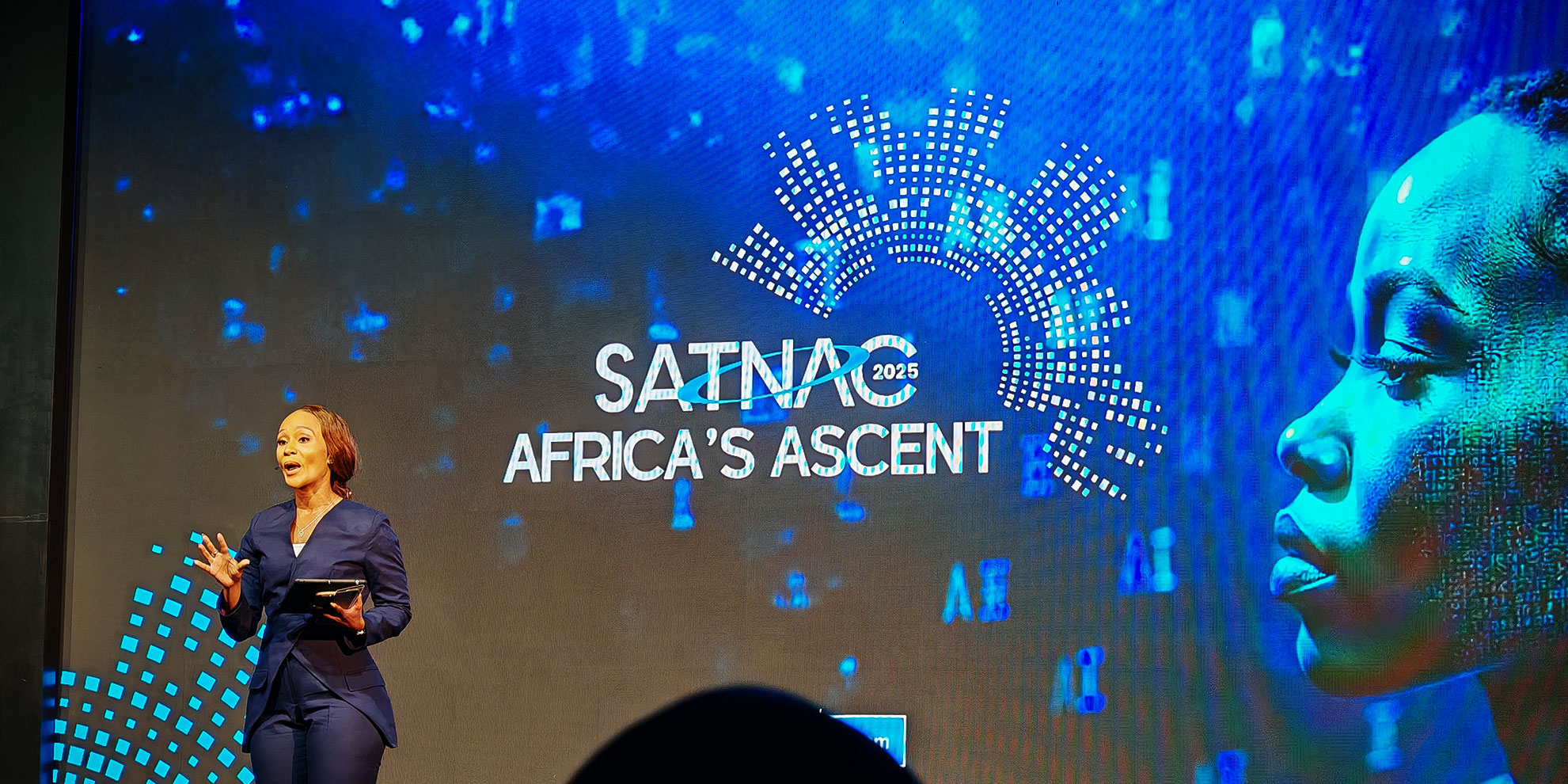
 CNBC anchor Fifi Peters was the MC, and she had her hands full trying to corral the delegates. (Photo: Lindsey Schutters)
 The key to wearing a Batman mask (think the full plastic one that would finish off the costume) to a black-tie masquerade ball is confidence. You’re going to get comments, and there is always the threat of being denied access to the event. It’s a gamble, much like the one Telkom took in 1997 to address the skills shortage in the telecoms industry.
Twenty-eight years later, and we’re experiencing a new seismic shift (and approaching a new bubble pop). Only, this time, the conversations before dinner focus on the disturbingly low repeatability some university researchers are experiencing in their application development work with the current crop of large language models (LLMs).
Read more: Stanlib adds pension funds to Cassava’s bet on African AI factories
Nokia executives provided a free consultation when they inquired about a local group of researchers focused on fibre sensing. This cutting-edge technology allows underground fibre cables to detect vibrations from approaching excavators.
While the knowledge exchange was happening over drinks, the main plenary of the formal programme was dominated by vibes. And the vibe at the Arabella Hotel in Keainmond, Western Cape, was one of aggressive optimism, bordering on the evangelical.
On your marks
If you listened only to the headline acts, you’d have been forgiven for thinking the digital divide had been filled with fibre-optic cement and smoothed over.
“For the first time in modern history, Africa is standing at the starting point in the starting line of technological evolution at the same moment as the rest of the world,” announced Telkom Group CEO Serame Taukobong.
It’s a compelling narrative, especially when delivered to a room full of industry captains. “In the age of intelligent systems, Africa is not behind. We are alongside artificial intelligence.”
Look, it would make a great LinkedIn carousel. Taukobong doubled down on the human element, insisting that “Africa’s greatest resource is not mineral or mental. It is our imagination, our creativity, our resilience and our people.”
Read more: GovTech 2025 hawks digital dreams in decaying Durban
But there was a tension in the room, a static electricity that wasn’t just coming from the server racks. It was the tension between the Africa Rising narrative and the reality of a continent that still struggles to keep the lights on, let alone power a localised LLM training cluster.
Idit Duvdevany Aronsohn, head of ESG and people relations for Amdocs, tried to bridge that gap with a sentiment that felt like a challenge rather than a statement of fact: “Africa doesn’t need to catch up. It can leap ahead if inclusion is designed from day one.”
Outrun reality
It took the futurist Graeme Codrington to walk onto the stage, poke the bear and offer a sobering splash of cold water.
“I think that our biggest problem is that we’ve decided to not look at the things that really matter,” he told the hushed auditorium.
“We are not using the technologies that we have got to change the world. We are using it to reinforce the world as it already exists.”
Are we just building faster ways to do the same old inefficient things? Codrington warned that “the real innovation in the next five years is not coming up with another smarter API [Application Programming Interface] or a faster GPT.”
It was a necessary stray bullet fired at the LLM hype cycle. While the students — the supposed beneficiaries of this grand gathering — were showcasing projects on everything from proactive customer support to fraud detection in the hallway outside, the main stage seemed more preoccupied with the idea of AI than the messy application of it.
Out of the running
This is where the Satnac paradox hit hardest. We were told repeatedly that the students are the point. However, Taukobong started his talk by displaying a slide referring to an academic paper on LLMs that was presented on the same platform a decade ago but remained unaddressed.
/file/attachments/orphans/IMG_20251201_100121_693144.jpg "Serame Taukobong cites a white paper presented at Satnac a decade ago that was never acted upon. (Photo: Lindsey Schutters)")
Raymond Crown, ICT director at UWC, framed the stakes correctly: “The retention of graduates, keeping our best minds working on South African and African problems, is now a national priority.”
Read more: Africa has an AI skills problem that is forcing a youth empowerment rethink
Yet, listening to the plenary, you sometimes felt the students were props in a corporate play. Dr Mmaki Jantjies, group executive for innovation and transformation at Telkom SA and the Satnac 2025 conference chair, noted that “countries and companies don’t fall behind because they move too fast. They fall behind because they adapt too slowly.”
But adaptation requires listening to the kids who actually know how to prompt-engineer the future, not just talking at them about “mission-critical local capacity”.
Reaching the finish line
Ultimately, the mask has to come off. The tech bubble we are currently inflating will eventually burst, or at least deflate to a manageable size. When it does, what is left for the African user?
Gugu Mthembu, Telkom's chief marketing officer, offered perhaps the most grounded perspective of the week, cutting through the Silicon Valley-speak.
“Every tower, every submarine cable, every cloud node is a job, a learner, a clinic and a business enabled,” she said.
She then posed the question that should have been printed on the conference lanyards: “Does our cloud, does our AI, does our cyber ultimately make a human life on this continent safer, live a fairer and more dignified life?”
Read more: Google bets on invisibility as the means to win the AI war
As the delegates discussed digital transformation strategies, I thought about the students packing up their demos in the exhibition hall.
“The future is not being built in Silicon Valley. It is being built wherever people refuse to be left behind,” said the Telkom CEO.
He’s right. But looking around Satnac 2025, you have to wonder if the people building that future were the ones on stage, or the ones struggling to get a seat at the table. DM