



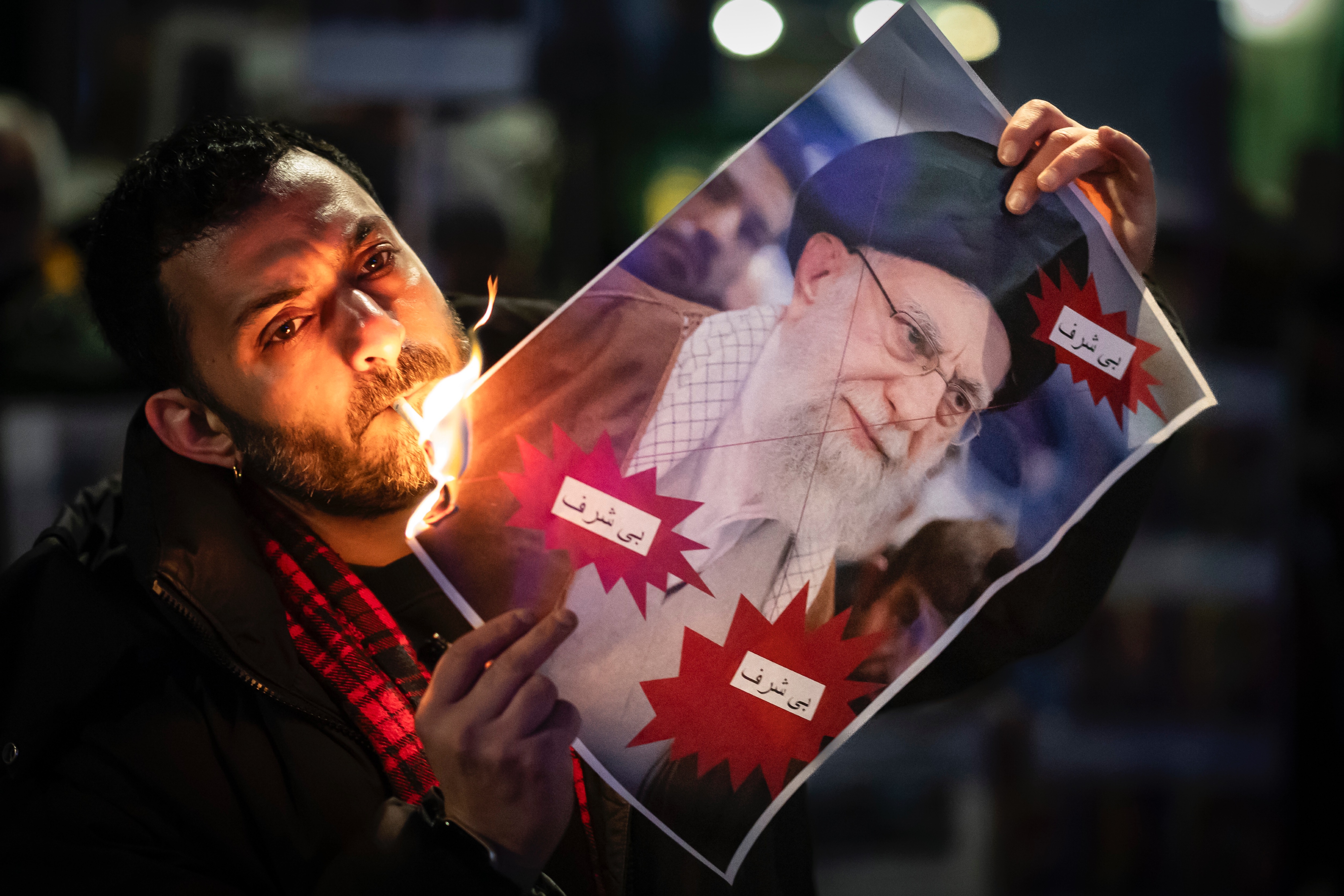
 A protester in Zurich, Switzerland, burns images of Iranian Supreme Leader Ali Khamenei during a rally on 13 January in support of the nationwide mass demonstrations in Iran against the government. (Photo: Michael Buholzer / EPA)
US President Donald Trump urged Iranians on Tuesday to keep protesting and said help was on the way, without giving details, as Iran’s clerical establishment pressed its crackdown against the biggest demonstrations in years.
“Iranian Patriots, KEEP PROTESTING — TAKE OVER YOUR INSTITUTIONS!!!... HELP IS ON ITS WAY,” Trump said in a post on Truth Social, adding he had cancelled all meetings with Iranian officials until the “senseless killing” of protesters stopped.
Asked what he meant by “help is on its way”, Trump told reporters that they would have to figure it out. Trump did not attend a national security meeting on Iran earlier on Tuesday, described as a regular briefing, said White House press secretary Karoline Leavitt.
The unrest, sparked by dire economic conditions, has posed the biggest internal challenge to Iran’s rulers for at least three years and has come at a time of intensifying international pressure after Israeli and US strikes on Iran last year.
Following the US president’s post, Iranian security chief Ali Larijani said on social media platform X that Trump and Israeli Prime Minister Benjamin Netanyahu were the “main killers” of the Iranian people.
An Iranian official said about 2,000 people had been killed in the protests, the first time authorities have given an overall death toll from more than two weeks of nationwide unrest.
The US-based rights group Hrana said that of the 2,003 people whose deaths it had confirmed, 1,850 were protesters. It said 16,784 people had been detained, a sharp increase from the figure it gave on Monday.
/file/attachments/orphans/13642938_132460.jpg "Protesters in Zurich, Switzerland, attend a rally on 13 January in support of the nationwide mass demonstrations in Iran. (Photo: Michael Buholzer / EPA)")
/file/attachments/orphans/13642889_800902.jpg "Protesters in Zurich, Switzerland, stand in solidarity with the Iranian demonstrators on 13 January. (Photo: Michael Buholzer / EPA)<br>")
Trump announces import tariffs
On Monday evening, Trump announced 25% import tariffs on products from any country doing business with Iran — a major oil exporter. Trump has also said more military action was among the options he was weighing to punish Iran over the crackdown.
Tehran has not yet responded publicly to Trump’s announcement of the tariffs, but it was swiftly criticised by China. Iran, already under heavy US sanctions, exports much of its oil to China, with Turkey, Iraq, the United Arab Emirates and India among its other top trading partners.
Iran’s foreign minister, Abbas Araqchi, said on Monday he had continued to communicate with US special envoy Steve Witkoff during the protests and that Tehran was studying ideas proposed by Washington.
Witkoff met Reza Pahlavi, the exiled son of Iran’s last shah and a prominent voice in the fragmented opposition, over the weekend, Axios reported. Pahlavi has urged Trump to intervene.
Iranian authorities have accused the US and Israel of fomenting the unrest.
Russia on Tuesday condemned what it described as “subversive external interference” in Iran’s internal politics, saying any repeat of last year’s US strikes would have “disastrous consequences” for the Middle East and international security.
No signs of fracture
Despite the protests, the economic strains and years of external pressure, there are as yet no signs of fracture in the security elite that could bring down the clerical system in power since the 1979 Islamic Revolution.
Britain, France, Germany and Italy all summoned Iranian ambassadors in protest over the crackdown.
“The rising number of casualties in Iran is horrifying,” European Commission President Ursula von der Leyen posted on X.
Underscoring international uncertainty over what comes next in Iran, which has been one of the dominant powers across the Middle East for decades, German Chancellor Friedrich Merz said he believed the government would fall.
“I assume that we are now witnessing the final days and weeks of this regime,” he said, adding that if it had to maintain power through violence, “it is effectively at its end”.
Araqchi dismissed Merz’s criticisms, accusing Berlin of double standards and saying Merz had “obliterated any shred of credibility”.
Man accused in protests set to be executed
The protests began on 28 December over the fall in value of the currency and have grown into wider demonstrations and calls for the fall of the clerical establishment.
Iran’s authorities have taken a dual approach, cracking down while also calling protests over economic problems legitimate.
Hengaw, an Iranian Kurdish rights group, has reported that a 26-year-old man, Erfan Soltani, arrested in connection with protests in the city of Karaj, will be executed on Wednesday. Authorities had told the family that the death sentence was final, Hengaw reported, citing a source close to the family.
Reuters could not independently confirm the report. State media has not reported any death sentences so far.
Parliament member Mohammadreza Sabaghian, who represents the central area of Yazd, said the government needed to resolve people’s dissatisfaction, otherwise “the same events will occur with greater intensity”.
Communications restrictions, including an internet blackout, have hampered the flow of information. The UN said phone service had been restored but the internet still faced restrictions. DM