




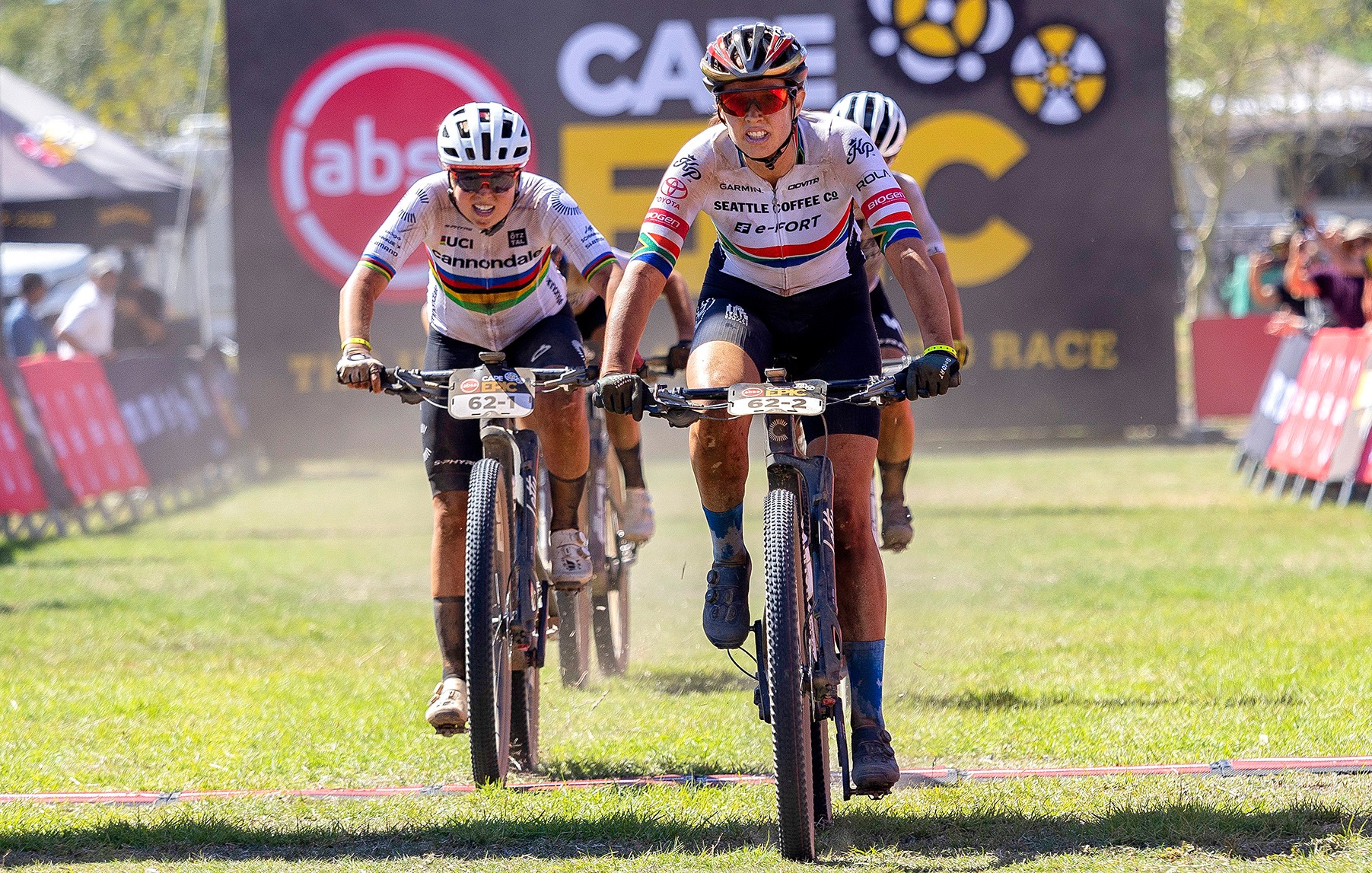
 South Africa's Candice Lill (right) is hoping to win the Cape Epic in 2026. (Photo: EPA / Kim Ludbrook)
 One of the most iconic stage races in mountain biking, the annual Cape Epic, returns this weekend on 15 March 2026.
The eight-stage race winds through some of the world’s most incredible scenery, from the arduous Klein Karoo to the rolling orchards and vineyards that define the Western Cape.
It consistently attracts professionals of a global calibre alongside dedicated amateurs, all eager to test themselves against its rugged and unpredictable terrain.
For the elite women’s section, riders face a new challenge as the route changes for this year’s race.
For many years, parity was pursued by having the women race the same distance as the men. This year, however, organisers have shifted the approach, aiming for parity in race duration rather than distance.
/file/attachments/orphans/11381498_723778.jpg "South Africa’s Matthew Beers (left) during the 2023 Absa Cape Epic at Lourensford Wine Estate. (Photo: EPA / Kim Ludbrook)")
In a statement, the organisers of the Cape Epic said the change would bring the stage race “in line with the norms of cycling more generally”, and that they hoped the adjusted course would “encourage earlier attacks, smaller time gaps and closer competition”.
Additionally, for the first time in 20 years the Cape Epic will venture into the dry lands of Montagu for stage one and two of the race.
Inhospitable yet striking, Montagu is set to revive old traditions and stir up memories of past triumphs.
‘A very positive change’
This shift to race distances that prioritise time on course is not new. It already features in cross-country mountain biking internationally, bringing the Cape Epic more closely in line with broader norms across the sport.
Over eight days, the men will cover 707km and climb an outstanding 15,900m – that is nearly twice the height of Mount Everest.
In contrast, the elite women’s route will see the riders cover 132km less than the men, with a difference of 2,550m in climbing.
To achieve this, the women’s route will either have a different start location for point-to-point races, or deviations from the main route on the loop stages.
The aim for this year will be to have the elite women’s stages take a similar time to complete as the men’s race.
Last year, the winners of the elite women’s race completed the race with a time stamp of 29 hours, while the elite men’s winning time was 23 hours.
Both the Prologue and Stage 7 will remain unchanged, as their racing duration already falls within the event’s time-parity guidelines, while the other six stages will be adjusted in distance and total climbing.
/file/dailymaverick/wp-content/uploads/2023/03/ACE23_Stage2_SamClark_0404.jpg "Candice Lill (front) leads Amy Wakefield (in second) at speed during stage 2 of the 2023 Absa Cape Epic. (Photo: Sam Clark, Absa Cape Epic)")
“From my side, I’m very excited about it. I think it’s a very positive change just in terms of bringing up the professionalism of the women’s side,” Candice Lill, five-time silver medallist for the Cape Epic, told Daily Maverick.
“I think it’s difficult sometimes to explain to people because they think that the Cape Epic is being offensive against women because we can’t do the same distance [as men],” she said. “But it’s not about that at all. [The organisers] consulted all of us. There were long discussions about whether they should make this change or not.”
By increasing competition as well as accessibility, Lill believes the Cape Epic will see growth in the women’s field.
“We need to make it more accessible for women, and essentially, if you make a change, be it, yes, shortening the distance to be within the same time as the men, you are going to have more opportunity for better racing,” she said.
Eliminated lulls
In previous editions, with smaller numbers in the race, the longer routes often produced long stretches of dirt road where the pace stabilised and the contest essentially stalled, said Lill.
“With those sections being taken out, especially if [the organisers] do it in a smart way, it will just make the racing more exciting; things will be happening all the time, as opposed to having these long sections.”
Closing the gap in racing will further provide increased coverage of the elite women’s race.
/file/dailymaverick/wp-content/uploads/2025/03/12916732.jpg "Switzerland’s Nino Schurter (left) and Filippo Colombo celebrate after stage 7, winning the 2025 Cape Epic, on 23 March 2025. (Photo: EPA-EFE / Kim Ludbrook)")
Although the race featured helicopters, drones and e-bikes to produce a full-day livestream, the structure of the broadcast had sometimes made it difficult to capture both races equally, said Lill.
The focus would often follow the men’s race as they would be leading, meaning that by the time crews refuelled and returned, “our racing was actually happening and they weren’t getting there”, said Lill.
“So, [the new route] brings that all together so that it’s almost like our racing is happening simultaneously.”
Women racing in the Open, NTT Masters, GIC Grand Masters or Mixed categories will not be affected by the route changes, organisers confirmed.
Title up for grabs
The absence of last year’s winning pairs has blown the race wide open.
Defending champions Annika Langvad and Sofia Gomez Villafañe will not be competing, leaving the door open for a highly competitive women’s field.
Current world marathon champion American Kate Courtney will partner with German Greta Seiwald, the four-day Tankwa Trek winner. This was a last-minute partner swap for Courtney after her fellow American Melisa Rollins withdrew due to injury.
Returning to the Cape Epic after taking a break from the race in 2025, Lill is hoping to turn her silver medals into gold.
Her partner this year is Alessandra Keller from Switzerland. While this is Keller’s maiden Cape Epic, the rider boasts a world of experience in cross-country mountain biking.
She was the 2025 Short Track world champion, the junior and U23 world champion and she dominated the 2022 and 2024 seasons, claiming World Cup titles in both cross-country Olympic and short track disciplines.
Keller’s “never say die” attitude and riding style paired with Lill’s vast experience is sure to make for an exciting pair.
“I have a lot of faith in her. We’re very well matched in terms of riding and personality,” Lill told Daily Maverick.
/file/dailymaverick/wp-content/uploads/2025/03/Epic25_S7_DomBarnardt-3369.jpg "Denmark’s Annika Langvad (left) claimed her sixth Absa Cape Epic title, and teammate, Argentinian Sofia Gomez Villafana (Toyota|Specialized) her second in the women's race in 2025. (Photo: Dom Barnardt / Cape Epic)")
In the men’s race, last year’s winners Nino Schurter and Filippo Colombo will also be absent, making three-time champion Matthew Beers and fellow South Africa Tristan Nortje the pre-race favourites.
Beers was meant to ride with his partner from 2025, Keegan Swenson. However, following a collision with a car during training resulting in a fractured hip, Swenson was forced to withdraw.
As the favourites, Beers and Nortje will be attempting to become the first all-South African men’s team to win the overall title in the event’s history.
All routes will start at the Meerendal Wine Estate and finish in the wine region of Stellenbosch. DM
Elite Men’s Route:
Prologue: Length: 20km // Climbing: 650m
Stage 1: Length: 90km // Climbing: 2150m
Stage 2: Length: 102km // Climbing: 2250m
Stage 3: Length: 134km // Climbing: 1750m
Stage 4: Length: 84km // Climbing: 1950m
Stage 5: Length: 128km // Climbing: 2700m
Stage 6: Length: 76km // Climbing: 2450m
Stage 7: Length: 58km // Climbing: 2150m
Elite Women’s Route:
Prologue: Length: 20km // Climbing: 650m
Stage 1: Length: 70km // Climbing: 1800m
Stage 2: Length: 83km // Climbing: 1850m
Stage 3: Length: 107km // Climbing: 1450m
Stage 4: Length: 73km // Climbing: 1450m
Stage 5: Length: 89km // Climbing: 2150m
Stage 6: Length: 60km // Climbing: 1850m
Stage 7: Length: 58km // Climbing: 2150m