




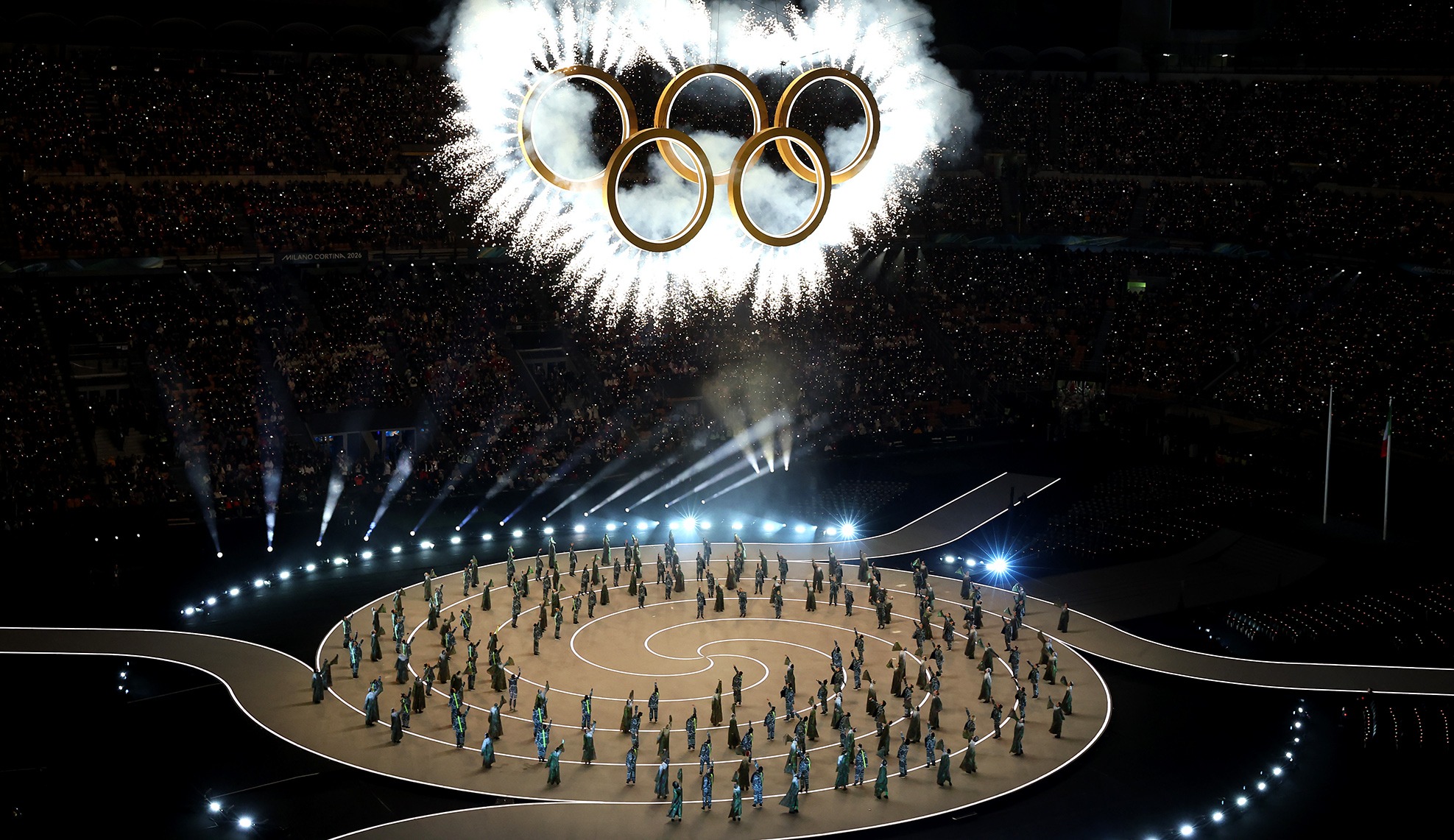
 The 2026 Winter Olympics opened at the San Siro Stadium in Milan on 6 February 2026 and delivered a memorable 16 days of competition. (Photo: Maja Hitij / Getty Images)
For many South Africans, the spectacle unfolded at a distance. Following SuperSport’s late decision not to broadcast the event, audiences were largely left to piece together highlights, headlines and viral moments through international news outlets and social media feeds.
Declaring the Games officially over, International Olympic Committee (IOC) president Kirsty Coventry described the two weeks as “fantastic”.
“Over the last two weeks we have seen and experienced incredible Games. I have no words really,” she said.
Norway topped the medal table with 18 golds and 41 in total, beating the Olympic giant that is the US who racked up 12 golds and 33 in total.
The Winter Olympics are always exciting, with death-defying jumps and outrageous speeds as athletes step up to the plate and showcase their talents.
/file/attachments/orphans/GettyImages-2261656704_269560.jpg "Nicole Burger of Team South Africa in action during the women’s skeleton heat two on day seven of the Milano Cortina 2026 Winter Olympic Games. (Photo: Daniel Kopatsch / VOIGT / Getty Images)")
However, the 2026 edition will also be remembered for the political tensions that cut through the snow and spectacle, reminding the world that no matter how hard the IOC tries, even the Olympics cannot exist in isolation from global unrest.
‘ICE out’
Even before the Games began, tensions were erupting in Italy when hundreds of people took to the streets to protest against the presence of US Immigration and Customs Enforcement (ICE) agents. The student-led demonstration featured banners reading “ICE out” and “ICE should be in my drinks and not my city”.
This came amid global outrage over an immigration crackdown initiated by President Donald Trump in which the agency has been linked to the fatal shooting of two Americans in the US.
In addition, during the opening ceremony of the Games, in a moment of audible dissent, the crowd erupted into a chorus of boos when the big screen spotlighted US Vice-President JD Vance.
What’s more, Ukrainian skeleton athlete Vladyslav Heraskevych was banned from competing by the IOC on 12 February for wearing a helmet that violated the IOC’s rules on athlete expression.
/file/attachments/orphans/GettyImages-2260886117_159907.jpg "Ukraine’s Vladyslav Heraskevych was banned from competing by the IOC because he refused orders to change his ‘Helmet of Remembrance’. (Photo: Richard Heathcote / Getty Images)")
Heraskevych wore a “Helmet of Remembrance” during his practice sessions that featured images of fellow Ukrainian athletes who had been killed during Russia’s invasion of his home nation.
However, in the same breath, the IOC is also defending its decision to sell controversial T-shirts emblazoned with the poster of the 1936 Berlin Olympics. The 1936 Summer Olympics are largely remembered for being exploited as a Nazi propaganda platform by German Chancellor Adolf Hitler.
An IOC spokesperson told the BBC that while it “of course acknowledge[s] the historical issues of Nazi propaganda” it also wanted to remember that the Berlin 1936 Games saw “4,483 athletes from 49 countries compete in 149 medal events”.
“We made an Olympic Heritage Collection available to the public that celebrates 130 years of Olympic art and design. For this series, emblems, pictograms, posters and mascots from all editions of the Olympic Games are featured,” the spokesperson said.
Green and gold
Amid all the geopolitical tensions, the South African delegation can count themselves proud. This year, South Africa sent its largest Winter Olympics contingent yet. Five athletes – Malica Malherbe, Nicole Burger, Matt Smith, Thomas Wei and Lara Markthaler – represented the country clad in green and gold.
/file/attachments/orphans/IMG_94971_938790.jpg "Cross-country skier Matt Smith represented South Africa with pride. (Photo: Supplied / Matt Smith)")
Nicole Burger, the first South African woman to compete in the skeleton, finished 25th overall after four heats, with a total time of 3:58.10, which was 9.08 behind the gold medal winner, reaching speeds of 116.58km/h.
Malherbe also finished in the top 30 in the freestyle competition, while Markthaler just missed out in both the giant slalom and slalom event but still went out in style as she celebrated her birthday the best way she knows how: on the slopes.
Weir was unfortunate with a DNF (Did Not Finish) on the brutal alpine slalom course alongside 49 other competitors who were unable to finish.
While cross-country skier Matt Smith has no hopes of medalling any time soon, his greatest impact was perhaps off the course. Using social media, Smith spotlighted the often unseen hard work required of athletes from non-skiing nations to compete, and the value they bring in growing the sport beyond its traditional northern strongholds.
High risk, high reward
This rang true when Brazil’s Lucas Pinheiro Braathen won gold in the giant slalom, carving his name in snow sport history by becoming the first South American to win gold at the Winter Olympics.
Despite heavy snow and fog, he held off the world’s top-ranked skier, Switzerland’s Marco Odermatt, to win gold by 0.58 seconds.
For the first time since the 1980 “Miracle on Ice” squad of amateurs brought home the gold, the US men’s ice hockey team snapped their Olympic drought in a nerve-shredding final when they beat Canada.
/file/attachments/orphans/GettyImages-2262980135_414082.jpg "The US men’s ice hockey team won their first Olympic gold since 1980. (Photo: Bruce Bennett / Getty Images)")
/file/attachments/orphans/GettyImages-2262973909_679874.jpg "Jack Hughes lost a tooth but scored the overtime winner to give the US a 2-1 win over Canada in the men’s ice hockey gold medal match. (Photo: Elsa / Getty Images)")
After taking a high stick to the mouth, it only seemed fitting that Jack Hughes would score the winning goal in a 2-1 overtime victory against their arch-rivals.
Mikaela Shiffrin provided one of the most emotional and redemptive arcs of the 2026 Games. After a heartbreaking experience in Beijing four years ago where she did not win a single medal, she returned to the top of the podium in Italy to cement her status as the greatest alpine skier of all time.
She is the only American in alpine ski history to hold three gold medals, breaking a record she previously held with Ted Ligety and Andrea Mead Lawrence. With 108 world cup wins, Shiffrin is arguable the most decorated skier in alpine history.
/file/attachments/orphans/GettyImages-2262434744_889152.jpg "Alpine skier Mikaela Shiffrin won the women’s slalom. (Photo: Daniel Kopatsch / VOIGT / Getty Images)")
After this edition of the Games, Eileen Gu now holds the most gold medals of any free skier after she won gold in the women’s halfpipe and walked away with two silvers in the women’s big air and slopestyle free-skiing events.
But, she is more than just her medals. The American-born athlete is the highest earner at the 2026 Olympics, a Stanford University student majoring in international relations, is a professional model and was a controversial figure for some time after deciding to switch allegiances from the US to China in 2019.
The Canadian men claimed Olympic curling gold with a 9-6 victory over Britain on Saturday. This was after they were embroiled in a cheating scandal during the round-robin stage of the Olympics. Canada’s Marc Kennedy was accused by the Swedish team of double-touching the curling stone, which is an illegal move.
/file/attachments/orphans/GettyImages-2262317954_582141.jpg "Australia’s Danielle Scott in the women’s aerials final.(Photo: Patrick Smith / Getty Images)")
Alysa Liu became the first American woman to win an individual figure skating gold medal in 24 years. This was a comeback for the books following her retirement after the 2022 Beijing Olympics where she debuted at just 16 years old.
/file/attachments/orphans/GettyImages-2262541604_295469.jpg "The US’s Alysa Liu celebrates after winning gold. (Photo: Matthew Stockman / Getty Images)")
The Winter Olympics were also not without their death-defying accidents. US skiing great Lindsey Vonn had to cut her Olympic run short after she suffered a complex leg fracture in her downhill race that required multiple surgeries.
In the four-man bobsleigh event, Jakob Mandlbauer, the pilot for the Austrian team, was carried off on a stretcher after a dramatic crash during the race in which his team’s sled flipped upside down.
Finally, Poland’s Kamila Sellier had to undergo surgery and lengthy treatment after a competitor’s blade sliced her below her left eye in the quarterfinals of the women’s 1,500m short track speed skating race on 20 February. DM
Comments
Scroll down to load comments...