



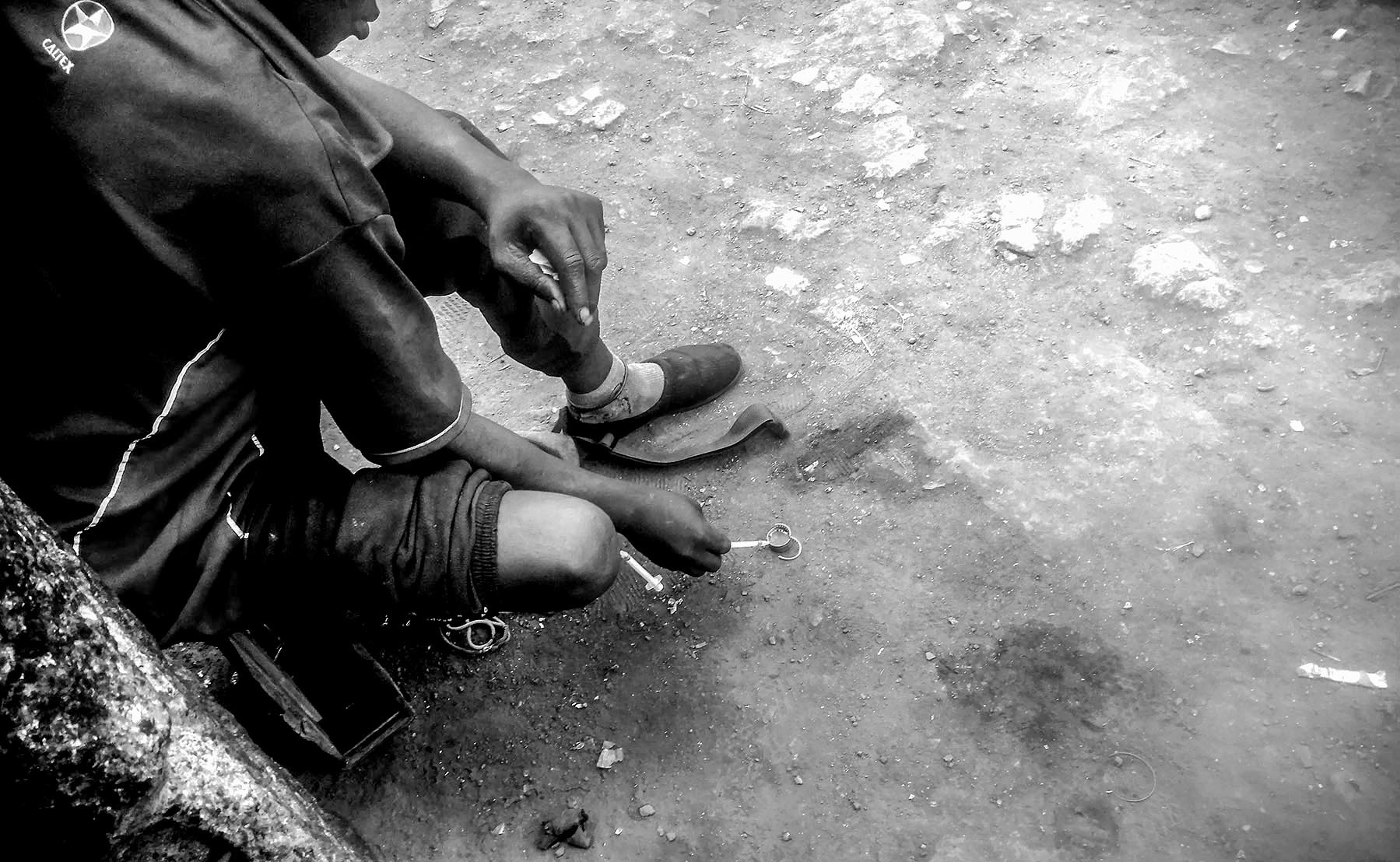
 An addict demonstrates how he prepares his dose in a medical syringe before injecting himself. (Photo: Bheki Simelane)
Goliath Mofokeng, 34, from Protea in Soweto, has been a nyaope addict since he was 12 years old. He was recently hired at a local scrapyard to weigh metal and other scrap.
“Before I landed the job a few days ago, the first thing I’d do is go out to ‘hustle’ because I cannot survive without that morning hit,” says Mofokeng, which is not his real name.
He does not want to reveal how much he earns at the scrapyard, but says he will not quit hustling just because he now has a job.
Mofokeng says sometimes he hustles at night and makes enough money to last him the whole of the next day, up to R350 or R400.
“I use the money to buy food,” he says. “I eat the cheap R10 or R20 plates of food sold in the township, and I use the rest of the money on smoking and cold drink.”
“Hustling involves going out and finding whatever you can to sell at the scrapyard and get some money,” Mofokeng says. “But because there are so many of us now, one needs to be strategic.”
“You find some people claiming that you cannot encroach on their territory, and fights often break out,” Mofokeng adds. “You have to have a thick skin.”
/file/attachments/orphans/pic_518071.jpg "Goliath Mofokeng, 34, a nyaope addict from Protea in Soweto, waits for his food after taking a break from his work at a local scrapyard. (Photo: Bheki Simelane)")
Lack of resources
Nyaope is low-grade heroin, often combined with cannabis to be smoked or it is injected. It has carved its way into South African townships, especially among young people.
Katlego Morare, a research psychologist from Wits University, said, “There is a great lack of relevant resources for dealing with nyaope specifically, including a lack of specialist treatment centres.”
Asked if there is a link between nyaope addiction and poverty, Morare says research shows that many nyaope addicts come from socioeconomically disadvantaged communities.
Morare says there are many reasons why the youth fall into the trap of nyaope consumption, and ultimately addiction. Describing what contributes to nyaope use and addiction, Morare said:
“Their contexts, what is present, and what they are exposed to. In terms of what is lacking, this includes a lack of mental health services and self-esteem-building and/or resilience-building efforts, lack of care, support, guidance,” Morare said.
“Protection from external influences at the family level, lack of relevant drug addiction education, a lack of security measures, a lack of school counsellors at the school level, a lack of future-building resources at the community level, and a lack of poor governance at the national level,” Morare added.
Read more: The Nyaope Boys — ‘There is one way in; your way out, it’s only when you are dead’
In Gauteng townships, nyaope is easily accessible, cheap and widely available,
“It is not an easy issue to tackle,” Morare said. “Combating nyaope consumption requires unity, collaboration and integrity at every level, from the individual, family, school, community, to the wider society and government.”
Morare said addicts’ “primary goal is to curb the experience of these withdrawal symptoms, thereby making engagement in other activities less important and urgent”.
“Withdrawal symptoms include severe stomach cramps, nausea and excessive sweating.”
/file/attachments/orphans/IMG_20260204_143349_866137.jpg "Mofokeng walks to a nearby informal trader to buy a plate of food. He has been addicted to nyaope for 22 years. (Photo: Bheki Simelane)")
Read more: SA is facing a fast-escalating heroin crisis — and it’s being misunderstood
‘Not a decent life’
Mofokeng says he is happy that he is still alive. He attributes this to leading a crime-free life. But according to him, his health is no longer what it used to be due to both his addiction and work collecting scrap to sell.
“I was knocked down by a car while hustling along the Chris Hani Road,” he says.
He says sometimes he strongly considers quitting, but also acknowledges how difficult it is. He says he smokes nyaope to cope with the hardships he has faced in his life, without elaborating on them.
“It’s a lot, and I don’t even get the R350 social relief of distress grant because the government does not like us – not many people do,” Mofokeng says. “I do not have a decent life in the street and at home.”
He says he cannot quit nyaope yet because of the constant consolation he gets from smoking, a habit on which he became hooked while experimenting as a child. He counts more than two dozen addicts he knows, who he says have died.
Read more: Cutting through the myths and misconceptions around harm reduction services for addicts
The hustle
Nyaope addicts hustle like no other. Every day, they are out early so that they can make enough money to get their hands on that early morning dose. Mofokeng is no different. With his years of experience in hustling, he knows exactly where to go.
As he goes to buy some food at a local trader around midday on Wednesday, he keeps his eyes glued to the ground. He occasionally bends over to pick up tiny pieces of metal that only he seems able to spot. He digs them up with his swollen hands.
He admits that most of his time is invested in securing his next fix. When he gets a moment of calm, he immediately dozes off, and it does not matter where he is.
/file/dailymaverick/wp-content/uploads/2024/03/MC-CapeFlats-Drugs_2-1.jpg "A drug addict injects heroin in Vrededorp, Johannesburg. (Photo: Joyrene Kramer)")
Back at the scrapyard, where several other nyaope addicts hang around, Mofokeng gets hold of a bucket half full of small metal pieces and begins to wash the metal pieces in clean water. He selects certain pieces and puts them aside.
“You want to look for anything shiny and anything that resembles copper, and that is what you weigh,” he says.
Near the entrance to the scrapyard, there is a metal sheet on which the prices of each type of metal are written. Copper is one of the top sellers at more than R150 per kg.
Mofokeng says addicts are easily manipulated. Nyaope diminishes their judgement and sometimes they’re exploited.
“I will not go to stack cases of beer in a wheelbarrow for R5,” he says. “I will only do that for R50 and nothing less than R40. I’m human, not a horse.”
A Soweto scrapyard owner who also sells nyaope and crystal meth and who preferred to remain anonymous says, “I will admit that we are making really good cash from the addicts, but we need to exercise some conscience, all of us, and say, let us help these kids because that’s all they need.”
He adds, “They do not need rehab. That thing does not work. They need help from us, the community and their families, everyone who can help them turn their lives around.”
Government interventions
Daily Maverick asked the Gauteng provincial government what it was doing about the devastation that nyaope was wreaking on young lives in the province’s townships.
Elijah Mhlanga, spokesperson for Gauteng Premier Panyaza Lesufi, referred to the province’s Tswa DAAR “Quit That” drive, which is the province’s anti-abuse response programme. It’s sold as a tool to gather data on addicts in order to, among other initiatives, inform policy and resource allocation.
But it doesn’t speak directly to those who are affected, the addicts and their parents. The provincial Department of Social Development runs rehabilitation centres, staffed by professionals. According to the department, the centres are equipped with vital resources to help people break free from substance abuse while giving families the support they desperately need.
These centres are far from Protea and, according to nyaope users, haven’t worked for them in the past. DM