




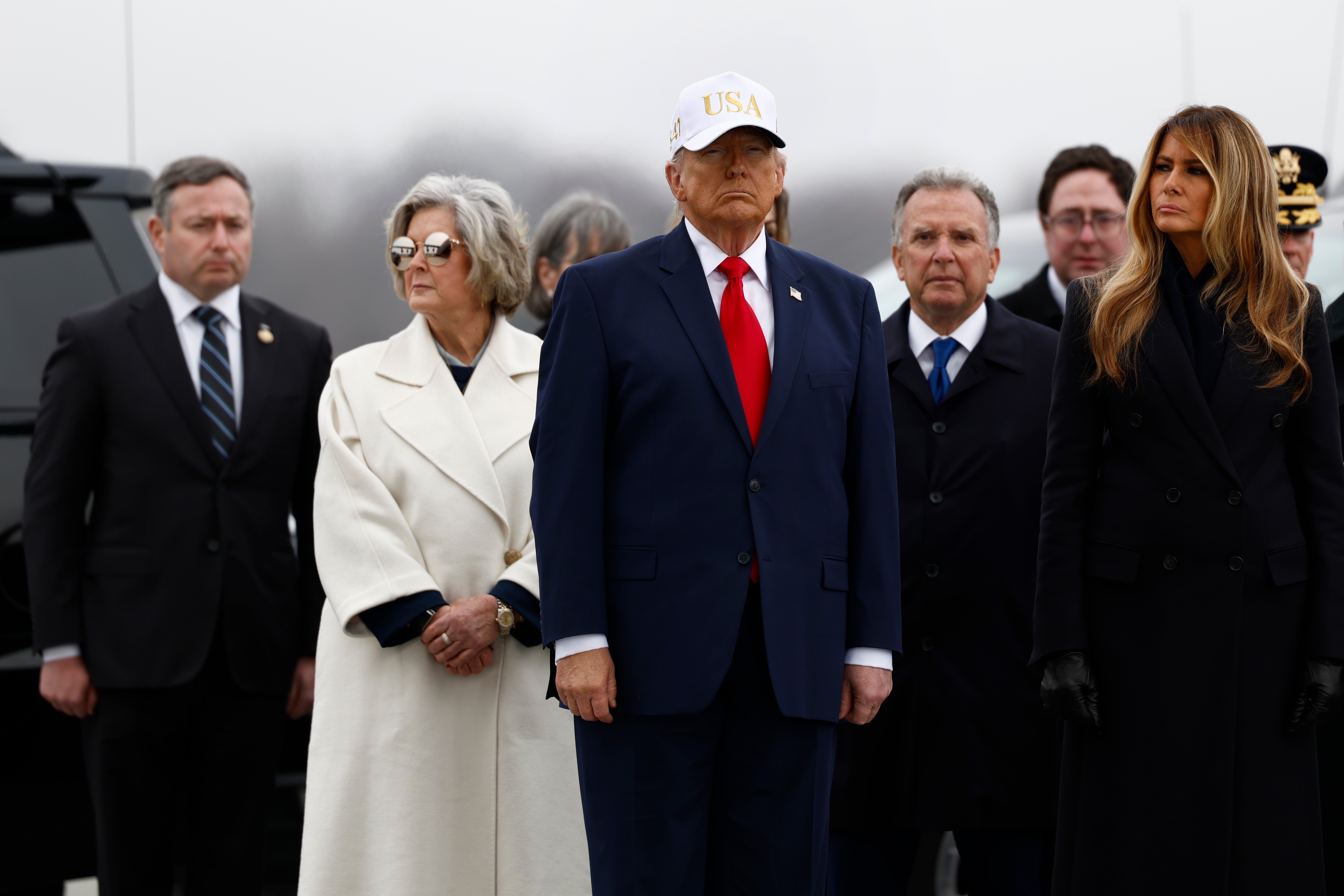
 US President Donald Trump (centre) and US First Lady Melania Trump (front right) attend the dignified transfer of six fallen US service members at Dover Air Force Base in Dover, Delaware, United States, on 7 March 2026. The remains of the soldiers from the 103rd Sustainment Command were being returned to the United States after they were killed in a drone attack in Kuwait. (Photo: EPA / Will Oliver)
No, the title of this story was – almost – clickbait. This story is obviously not about an election in Iran, although it would be a great pleasure to write a piece about a free and fair election taking place there. Instead, this story is about what may well happen in actual American electoral politics in the wake of the Iranian conflict.
Or, perhaps, even more appropriately, what may well happen if this war of choice drags on and on and, then, quietly begins to morph into what increasingly looks like one of those detested forever wars and briar patch-ish nation-building exercises. You know, the things so despised by Donald Trump, his minions and his vociferous Maganistas during the 2024 election and afterwards.
So far, this “conflict,” or “war” has taken place over several weeks at a dollar cost to the US of over $1-billion/day. (A war is what it has become, despite a reluctance to so name it, lest the Trump Administration bump into even more congressional annoyance or anger because of a pesky thing called the US Constitution and Congress’ authority over declarations of war).
/file/attachments/orphans/GettyImages-2265160280_708892.jpg "US President Donald Trump speaks to US Speaker of the House Mike Johnson (left). (Photo: Anna Moneymaker / Getty Images)")
That growing cost may have seemed unimaginable, unless you factored in the costs of all those warheads and missiles (both expended and now needing to be replaced in inventory), the extra operating costs in this Middle Eastern theatre of conflict with that massive fleet, and the costs of those really expensive lost aircraft and (at least potentially) even naval vessels. This is before the lost opportunities (and costs) in bringing this huge floating and flying mission’s equipment and personnel, diverted from other theatres, to its current duty station.
Of course, that massive and growing number excludes the “value” of American personnel killed or wounded in the conflict, similar fatalities among other nations’ forces, the rising death toll and damage inside Iran, in the Gulf Arab states and inside Israel – and now among the Lebanese as well in the latest Hezbollah/Israel fighting.
This calculation does not include the impact from the disruptions to the global trading system and the negative impact of rising costs for petroleum, natural gas and fertiliser. And if you run a shipping fleet, your insurance premiums may go through the roof.
/file/attachments/orphans/GettyImages-2266909637_309386.jpg "An injured man in central Tehran following a strike on a residential building on 16 March 2026. (Photo: Getty Images)")
This is just what is happening already. Now, imagine the fighting continuing through the Northern Hemisphere’s summer and into autumn and – presto – all of this runs smack into the American mid-term electoral efforts in November.
Now, nobody really expects the current intensity of fighting to continue for the next seven months or so. But who really knows, since this is the Middle East and stuff happens in that world, where vendettas, unresolved (unresolvable) conflicts and existential fears and dreads are always on the menu.
But even if this conflict in all its manifestations only rumbles on with only an occasional missile or drone flight, some of these issues are already becoming baked into thinking and calculations by the protagonists. But if the current conflict were to continue at its current rates of damage and costs — or even at a somewhat abated level, but still continuing? What then?
What’s at stake
For Americans, and by extension for the rest of us, it is important to remember, beyond all the death and destruction, that the US is already heading into its mid-term electoral cycle. This means that although the presidency as an office is not up for election until 2028, the entirety of the House of Representatives is, as well as a third of the Senate.
This matters because Donald Trump’s Republican Party holds razor-thin majorities in both houses, and Democrats are increasingly exuberant over the chances they can win enough House seats to gain control of that chamber. Some even more optimistic Democratic strategists and politicians believe they may even gain a majority in the Senate, although that is a more distant hope, given that a majority of the Senate seats up for election this year are already held by Republicans.
/file/attachments/orphans/GettyImages-2264651226_906820.jpg "US House Minority Leader Hakeem Jeffries speaks to reporters during a news conference in the US Capitol Building in Washington, DC, on 3 March 2026 to discuss the US and Israeli attacks on Iran. (Photo: Anna Moneymaker / Getty Images)")
Control of the Congress’ chambers matters because with numerical control comes the chamber’s leadership, committee chairmanships and the power to call hearings, issue subpoenas for documents and testimony by administration officials on pending legislation, and initiate investigations. And then there is control of the budget, too.
If so much of the performance and decisions of the Trump Administration come under increasing scrutiny, a Democratic House or Senate, or both, could subject the administration to a potentially unending round of adverse public, official examination. And they might well be spoiled for choice in picking their spots.
In the run-up to the election, of course, many issues will be at the forefront. Without a presidential election taking place, many candidates and voters – from either party or both – will try to focus on something other than who will be the next president two years hence. So far, at least, the core questions will probably focus on economic issues – unless the Iranian conflict turns into an actual and significant victory or goes really south and metastasises.
The ‘affordability’ challenge
When Trump and the Republicans won in 2024, a key element of their appeal was the economy – not necessarily those big, abstract numbers economists like to tout, but instead on things like the cost of everyday staples and necessities such as eggs, milk, petrol, rent/bond costs and the like. This is the “affordability” challenge.
There was indeed significant inflation during the Biden administration that preceded the second Trump term of office, largely a function of supply chain disruptions during the years of the Covid pandemic and in its aftermath. Promising to beat inflation and lower prices thus became a major factor in Trump’s re-election.
But, of course, quashing inflation is not something achieved by executive fiat or exhortations. The Trump Administration has now added fuel to the fire, however, with the effects of the Iran conflict, most especially the sudden, major price jumps in petrol and diesel fuel affecting virtually every item transported anywhere. This is a direct function of the galloping price rise for petroleum, which is a function of the Iranian conflict.
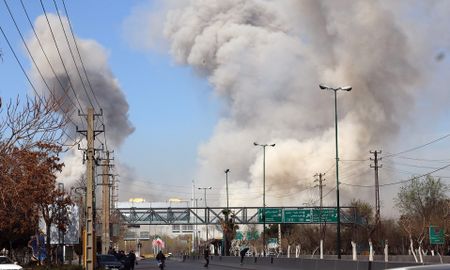
Yes, the US is now basically self-sufficient in petroleum and is a significant exporter of it, but the price of petroleum is set by global supply and demand issues, just like other commodity prices. It was initially affected by the beginning phases of the attacks on Iran by the US and Israel, and the retaliatory attacks on Gulf states by Iran.
Now the price is ratcheting upward sharply by the closure of the Strait of Hormuz, as Iran has choked off exports of petroleum and LNG through that very narrow passage. That represents a fifth of the total shipment of these products onward to East and South Asia — and elsewhere. It is those nasty, basic supply and demand principles.
And that, crucially, may push the Trumpian promise of solving the affordability challenge into the rubbish bin, all while keeping the exact opposite of it on front pages and in social media on through to November. That old truth of the vital importance of kitchen table issues may well push some voters in marginally Republican leaning districts the other way as part of a modest cascade of districts that flip Democratic.
Two other nodal points — matter. The first is the Trump promise of no more of those endless, forever wars and nation-building — and this was possibly a wedge issue for many younger men when they considered the history of those seemingly endless engagements by the US in Iraq and Afghanistan.
In the Trump Administration, however, the quick and nearly bloodless (except for the Cuban security guards) extraction of Venezuela’s Nicolas Maduro may have encouraged Trump to believe the Iranian “excursion” (in Trump’s words) would be a similar walk in the park – and not one of those troublesome, unending conflicts.
At least from the standpoint of the present, the Iranian conflict, in all its manifestations, may begin to verge in that direction for many people. This is in addition to a growing realisation that the costs – beyond price inflation – of this conflict are already mind-boggling. And for some in Magaland, such as Tucker Carlson and his ilk, there is the implication that the US has been dragged into one of those endless foreign wars by others – such as the folks in Tel Aviv and Jerusalem.
Epstein and ICE
There is more. There are also what appear to be the unending sagas of the Epstein Files and that over-vigorous, aggressive prosecution of Trump’s war on illegal immigrants. While neither of these issues is about to deep-six every Republican candidate in the midterm election, they may well deflate support for Republican candidates who embrace the Trumpian worldview and his policies a little too enthusiastically.
Here again, such an impact might well make things more difficult for Republicans in marginal districts.
/file/attachments/orphans/GettyImages-2225863393_116334.jpg "A billboard in Times Square, New York City, calls for the release of the Epstein files. (Photo: Adam Gray / Getty Images)")
So there we have it. Prices rising and petrol rising faster than inflation by a big margin; a conflict that somehow, unaccountably refuses to end heroically; continuing unease about the spreading stain of the Epstein Files; and a growing concern about ongoing ICE activities in rounding up undocumented aliens. What the Republicans must worry about, beyond that, is that collectively, these issues will flatten turnout among Republicans sufficiently to allow more enthusiastic Democratic voters to win in crucial districts.
That would spell trouble for a Republican Congress and the fate of the remainder of the Trump presidency. The temptation for Democrats, however, is to make this upcoming election all about Donald Trump, even though he will never be on a ballot again. In the thoughts of some experienced Democratic strategists, their party must find a way to speak to voters about the future, rather than the follies and failures of the present.
We shall see how it all shakes out. DM
Comments
Scroll down to load comments...