
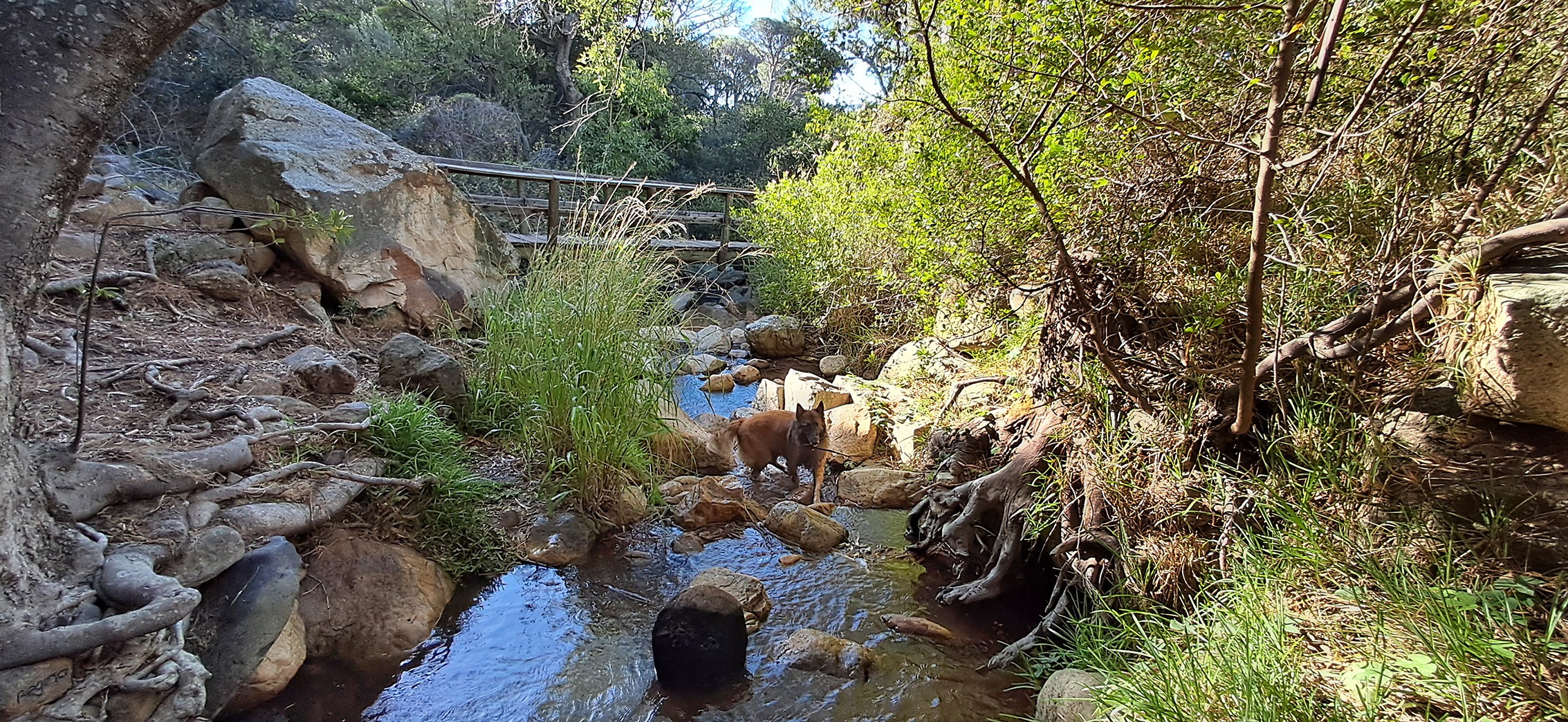
 Mountain trickles are real rivers doing real work. (Photo: Don Pinnock)
 /file/attachments/orphans/storiedmountainlogo_645719.jpg)
Table Mountain is a wetland. Not in the reedy, duck-filled sense people usually imagine, but in a much more surprising way. It’s an ancient sponge, a seep, a slow-release valve. It’s a piece of prehistoric plumbing that catches rain, holds it, filters it and feeds Cape Town both above and below ground, long after the clouds have moved on.
Water doesn’t just rush off the mountain in streams. Much of it sinks into cracks and layers of sandstone, trickling downslope underground, recharging aquifers in the city far below.
If you want to understand how well this system is functioning, you don’t start with pipes or charts or satellite images. You start with bugs.
/file/attachments/orphans/StreamDonPinnock-2_694633.jpg "Clear water is a good sign – but it’s not the whole story. (Photo: Don Pinnock)")
/file/attachments/orphans/StreamDonPinnock_992179.jpg "There’s more in Table Mountains small streams than you imagine. (Photo: Don Pinnock)")
Dr Ruth Fisher is a freshwater ecologist with Table Mountain National Park, which means she spends her days monitoring rivers that most people barely register. She reads water the way others read faces.
Her informants are small, soft-bodied and uncharismatic by Instagram standards: stoneflies, black fly larvae, ghost frog tadpoles. Creatures that tell her stories without saying a word. “These systems are sensitive,” she says, carefully. “And the organisms tell us what’s happening.”
Freshwater ecologists call them macroinvertebrates, but think of them instead as the mountain’s internal diagnostics. Some are fragile specialists, others are tough generalists. Some cling by their bums to rocks in fast-flowing water, mouths open, filter-feeding whatever drifts past. Others hide under stones, in gravel or in slow-moving side-pools. Together, they form a living ledger of oxygen levels, temperature, flow, disturbance and time.
/file/attachments/orphans/CaddisflyCapeNature_344565.jpg "Caddisfly. (Photo: Cape Nature)")
Stoneflies, Ruth says, are famously fussy. They only survive in cold, well-oxygenated, near-natural streams. If she finds stoneflies, she relaxes a little. If she doesn’t – especially where they used to be – alarm bells ring.
Black fly larvae tell a different story. They glue themselves to rocks and feed on suspended material drifting by. Find a sudden abundance of them and the river is telling you something else: there’s a lot more “stuff” in the water than there should be.
“It’s not just which species are there,” Ruth explains. “It’s how many. And where.”
This is why a stream that looks perfectly fine to a hiker can, ecologically speaking, be in trouble. Clear water is a good sign – but it’s not the whole story. Flow and diversity matter. Seasonality matters. Rivers are not static features; they’re moving conversations between rain, rock, plants and gravity. And on Table Mountain, those conversations are ancient.
/file/attachments/orphans/WhirligigbeetleDFFEInstituteofWaterQualityStudies_556491.jpg "Whirligig beetle. (Image: DFFE Institute of Water Quality Studies)")
Those narrow mountain trickles are real rivers doing real work. They provide habit, move sediment, feed wetlands and recharge groundwater, supporting species found nowhere else on Earth.
They’re home to endemics like the Table Mountain ghost frog. If you’ve never seen one, that’s not unusual. Adult ghost frogs are elusive, but their tadpoles are easier to find – flattened, muscular, equipped with sucker mouths that allow them to cling to rocks in fast-flowing, crystal-clear streams. They’re exquisitely specialised and therefore hugely vulnerable.
The ghost frog exists in only a handful of perennial streams on the mountain. Its tadpoles take up to two years to develop, far longer than most frogs, which means they need stable conditions over long periods.
“If the ghost frog could file a complaint,” Ruth says, “it would be about disturbance.”
/file/attachments/orphans/ThemarbledreedfrogorpaintedreedfrogHyperoliusmarmoratusSANParks_780190.jpg "The marbled reed frog or painted reed frog (Hyperolius marmoratus.) (Photo: SANParks)")
Her advice: stop trampling the streambed. Get rid of aliens that dump leaf litter and sediment into the water. Stop catching tadpoles. And please, for the love of clean water, stop pretending that alien trees are harmless because they look green.
Alien vegetation is one of the mountain’s saboteurs. Gum trees, poplars, wattles – they drink more water than indigenous fynbos, burn hotter when fires move through and shed leaf litter that behaves very differently in streams.
Some create dense mats on riverbeds, smothering habitat. Others shade streams, altering water temperature. None of this is good for the creatures living there.
Fire complicates things further. Fynbos evolved with fire, but post-fire landscapes shed sediment fast. After a burn, the first winter rains flush ash and soil into streams, sending pulses of material downstream. These impacts are often temporary – rivers are resilient – but repeated fires, combined with alien vegetation and dams, can test that resilience.
/file/attachments/orphans/TrevorAdamsconductsSouthAfricanScoringSystemintheSilvermineRiverinTableMountainNationalPark_684344.jpg "Trevor Adams conducts South African Scoring System in the Silvermine River in Table Mountain National Park. (Photo: TMNP)")
Ruth has noticed how many of the old mountain dams are now filled with sediment. Once-open water bodies have become solid ground. The mountain has been eroding grain by grain, after each burn.
This is where wetlands come in – and why it matters that Table Mountain is, effectively, one big wetland system. They slow water down, trap sediment, buffer floods. They allow water to seep sideways into soil and rock instead of rushing downhill in a single destructive surge. On the mountain, many wetlands are subtle: seeps, valley bottoms and plant communities that only reveal their purpose once you know how to read them.
“Once you know the plants,” Ruth says, “you start seeing wetlands everywhere.”
The good news? Most of Table Mountain’s freshwater systems are still in good shape. The rivers Ruth monitors are largely stable, near-natural and functioning as they should. The mountain is still doing its job as a strategic water source area – feeding streams you can see, and aquifers you can’t.
The trouble spots are specific. Orange Kloof, for instance, behaves unpredictably. Its ecological health jumps between categories from year to year. Ruth suspects inconsistent dam releases upstream, but suspicion isn’t enough. Science demands evidence. So she measures – carefully, repeatedly, over time. She installs pressure loggers in rivers – small, expensive devices that sit underwater, recording flow fluctuations day after day.
Eventually, these numbers may help her make the case for management changes: better dam release timing, more consistent ecological flows, decisions grounded in how rivers actually behave rather than how we wish they would.
Rivers, under South African law, have rights. They're entitled to a minimum ecological reserve – enough water to sustain basic processes and life. Translating that principle into reality, however, is messy. Water management crosses departments, mandates and political priorities. Data is the bridge, but it takes time to build.
In the meantime, the bugs keep the score. They respond to oxygen, temperature, flow, sediment and disturbance. They disappear when thresholds are crossed. And once they’re gone – especially on a mountain where “upstream” has no further up – they might not come back.
If Table Mountain had a user manual, it would be more like instructions written in larvae and seepage and cold water sliding over stone:
- Walk lightly;
- Step over and not into streams;
- Don’t assume small means unimportant; and
- If you want to know how the system is really doing, don’t look at the view – look at the water, and the tiny lives holding on inside it. DM
Read the full Table Mountain series:
• The flat mountain that wouldn’t behave
• What is Table Mountain? A story of Deep Time
• Hotter, drier, wilder: reinventing conservation for a changing climate
• Table Mountain’s green cloak that took 60 million years to weave
• The fluid intelligence of Table Mountain’s rivers
• What it takes to keep Table Mountain wild
• Rough sleepers: The mountain keeps us
• Cormac Cullinan: thinking like a mountain, listening like a river