



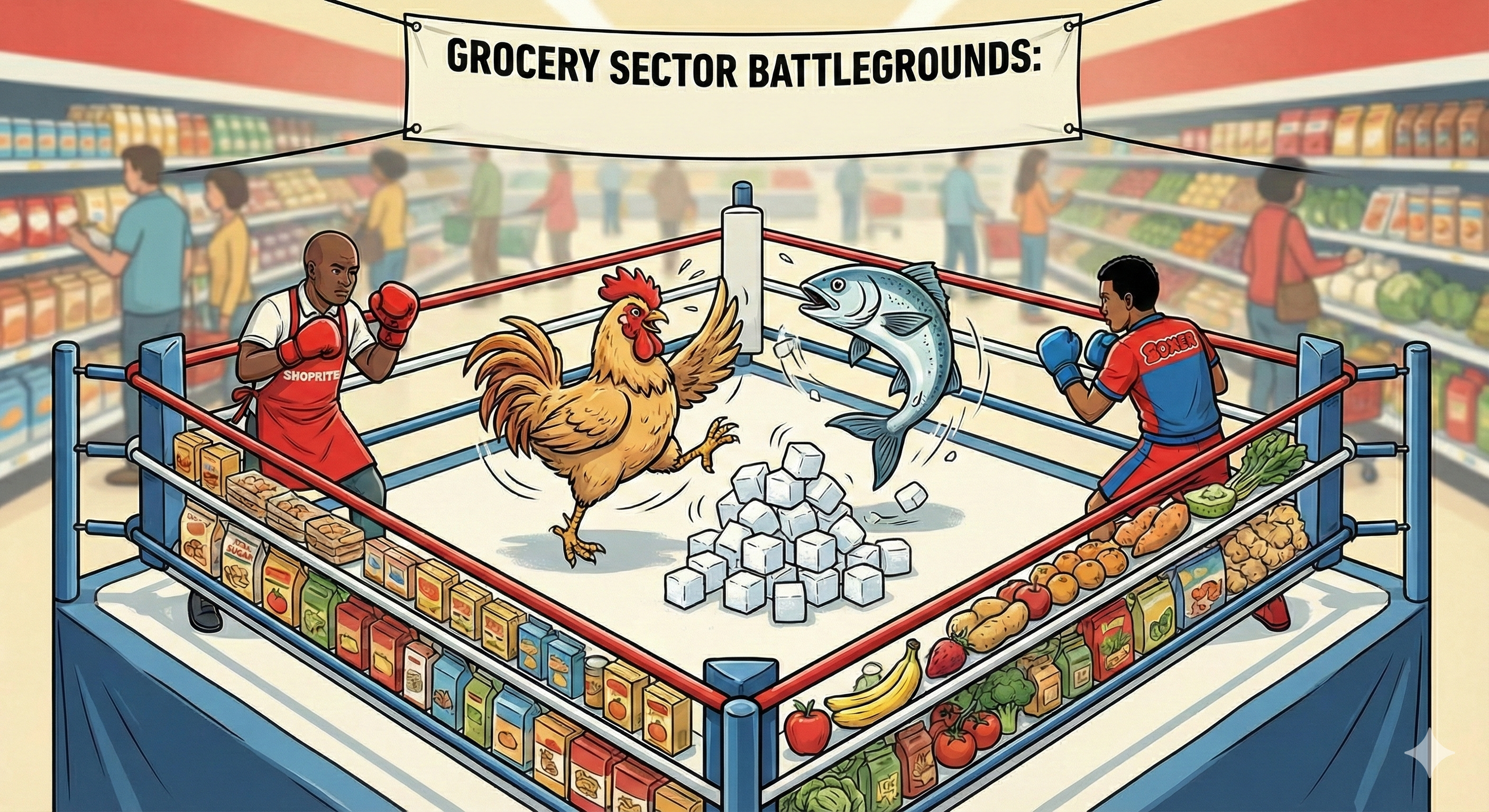
 SA’s grocery landscape is experiencing significant shifts as price wars heat up, with retailers battling it out over chicken, fish and sugar. Image created using Nano Banana Pro.
With recent updates from Shoprite and Boxer, we’ve got some new insights to chew on in the grocery sector. And instead of thinking about what this means for landlords, we can focus on what gets sold on the shelves, rather than where those shelves are located. Rainbow Chicken and Sea Harvest showed us how wild the ride can be in livestock-focused primary agriculture, while RCL Foods is struggling in the sugar business.
Buckle up…
The wild ones: primary agriculture
Under the broader umbrella of food producers, business models carry different levels of risk.
For example, a bakery business must focus on achieving operational excellence in using wheat to make bread and other warm delights. But it doesn’t farm the wheat itself or worry about storing any surplus and trying to export it. A bakery business can still have volatility in earnings, but not to the same extent as a wheat farmer, who is so dependent on regional rainfall and other agricultural matters.
/file/dailymaverick/wp-content/uploads/2023/12/GettyImages-1241914638-1.jpg "In the food value chain, a baker faces very different risks from the farmer that produces the wheat for the bakery’s flour. (Photo: Waldo Swiegers / Bloomberg via Getty Images)")
You won’t find many primary farming businesses on the JSE that focus on commodities such as wheat and maize, but you can at least invest in companies servicing the broader agriculture sector (such as the KAL Group – a company with strong growth ambitions).
You could also look at a commodity like sugar, although the latest RCL Foods update might just scare you off based on the stronger rand and what it means for the competitiveness of local production against imports. Headline earnings per share (Heps) at RCL Foods is down by at least 25% for the six months to December 2025, with the sugar segment dragging down the rest of the business.
Alternatively, you can bravely step into forms of primary agriculture that focus on animals rather than crops, such as chicken farming and seafood.
/file/dailymaverick/wp-content/uploads/2024/08/IMG-20240807-picWA0012.jpg "Aside from chicken feed, the costs of delivering South Africa’s favourite protein tend to be fixed in nature. (Photo: Supplied)")
In doing so, there’s a term you need to fully understand: operating leverage. This concept speaks to the fixed costs in these businesses and what they mean for movements in profitability in relation to changes in revenue.
In simple terms, the cost of sending a fishing boat into the ocean doesn’t materially change based on how many fish it catches that day, or what the fish can be sold for. The fixed overheads are a substantial part of the cost base. Similarly, aside from the chicken feed used in raising chickens, the costs of delivering South Africa’s favourite protein tend to be fixed in nature – chickens take up the same amount of space and energy requirements regardless of what the drumsticks on the other end of the process can be sold for.
This is why the companies in this sector can report extraordinary swings in profitability in any given period. For example, Rainbow Chicken grew Heps by between 94.9% and 114.9% for the six months to 28 December 2025, with various improvements throughout the business that drove this fantastic outcome. At Sea Harvest, the year ended December 2025 was even more breathtaking: Heps increased by between 293% and 303%. Better catch rates and other efficiency gains helped earnings quadruple in the space of one year.
But you do have to be careful: it’s very hard to forecast the performance of these businesses, and you cannot extrapolate such high growth rates in the hope that they will continue. This is why the valuation multiples are often very low, as the market is wise enough not to pay a high multiple based on earnings in a particularly good year.
Boxer and Shoprite step into the ring
Chicken. Fish. Sugar. These are the battlegrounds at your local grocery store, especially those targeting lower-income South Africans, for whom price sensitivity is a matter of life and death. Boxer and Shoprite have a hugely important role to play in South Africa. And if you ever doubted the importance of competition and the value of capitalism, then hopefully the recent food inflation figures at these businesses will put those doubts to rest.
Or food deflation, I should say. Boxer and Shoprite don’t report numbers for identical periods, so we have to be careful in directly comparing them and drawing conclusions. What we do know is that at Shoprite and Usave within Shoprite (its Boxer competitor), prices went down in 2025 rather than up. The same is true at Boxer. Marginalised South Africans were able to pay less for food in 2025 than in 2024, a fantastic achievement and a reflection of how well these businesses are run.
As a further indication of how resilient and defensive these business models are, Boxer bucked the trend that we’ve seen at other retailers around Black Friday. Where most retailers are talking about a pull-forward of spend from festive shopping in December to Black Friday shopping in November, Boxer actually had its weakest month (in year-on-year terms) in November. Boxer’s business is focused on delivering daily essentials to shoppers, not Black Friday deals.
/file/attachments/2988/boxerphilosophy_500591.jpg "Source: Boxer results presentation")
Although Shoprite didn’t give any disclosure on this for Shoprite and Usave, I suspect that similar trends are at play (especially at Usave as the purest competitor to Boxer).
At the other end of the income curve (where Boxer doesn’t play at all), we find Shoprite continuing to achieve excellent growth through Checkers and Checkers Hyper. There’s positive selling price inflation in that business, as shoppers can afford to absorb modest increases and aren’t as sensitive to every price on the shelf. In this model, other factors such as assortment and convenience become very important differentiators.
And where Boxer is hyper-focused on doing one thing extremely well, Shoprite is building out a more diversified group with new growth engines such as Petshop Science (45 new stores in the past year). Now imagine all these retail formats with Sixty60 as the single omnichannel fulfilment offering layered on top.
We are lucky to have truly world-class businesses in this country. DM