




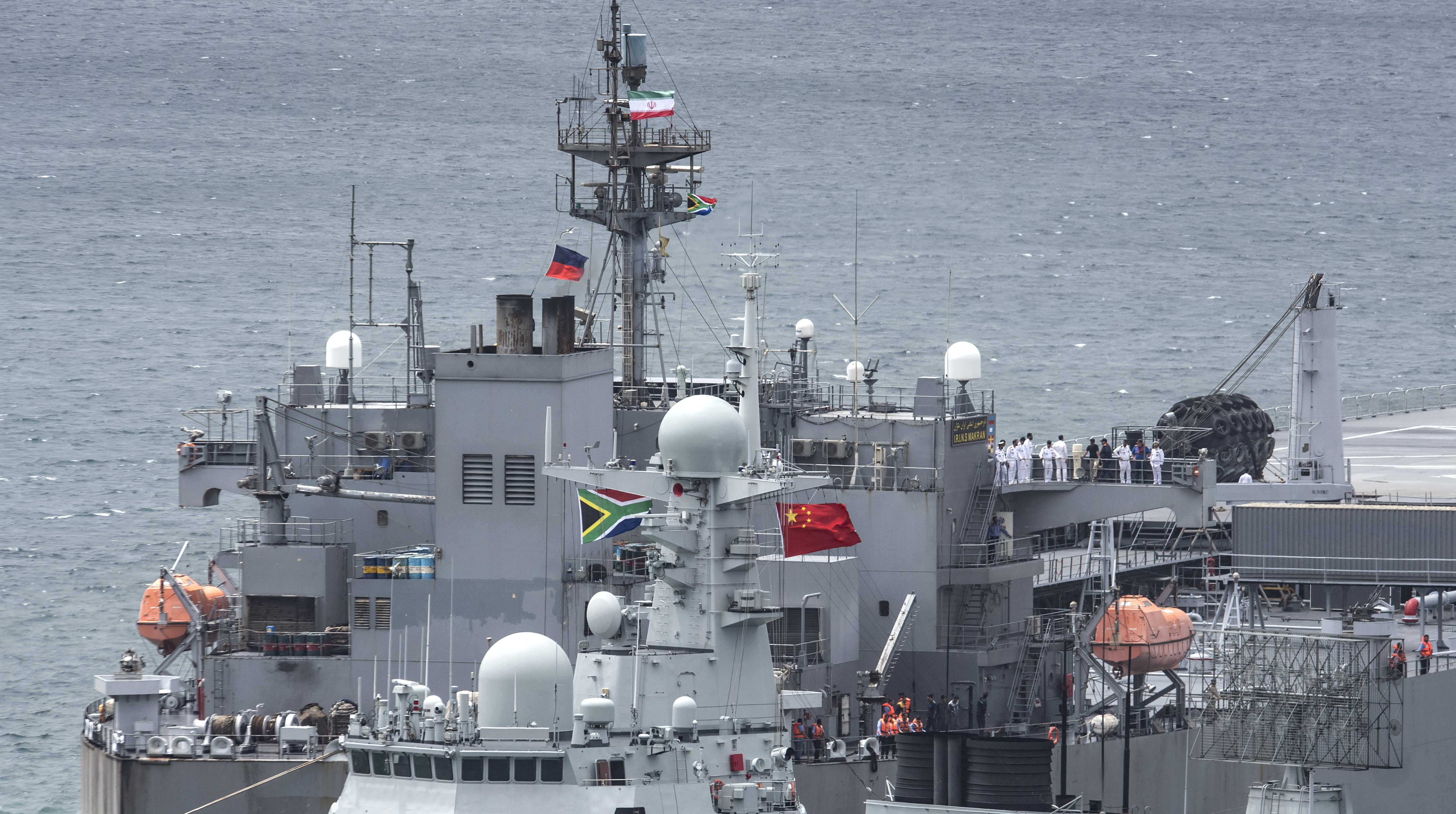
 Iranian and Chinese warships at Naval Base Simon’s Town in January 2026. (Photo: Brenton Geach)
 /file/dailymaverick/wp-content/uploads/2025/10/label-Op-Ed.jpg)
At first glance, South Africa appears far removed from the epicentres of contemporary geopolitical tension. Conflicts in the Middle East and great power competition across the Indo-Pacific seem geographically distant for a country located at the southern tip of Africa. In most Indo-Pacific strategies, South Africa occupies a peripheral position, if it features at all.
This sense of distance is misleading, since South Africa is inextricably linked to global tensions through the maritime domain. More than 90% of the country’s trade moves by sea, its ports sit astride some of the world’s critical global shipping routes and developments across the Indian Ocean routinely shape its economic and security environment. Geography may place South Africa at the edge of major theatres, but the ocean binds it tightly to them.
In principle, South Africa has framed its maritime engagement around multilateralism, non-traditional security threats and the Indian Ocean as a zone of peace. Naval cooperation has typically focused on these principles and practical search-and-rescue, rather than overt power projection. The 2026 Will for Peace exercise was officially presented within this tradition, emphasising interoperability and cooperation, against a backdrop of BRICS expansion and shifting global maritime priorities.
Yet, such a naval exercise has also brought the geopolitical onto South Africa’s shores, exacerbating political schisms at home and reinforcing that a coherent ocean strategy is needed. Naval exercises are never neutral. In a maritime environment that is increasingly securitised, even activities framed as low-politics cooperation can be read as signals of alignment, comfort and strategic proximity. As competition intensifies across the Indo-Pacific and beyond, regional and global powers scrutinise who exercises with whom, where and under what political circumstances.
Will for Peace thus carried meaning beyond technical readiness. It became a stage on which competing visions of South Africa’s global role were projected and contested. In the absence of a clearly articulated national maritime or Indo-Pacific strategy, operational activities risk substituting for doctrine. Practice begins to speak louder than policy, often in ways policymakers do not fully intend.
The controversy surrounding Iranian participation in Will for Peace was especially revealing. According to a number of reports, President Cyril Ramaphosa sought to exclude Iranian warships, presumably to limit diplomatic friction with the US during a sensitive period in bilateral relations, including around trade agreements. Yet the South African National Defence Force (SANDF) reportedly proceeded with Iran’s participation, in turn inviting intense criticism from the country’s main opposition, the DA.
This episode points to more than a simple administrative mishap. Rather, the country, as an emerging middle power, faces considerations on two fronts:
First, South Africa is required to balance relations with the US and its partners, which are already strained. Disagreements about BRICS positioning and politically charged issues such as asylum claims under the banner of “white genocide” have created a fragile bilateral climate. Against this backdrop, Will for Peace fed into an existing narrative of mistrust. In such an environment, collaboration with authoritarian regimes reinforces perceptions, especially within US discourse, that South Africa is drifting into an adversarial camp, rather than occupying a position of principled non-alignment.
/file/attachments/orphans/naval3550_284563.jpg "All the warships that took part in the Will for Peace exercise in Simon’s Town: The Chinese guided-missile destroyer Tangshan (Hull 122), the United Arab Emirates Navy Gowind-class corvette, the Bani Yas (P110), the Iranian corvette IRIS Naghdi, the South African frigate SAS Amatola (F145) and, in the foreground, SAS Assegaai, South Africa's historic Daphné-class submarine. which is now a museum. (Photo: Brenton Geach)")
The presence of Iranian and Russian warships sits uneasily alongside South Africa’s stated commitment to non-alignment and risks eroding key relationships, particularly with the US and European Union. This reputational cost is especially acute in a global environment where geopolitical narratives increasingly rely on binary classifications – a context in which nuance is easily lost.
Second, Iran’s participation cannot be separated from the broader evolution of BRICS. The bloc’s expansion has increased its heterogeneity, incorporating states with divergent regional priorities, regime types and relationships with the West. While this expansion reflects a shared concern with global structural imbalance, it also complicates consensus and narrows the room for manoeuvre for middle powers in the grouping. Despite the politically awkward position that South Africa finds itself in, its joining of the group was first and foremost economic and practical. Similarly, its participation in such joint naval exercises reflects material and institutional necessity given chronic underfunding of the SANDF and the consequent erosion of capacity and operational readiness. Multinational exercises facilitate skills transfer while exposing personnel to advanced platforms and procedures while providing technical learning opportunities.
Still the apparent absence of India raises questions about whether Mosi-style drills genuinely reflect BRICS cooperation or merely a subset of its members. As BRICS expands, its internal diversity grows, making it harder for South Africa to balance solidarity with autonomy.
As a result of these competing priorities, South Africa is left with a deeper problem of strategic incoherence – a gap between political-normative commitments and institutional execution with a defence establishment comfortable with multilinear military engagement. The issue is not necessarily one of outright defiance, but of insufficiently codified strategic intent. When national strategy is underarticulated, it becomes contested across institutions. In such circumstances, decisions may default to precedent, habit or organisational preference, although any blatant disregard for presidential authority, if true, is worrying.
South Africa’s traditional role as a middle power – that is less about material capability and more to do with consensus-building and normative leadership, as seen in its G20 role – works best in diplomatic settings where ambiguity is tolerated and flexibility is an asset. In the maritime domain, however, ambiguity is harder to sustain. Ships, exercises and partnerships are visible, and they invite interpretation, whether or not policymakers wish them to. Added to the mix, South Africa’s unique connectedness to three oceans has not prompted formal strategic positioning, including towards the Indo-Pacific, where some of the world’s largest economies reside. Instead, its involvement is shaped by historical identity, multilateral commitments and operational momentum.
/file/attachments/orphans/russia_2998_384143.jpg "The Russian Steregushchiy-class corvette RFS Stoikiy (545) at the Simon’s Town naval harbour. (Photo: Brenton Geach)")
Indeed, South Africa faces a defining moment as an emerging middle power. It is required to balance its various partnerships through agility and coalition-building. Moreover, as geopolitical competition intensifies across maritime domains, the space for strategic ambiguity shrinks. This only reinforces the pressing need for coherent positioning to avoid another diplomatic and national mishap.
The questions that could guide South Africa’s maritime positioning include: Should South Africa clarify its Indo-Pacific priorities? How should it reconcile BRICS solidarity with broader economic and diplomatic imperatives? And what does its handling of Iran suggest about the role it intends to play in increasingly contested maritime geopolitics?
Until these questions are addressed, South Africa’s vessels may speak more loudly than its strategy – and the costs of strategic coherence will grow. DM
Lisa Otto is associate professor at the University of Johannesburg and Yu-Shan Wu is senior researcher at University of Johannesburg.