
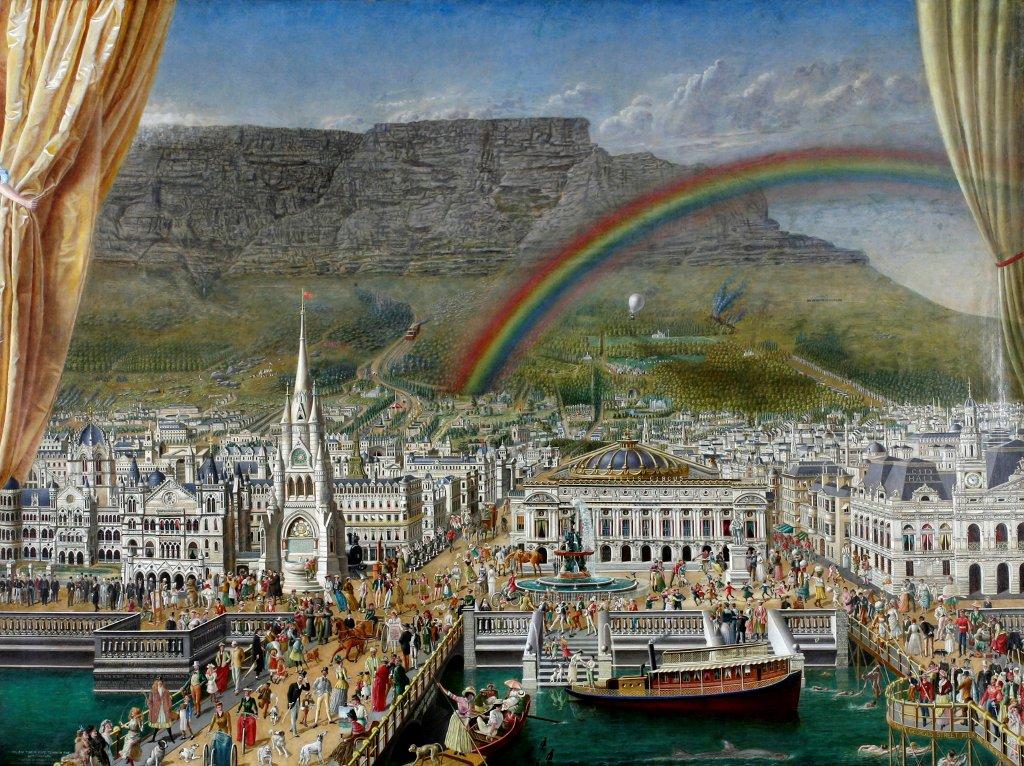
 L James Ford, Holiday in Cape Town in the 20th Century in Honour of the Expected Arrival of the Governor-General of United South Africa.1891-1899. (Iziko South African National Gallery
 /file/attachments/orphans/storiedmountain_745794.jpg)
Table Mountain is so familiar it risks becoming invisible – a postcard backdrop, a fixed silhouette above the city. But this series looks closer. The Storeyed Mountain explores Table Mountain as an ancient, living system: shaped by deep time and drifting myths, woven with fynbos archives, threaded by hidden rivers, challenged by climate change and entangled with the lives of creatures and people who share its slopes. These essays ask what the mountain really is – not an object, but a presence: ecological, historical, political and robustly alive.
It was called Hoerikwaggo, or something similar. The people who named it, the Khoi, had no writing and the person who wrote it down would have been a Dutch sailor who rendered the sounds as best he could. It meant Mountain of the Sea, which seemed perfectly suited, given how it looms out of the Southern Atlantic.
However, Tabao do Cabo (Table of the Cape) was the one that stuck, for obvious reasons.
The big sandstone rock became a landmark for the Cape of Storms, which suggests that the Portuguese who first came across it arrived in winter with fierce gales roaring in from the northwest.
/file/attachments/orphans/Don-A55_440898.jpg "Gottfried Freiderich Riedel, Cape Town and Table Bay, 1780. Hand coloured copper engraving. (Image: William Fehr collection / Iziko)")
The name they eventually gave the area was Cabo da Boa Esperance (Cape of Good Hope), which they probably thought up in summer when the southeast wind bore them round the mountain and back homeward. Or perhaps because it seemed a gateway to riches. History is a bit vague here.
Either way, the mountain became famous as a fulcrum at the tip of Africa between the explorative West and the Far East, but for most, it existed mainly as hearsay.
Before artists stood on its slopes with sketchbooks, many worked at a considerable distance, relying on the descriptions of sailors who had seen the mountain briefly, from below, while seasick, underslept and inclined to embellishment.
The result was a body of images that say less about the mountain itself than about how information mutates when passed from deck to dock to drawing table.
/file/attachments/orphans/Don-CD65_191089.jpg "George Lambert and Samuel Scott, 1730. Oil on canvas. (Image: William Fehr collection / Iziko)")
Sailors were generally unreliable narrators. After months at sea, any landform large enough to interrupt the horizon took on exaggerated significance. A flat-topped mountain at the end of an ocean crossing was not just geography; it was relief, salvation and proof that the world still contained edges.
Descriptions were coloured accordingly – the mountain was vast, abrupt, weirdly flat and, depending on the weather, either serene or menacing. Artists receiving these accounts had little reason to doubt them and every incentive to dramatise.
One recurring problem was that Table Mountain refused to conform to European ideas of how mountains ought to behave. Mountains were expected to peak, preferably sharply, like punctuation marks in the landscape.
Table Mountain, by contrast, looked as if someone had taken a normal mountain and sliced off the top. Artists responded by interpreting flatness as intention. The summit they depicted was terraced, stepped, or neatly layered, resembling anything from a ziggurat to a tiered garden. Nature, it seemed, must have had a plan.
This architectural instinct often tipped into outright fortification. In several paintings, the mountain was crowned with walls, towers and flags, transforming it into a colossal natural citadel.
/file/attachments/orphans/Don-GH87_467923.jpg "Allain Mallett, 1683. (Image: Goodhope collection)")
Scale also suffered in translation, with ships rendered in obsessive detail – every rope, sail and cannon lovingly engraved – while the mountain behind them loomed implausibly close or theatrically distant. Perspective bent to artistic need. The mountain became a backdrop, a looming presence, or a floating shelf in the sky, depending on how impressive the sailor’s story had been.
Animals wandered into these scenes not because artists had seen them on the slopes, but because the sailors’ Africa came fully stocked. When Europeans arrived, the area around Table Mountain did indeed host a surprising range of wildlife: hippos in the wetlands, elephants moving through the lowlands, leopards in the mountains, and very probably lions. Rhinos may also have passed through.
/file/attachments/orphans/Don-A23_805548.jpg "John Wood Deane, Handing back of the Cape to the Dutch in 1803, Hand coloured aquatint engraved by T. Busby,1805. (Image: William Fehr collection / Iziko)")
To an artist working from second-hand descriptions, this abundance easily condensed into a single, convenient tableau. Thus ostriches, rhinos and other African specialities appeared in the foreground, as if the mountain doubled as a well-managed menagerie.
Clouds added another layer of confusion. The familiar “tablecloth” spilling over the summit was often interpreted as smoke. Flat mountains plus smoke suggested volcanic potential, and while Table Mountain is resolutely not a volcano, it was useful, dramatically speaking, to treat it as one-in-waiting. A mountain that might erupt at any moment felt more exciting than one that simply existed, unmoving and indifferent.
/file/attachments/orphans/Don-A1_909606.jpg "Unknown artist, Shipping in Table Bay, 1785. (Image: William Fehr Collection / Iziko)")
In the end, these strange early images reveal the gap between seeing and knowing. Table Mountain was filtered through sailors’ exaggerations, artists’ expectations and Europe’s need to make unfamiliar landscapes legible.
The mountain itself remained unchanged: flat, immovable and unimpressed. Everything else – the battlements, the beasts, the smoke – was human invention, layered on to a piece of geology that neither needed nor requested explanation. What we have today is a beloved mountain surrounded by city. This series, The Storeyed Mountain, will explore the implications. DM
This is the first article in The Storied Mountain series.
NEXT UP: What is Table Mountain? A story of Deep Time