




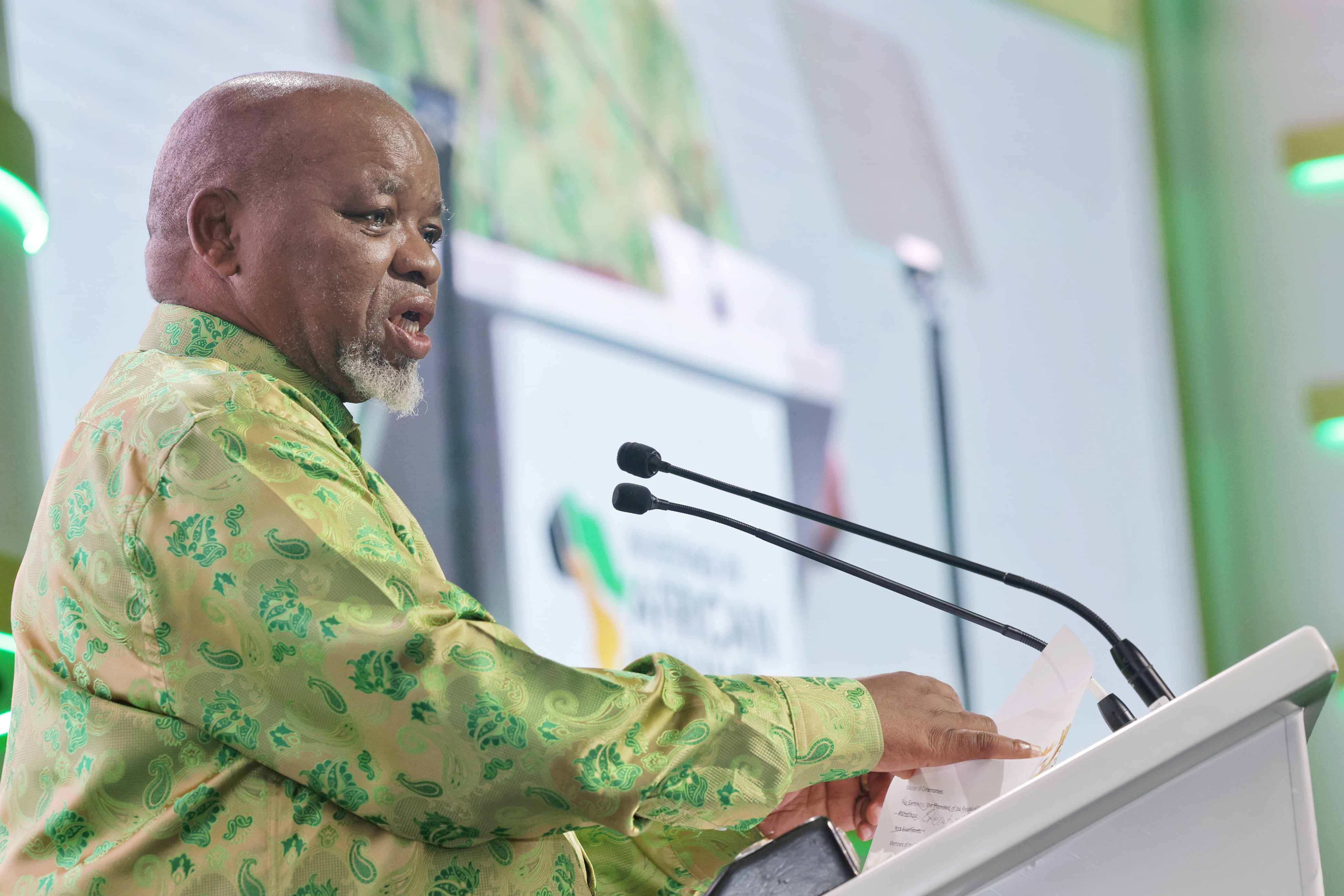
 Minerals and Petroleum Resources Minister Gwede Mantashe at the Mining Indaba held at the Cape Town Convention Centre. (Photo: Jairus Mmutle / GCIS)
 Every week, about 500,000 metric tons of manganese ore departs South African shores to foreign lands (mostly China). That’s almost half of the global export volume to mainly serve the steelmaking business and for lithium batteries.
But when Daily Maverick asked Minerals and Petroleum Resources Minister Gwede Mantashe about the country’s manganese strategy, he was almost dismissive of the concept of focusing on one of the critical minerals on his list of 21.
“Why should we ringfence manganese from the other critical minerals? What about coal?”
Meanwhile, manganese smelter Transalloys is in crisis and was allegedly left out of the ferrochrome electricity tariff conversation.
What’s in a name?
The Africa Finance Corporation (AFC) is long on critical minerals, though.
“It is for us as Africans to understand that we need to reframe how we see minerals. They are not just commodities for export; they are essential tools in our development.”
That is the perspective of Samaila Zubairu, AFC president and CEO. He came to Mining Indaba 2026 to launch the Compendium of Africa’s Strategic Minerals 2026, which is a database of all the continent’s mineral wealth.
Although Zubairu thinks it to be far more: “This is not a geological map... It is giving life to the African minerals vision... giving tools to the Africa mineral group.”
What the compendium does nail, however, is an identification of the strategic interconnectedness of various minerals and their use cases, as well as the enormous missed opportunity:
Food security, industrialisation, housing and transport infrastructure... are as fundamental to the continent’s future as batteries and electric vehicles (EVs). For this reason, the compendium deliberately elevates fertiliser minerals such as phosphates and potash... alongside iron ore, and steel. Africa’s $2.8-trillion in iron ore at the mine gate translates into an estimated $25.4-trillion in steel value.
When Daily Maverick pressed for clarity on the investment strategy for the steel industry – which China dominates using African minerals – Zubairu explained that the AFC is willing to finance the resources directly (iron ore in Nigeria, South Africa and Zambia) and “connect the dots” to prove that a market exists for transformation.
The aggregation game
The AFC, in Zubairu’s description at least, believes that Africa has all the necessary alloys for steel production (manganese, chromium, and vanadium). Its role is to bring it all together, rather than treating them as isolated mining projects.
But the barrier to this integration has always been the bankability of early-stage projects. Sameh Shenouda, the AFC’s chief investment officer, followed on from the CEO’s words, explaining that the corporation is stepping in to absorb that specific risk. By spending early-stage money to convert half-baked development plans into bankable projects, the AFC claims to trigger a massive multiplier effect.
“For every dollar AFC invests in a de-risked project, there’s anywhere between six to ten dollars that come alongside us,” Shenouda said.
Breaking the extraction curse
This financial engineering supports a broader ideological battle being waged at the CTICC this week: a rejection of the global Critical Minerals nomenclature in favour of Strategic Minerals.
The argument, led by Mantashe and echoed by the AFC, is that “criticality” (his word) is a subjective term imposed by the Global North. Mantashe went in hard on this distinction in his opening keynote: “America defines the [minerals] in terms of the role in the defence system... if you go to China is the role it plays in the technology... In Africa, it should have a different meaning. Here we need the role of the minerals on the economy.”
African leaders at the Indaba argue that accepting these external definitions perpetuates the colonial pit-to-port extraction model, where Africa exports raw dirt and imports finished inflation.
/file/attachments/orphans/BMstrategiccriticalminerals_391830.jpg "Critical minerals deposits marked on a map. (Source: AFC)")
Chinese finger trap
This is where the rhetoric is reportedly meeting reality. Trade, Industry and Competition Minister Parks Tau confirmed that South Africa is leveraging its mineral endowment to rewrite trade terms, specifically with its biggest customers.
The minister recovered from the criticism he took with January’s transformation fund play with trade agreements with both China and the European Union that explicitly dismantle the old extraction model. “These new deals have moved away from the ‘pit to port’ model, and now specify that industrialisation at source would be a component,” Tau said.
Under this programmatic arrangement, access to South Africa’s resources is now tethered to local beneficiation. The EU-South Africa Clean Trade and Investment Partnership (CTIP), for example, is designed to ensure that minerals are processed within South Africa to support local reindustrialisation before they hit the water.
It takes a GNU
To make this work, the Ramaphosa administration is attempting to break down the notorious silos between state departments. Mantashe praised what is being dubbed the “whole-of-government” approach, a strategy that seemingly integrates mining, transport, water and trade into a single execution plan.
While Mantashe handles the regulatory framework and Tau secures the trade terms, Transport Minister Barbara Creecy is tasked with fixing the logistics backbone. She outlined reforms to re-establish rail as the primary freight mover, including bringing in private operators to ensure beneficiated products can actually reach the market.
Simultaneously, Water and Sanitation Minister Pemmy Majodina promised that water licensing, a frequent bottleneck for mining operations, has been slashed from three years to a 90-day online process.
As Zubairu put it, the goal is no longer just to export; it is to “control the ecosystem” of the supply chain within Africa.
Or, in Gwede Mantashe parlance: “We must not be following the fashion of others. We must assess the impact on our own continent”. DM