



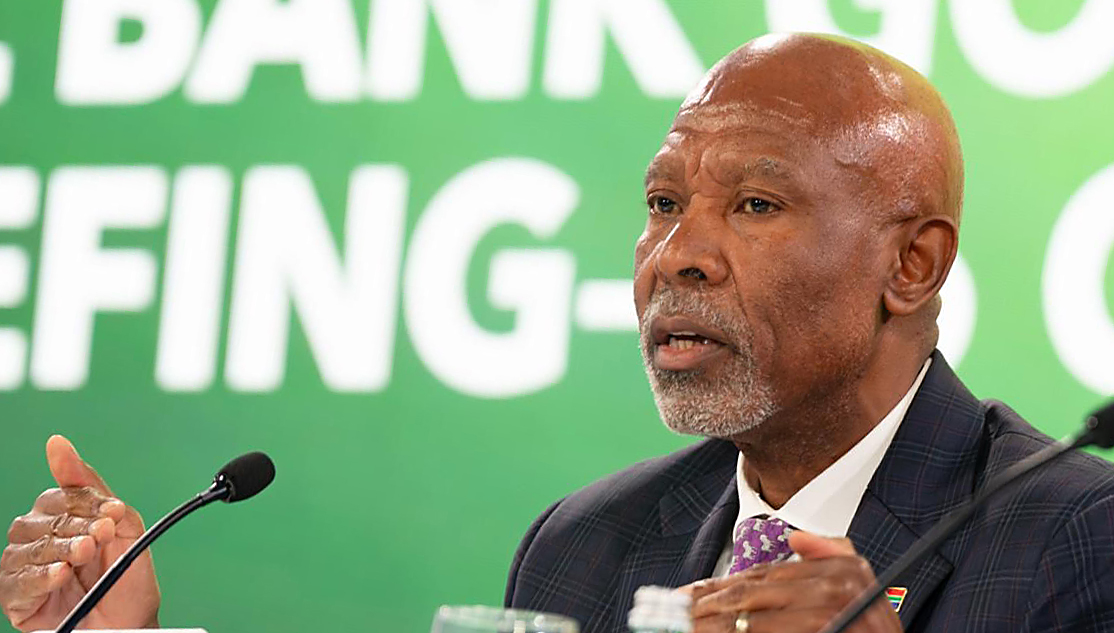
 South African Reserve Bank governor Lesetja Kganyago is not only willing to make the difficult decisions for the economy, he also political nous to see them to their conclusion. (Photo: IMF)
 While our country often gives the impression it is beset by impossible problems, it is also blessed with exceptional people. As they make their contributions in different ways, very few can claim to have driven a process that will lower the prices of goods that you buy. A decision that should improve lives for generations to come. Lesetja Kganyago is my pick for Person of the Year.
It is probably in the nature of a central bank governor to treat inflation as the enemy. But importantly, to be sensible about it.
As any Japanese citizen can tell you, without a little bit of inflation your economy will not grow. The trick, of course, is to get to the right level of inflation that both creates economic growth, and yet doesn’t put too much pressure on the poor (who suffer the most when the price of bread goes up).
Of the many, many contributions to our society made by Tito Mboweni (who passed away just over a year ago), one of the most important was his leadership when the SA Reserve Bank (SARB) adopted inflation targeting in 2000.
At the time, considering the nature of our economy, the bank was told to target an inflation rate of between 3% and 6%.
/file/attachments/2986/WhatsAppImage2025-12-14at214709_173117_9d8cfa4b1f7e6330c27a0882730b7543.jpeg)
While so many other things changed in our country, that held for 25 years. It is surely a comment on his genius as an economist that Kganyago realised that certain dynamics were coming together that meant this was the year he could achieve his dream of changing that target. That this was the time to strike to keep inflation lower for longer.
While the last five years have shown we live in a surprising world, this year has seen inflation coming down. Several of the big talking points of this year demonstrate that.
The braai and beer chats about Chinese cars reflect the fact that new car inflation is just 1.6%. The kitchen and wine discussions about food prices show how maize prices are likely to come down, partly as a result of the current La Niña season.
As China continues to increase its exports to export more and more to emerging markets, so we will feel their deflationary impact, whether it be in cars or solar panels.
The latest inflation predictions from the Bureau for Economic Research suggest inflation will remain below 4% for the next three years.
But he surely also deserves this nomination because of his political nous. On the face of it, our political situation would not look promising for a person who wanted to bring down the inflation target.
With more parties desperate for votes, it should, on paper, be harder to convince politicians to create a situation where the SARB would have to keep interest rates higher for longer (to keep inflation within the target).
Kganyago, however, was aware that in this situation he actually only needed to really convince three people. Because of the fragmented nature of the ANC at the moment, it was always unlikely that there would be organised resistance in the party to this move.
The first person was obviously the Finance Minister Enoch Godongwana. The second was probably the leader of the Democratic Alliance (DA), John Steenhuisen. Both of these were likely to support the plan anyway.
The DA has generally supported inflation targeting and Godongwana’s performance in office shows him to be fiscally hawkish. What Kganyago really needed was the support of President Cyril Ramaphosa.
/file/attachments/2986/WhatsAppImage2025-12-14at214708_412166_fabc27fa64f5c47fd4690c20c0b47c2a.jpeg)
Real political genius of Lesetja Kganyago
Perhaps the real political genius of how events unfolded is that Ramaphosa had to speak in public about this precisely once, outside Parliament immediately after Godongwana’s announcement of a lower target. This means that it does not appear to have cost Ramaphosa much political capital.
The way Kganyago did this was first to publicly campaign for a lower target. By speaking about it in various forums he got the ball rolling. He would also have recognised that the voices that would oppose the change were completely disorganised.
Both the EFF and MK seem to have been distracted by other (often internal) events, while Cosatu has said very little on the subject. But the real surprise, the real moment of assertiveness came when he announced that the SARB’s Monetary Policy Committee (MPC) would target the lower end of the old inflation target band of between 3% and 6%.
As he explained at the time, this was to anchor inflation expectations. (In short: if workers believe inflation will be kept at 3% they will ask for wage increases of 3%; if they believe inflation will be 6% they will ask for 6%. Therefore by lowering inflation expectations, you can actually lower inflation).
This led to the only apparent tension in this entire process, when the Finance Ministry felt it necessary to reassert its legal authority to set the target.
It appeared the tension eased almost immediately, and just months later Godongwana was happy to make his announcement during the Medium Term Budget Policy Statement.
One of the interesting aspects of this change is that it actually makes the job of Kganyago and the rest of the MPC much harder. The breadth of the previous target band gave them a target of three percentage points. Now, instead of being between 3% and 6%, the target is 3% with “a band of tolerance” of 1% either side.
The target is now one-third tighter and thus harder to hit. Proof perhaps that Kganyago is not motivated by the search for an easier life for himself. Instead, he is motivated to keep inflation lower.
And in the process, improve the lives of millions of people for many years to come. DM