




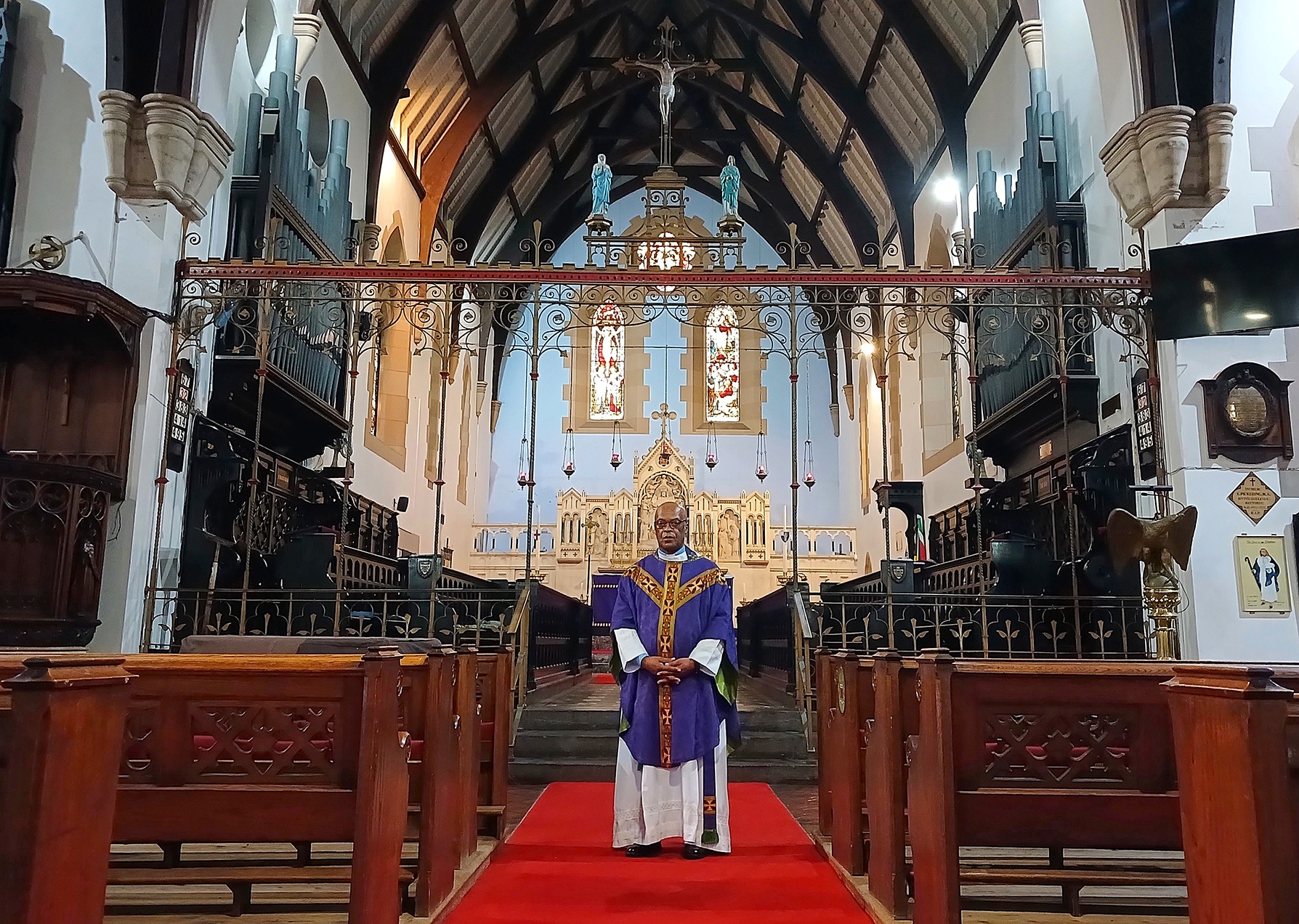
 Canon Fumi Kula, the priest of St Mary's Cathedral, said there was no greater honour than leading this historic church in Gqeberha as it celebrated its 200th anniversary last year. (Photo: Riaan Marais)
 When the Rev Francis McCleland arrived on the shores of Nelson Mandela Bay in the early 1800s, he realised that his steadily growing flock would need a place of worship.
Credited as the city’s first architect, he designed one of the most iconic buildings in Gqeberha’s storied history.
The Cathedral Church of St Mary the Virgin, which celebrated its 200th anniversary in 2025, is one of the finest examples of the city’s early architecture and a cornerstone of its rich heritage.
While the church’s square bell tower was once the highest structure in old Central, in recent years locating it has become increasingly difficult among the towering office blocks and retail stores that shot up as the city developed.
But if you take a short walk from Govan Mbeki Avenue up St Mary’s Terrace, you will find one of the city’s most precious hidden gems — regardless of your religious beliefs.
/file/attachments/orphans/StMarys1_653788.jpg "Hidden among the high-rise buildings of Central Gqeberha, St Mary’s Cathedral celebrated its 200th anniversary in 2025 and is the oldest church in the city. (Photo: Riaan Marais)")
Construction of the church started in 1825, at which time the site was already considered the unofficial church grounds as congregants regularly gathered there for sermons. During the nine years of construction, church services continued and simply moved indoors when the church was completed in 1834.
Over the past two centuries, the church has collected several special artefacts, some believed to date as far back as the 14th century.
Walking through the front door, you are greeted by Canon Fumi Kula, the head of the church for the past five years. A conversation with him soon turns into a casual history lesson as Kula shares his background and passion for the church’s place in history.
His spiritual journey began at the age of 10 when he was an altar server at another historically significant church in Nelson Mandela Bay — St Stephen’s in New Brighton.
He was ordained as a priest in 1994 and served at several congregations before taking up the reins at St Mary’s.
“I am extremely fortunate and blessed to find myself at the head of such an iconic church, particularly at such a special time. Not everyone has the opportunity to celebrate a 200-year legacy, and now I can say I am part of that legacy,” smiled Kula.
/file/attachments/orphans/StMarys8_485604.jpg "Once the tallest tower in the early days of the city, St Mary's is now dwarfed by the tall office blocks that surround it in Central Gqeberha. (Photo: Riaan Marais)")
An aerial view of the church reveals that it is cruciform. On the southeastern tip is the bell tower, which was constructed in 1844. The organ, which is still played during every service, was installed in 1866.
In 1895, a fire ripped through the building, gutting large portions of it and destroying numerous religious artefacts brought from England and accumulated over seven decades.
Luckily, several significant pieces were saved — some might even say by divine intervention.
Final resting place
For Kula, one of the most special pieces is hidden under a red carpet in front of the main altar.
Lifting the carpet reveals a large brass plate with ornate engravings, the most noticeable of which depicts a robed priest holding a sacramental chalice. The inscription explains that this is the final resting place of Augustus Theodore Wirgman, who served as the priest of St Mary’s for 42 years, until his death in October 1917.
/file/attachments/orphans/StMarys5_300531.jpg "The remains of three of St Mary’s former religious leaders are buried under the floor of the main church hall, and Canon Fumi Kula regards these as some of the most significant artefacts in the historic church. (Photo: Riaan Marais)")
“Despite this being an Anglican church, the inscription clearly states that Wirgman was a Catholic priest. I don’t fully grasp the politics behind it, but for me it signifies the inclusivity of the modern church, a true cornerstone of Christianity,” said Kula.
Wirgman is buried alongside two of his successors, Cuthbert Edward Mayo and Derek Betram Hill.
To the right of the main altar, a beautiful stained glass window depicts scenes from the resurrection of Christ. The artist is unknown, but historians believe the windows were saved from a church in Cologne, Germany, during the French Revolution and brought to Gqeberha in the early 1900s.
Right at the top of the arched window is a simple pane of glass, in a much less ornate style, showing a king holding a baby, both with halos around their heads.
Officially, the origin of this window is unknown, but experts from the Victoria and Albert Museum in London, who studied the window, believe it is from 14th-century England.
In the 1600s, during the English Civil War, many stained glass windows were used for target practice when castles and churches were ransacked. Historians believe that the window at St Mary’s may have been saved and smuggled out of England before it was gifted to Mayo, who unveiled it in May 1909.
/file/attachments/orphans/StMarys6_462931.jpg "Among its stained glass windows, the church considers the topmost section of this arch as the most special. Some historians believe the window originated in 14th-century England and was smuggled to South Africa in the early 1900s. (Photo: Riaan Marais)")
Under this window hangs a tattered flag, and several more soot-stained flags line the northern wall of the church. Besides being a reminder of the fire that nearly destroyed St Mary’s, they are also part of a special chantry reserved for the Port Elizabeth Volunteer Rifle Corps, more commonly known as Prince Alfred’s Guard.
The flags show the colours of various regiments within the 170-year-old military unit, while the names of members who died during war, and thereafter, are recorded on memorial plaques within the chantry.
/file/attachments/orphans/StMarys7_335680.jpg "A small section of the church is reserved for veterans of Prince Alfred's Guard, a military unit founded in 1856 as the Port Elizabeth Volunteer Rifle Corps. (Photo: Riaan Marais)")
Last year, St Mary’s was a hive of excitement when the congregation hosted a series of events, including choir performances and special services, to commemorate its 200th anniversary.
But for Kula, hosting Anglican church leaders from across South Africa and receiving special recognition from Archbishop Thabo Makgoba was not only a significant moment for the church, but a very personal and deeply spiritual milestone.
“Such an event has never been held in Gqeberha before. For me, it was very special, and I feel a great sense of pride — but also responsibility — to be part of this milestone.
“St Mary’s is not only a cornerstone of religion, but a cornerstone of the broader history of Gqeberha,” said Kula. DM