





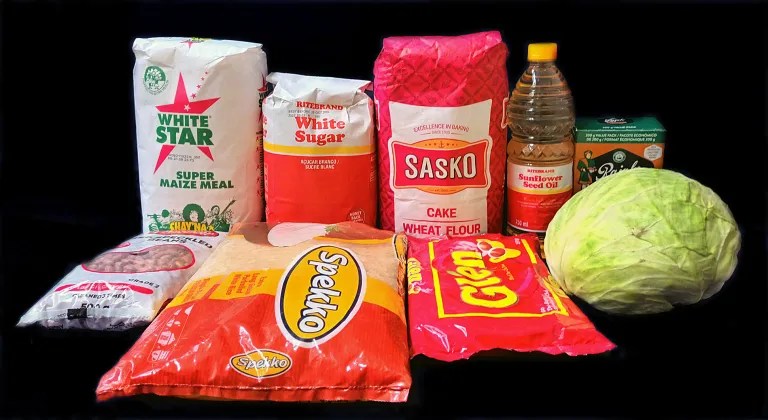
 Despite ‘softening inflation’ the food basket of 14 items remains unaffordable for SRD grant recipients, who now have to pay R14 more than last month for them. (Photo: Naledi Sikhakhane)
 Maverick Citizen has been tracking the prices of 14 basic food items that can be bought with the R370 Social Relief of Distress (SRD) grant. This basket has increased by R14 since January, despite “softening” inflation, and remains unaffordable for grant recipients.
The cost of our basket (owing to price increases for products such as flour, bread, sugar and curry powder) is now R426 – almost R60 more than the SRD grant.
Pietermaritzburg Economic Justice and Dignity’s Household Affordability Index tracking 44 basic food items decreased by R17.63 since January 2026 to R5,383.81. However, it had risen by R70.59 since last February.
/file/attachments/orphans/Food-prices-Jan-Feb-2026_468620.jpg "(Graphic: Rudi Louw)")
SRD grant restructuring
In the his State of the Nation Address (Sona) President Cyril Ramaphosa said the SRD grant will remain for another year, until 31 March 2027, unchanged at R370.
It would be redesigned to “effectively support livelihoods, skills development, work opportunities and productive activity”.
In the Budget review, the parliamentary finance committees recommend immediate steps to improve SRD administration, reduce wrongful exclusions and ensure that any move towards a permanent income-support mechanism is done with a credible funding strategy that does not lead to disproportionate cuts to other social and developmental programmes.
The Institute for Economic Justice (IEJ) has found that 80% of rejections result from misclassified financial status, that nearly half of successful applicants do not receive funds, and only 5.3% of appeals from eligible individuals succeed.
“I think the grant should have gotten an increase, as the cost of living is so high now,” said Elizabeth Raiters, a grant and social services activist. She explained that people withdrawing from a spaza shop are charged R10 for every R100, reducing the grant’s value, and are similarly charged through a bank. “I don’t understand how the [finance] minister thinks that the unemployed should survive on this.
/file/attachments/orphans/Chart_02-1024x548_541730.jpg)
“Another thing is that Sassa is currently upgrading their system, where they say they are trying to eliminate people that are not supposed to be getting the grant. But I can tell you that that is not true, the red tape is becoming worse for beneficiaries who are eligible.”
National Treasury and the Department of Social Development (DSD) will table a comprehensive policy paper on the future of the SRD grant and possible basic income support options, quantifying the fiscal costs and macroeconomic effects of alternative grant values and coverage (including values at or above the food poverty line) and set out clear financing options, including progressive tax measures.
The review said the extension of the SRD is meant to provide government with enough time to complete the policy work on “income support for working-age individuals”. While no fixed timelines have been agreed on, the intention is to “complete the policy refinement before the 2026 [Medium-Term Budget Policy Statement] to ensure alignment with fiscal planning and implementation of priorities”.
Treasury and DSD should, within 120 days of the adoption of this report by the House, present to Parliament costed options for improving the adequacy of the SRD grant.
The government is also considering options to link the grant to skills development and job opportunities.
“Government should fulfil its promise to transition the SRD grant into a basic income grant, without conditions or narrow targeting, at least to the level of the food poverty line. We have been told for several years now that the basic income policy is being developed, but it has not been released for public comment. DSD recently told Parliament it will only go back to Cabinet in March 2027 – an unacceptable delay,” said Dr Kelle Howson, a senior researcher in social security and workers’ rights at the IEJ.
“I don’t think linking the SRD to any skills development programme will actually succeed, especially the fact that we have so many skills centres in all the areas. But what actually happens to all the beneficiaries that actually completed these courses? There’s no jobs. If the government can’t create jobs, how can they have skills centres?” Raiters queried.
“I really do think it’s time for Universal Basic Income Grant and it should be implemented, especially for beneficiaries over the age of 35. The age for working employment advertisements is from 18 to 35. So, what happens to people who are unemployed and have no income after the age of 35? I think government should really look at that, because I do call them the missing middle. You’re too young to receive the old age grant, you’re too old to get a job because you’re over 35.”
Sona and the Budget on food insecurity
“The Sona could have placed food security much more strongly on the agenda. It is one of the most urgent social problems to address, given the immediacy of its relevance to human wellbeing and societal development, and that such high rates of food insecurity and hunger stubbornly endure despite more than ample production of a vast range of foods in South Africa,” said Dr Andrew Bennie, a senior researcher in food systems at the IEJ.
“It would also have been an important moment for the Presidency to highlight and affirm its support for the finalisation and implementation of the National Food and Nutrition Security Plan this year. Nonetheless, the National Strategy to Accelerate Action for Children is important, but clarity is required on the budgetary commitments that are being made to this plan and its targets,” Bennie said.
“But still, it is worrying that little attention seems to be paid by the Budget speech to food system interventions – there is little attention given to food, nutrition, agriculture and land. There is opportunity here to turn meaningfully addressing the hunger and food insecurity crisis into a nation-building effort, but this can only happen if government leads the way with clear intention, targets, programmes – and budgets.”
‘Softening’ inflation
/file/attachments/orphans/Chart_01-1024x643_376368.jpg)
According to Statistics South Africa, consumer price inflation dipped to 3.5% in January from 3.6% in December. Food inflation remained at 4.4% for a third month.
The annual rate for cereal products decreased to 0.6% from 2.1% in December.
White rice recorded a rate of -11.0%, and maize meal inflation lowered from 9.5% in December to 2.6% in January.
The rate for oils and fats softened to 4.0% from 4.6% in December.
The milk, other dairy products and eggs category registered -0.5%, higher than December’s -1.1%.
Eggs are becoming more affordable. The average price for a tray of six was R22,90 in January, down from R24,51 in January 2025.
The annual rate for meat rose further to 13.5% from December’s 12.6%.
Beef steak (31.2%), stewing beef (30.3%) and beef mince (28.0%) recorded the highest annual rates of all products analysed by Stats SA. Even affordable beef products such as offal climbed from 10.5% in December to 17.2% in January.
Pork too rose, from 11.5% to 19.5%, in the same period.
“This means continued food insecurity and an inability to reach their potential, to participate fully in their communities and economy, and to build sustainable livelihoods over time. Without a safety net, hunger is a trap that is very difficult to escape from,” Howson said. DM