



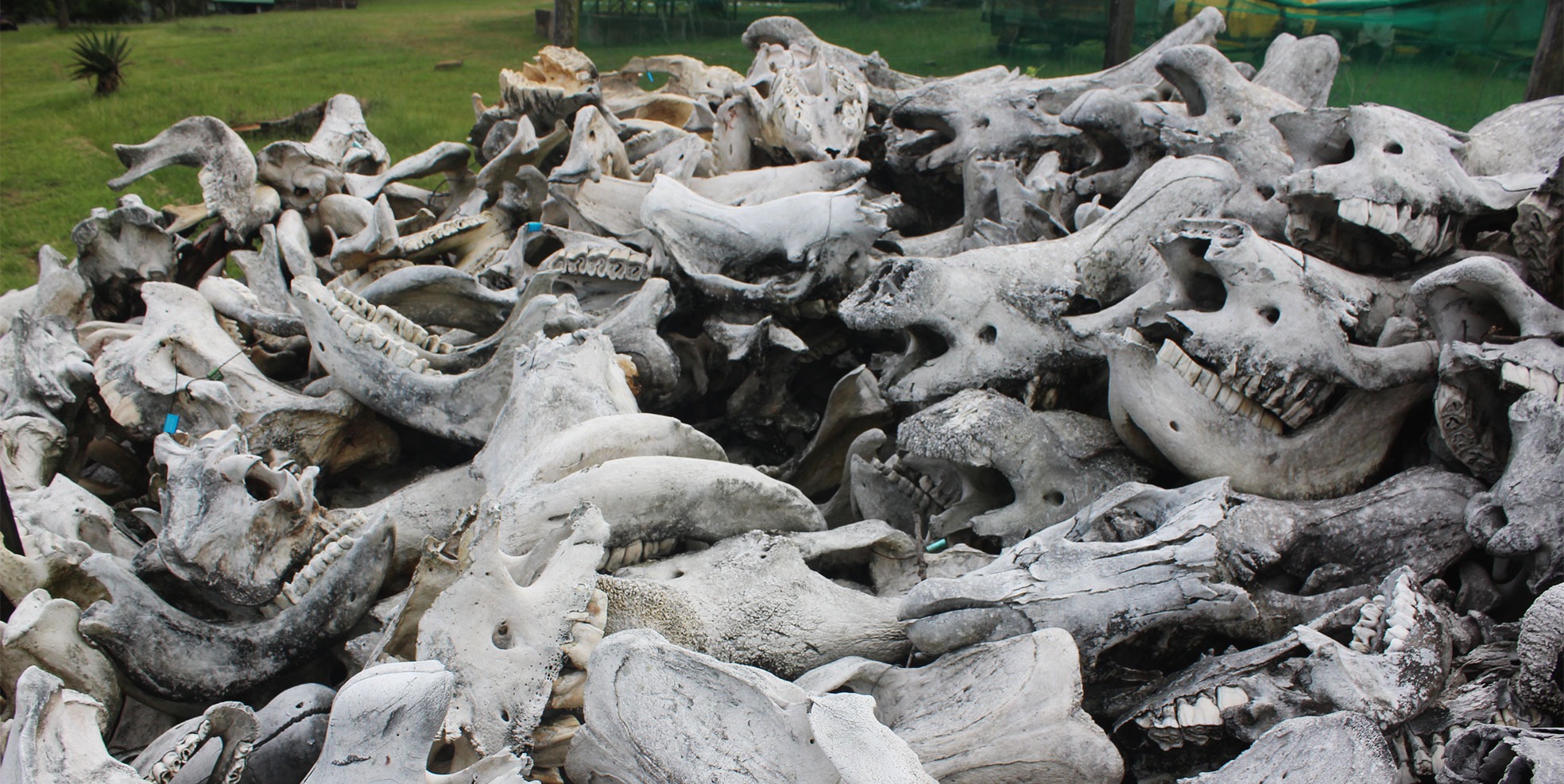
 Casualties of a poaching war. Rhino skulls are collected from the scene of all suspected poaching cases in the Hluhluwe-iMfolozi Park in KwaZulu-Natal. Due to their large size and shape, the skulls are less likely to be crunched apart by hyenas and other predators feeding on the carcasses. (Photo: Tony Carnie)
 Bleached by years of sun and rain, the skulls of hundreds of rhinos have been piling up steadily in the “boneyards” of Africa’s oldest game reserve.
Most skulls have an aluminium identity tag fixed to them with a ring of steel wire passing through empty eye sockets. But it’s impossible to count accurately just how many skulls are stacked in the graveyard visited by Daily Maverick last week in the central Nqumeni section of the Hluhluwe-iMfolozi Park.
Or the exact manner of their deaths.
Some may have died relatively quickly. Shot through the brain using heavy-calibre rifles. Others are more likely to have suffered a much slower and agonising death. Their lifeblood was probably still dripping into the soil from bullet wounds that punctured their hearts or lungs when the poachers hacked off their horns hurriedly with an axe or panga.
What is certain, however, is that the platform of skulls at Nqumeni has grown substantially since this writer photographed the same gum pole structure in May 2018. At the time, there were roughly 40 skulls. Now there seem to be well over 150 on the platform, or lying on the ground close by.
/file/attachments/orphans/tony-bones-2-bone-platform-then-and-now-pic-tony-carnie_814763.jpg "Eight years ago, Daily Maverick photographed this pile of rhino skulls (left) in the Nqumeni section of Hluhluwe-iMfolozi Park. This is what the now extended platform of bones looked like during a visit last week. (Photo: Tony Carnie)")
All the skull tag numbers are recorded on a national database, along with the GPS location of where they were found, the date of discovery and other information available to crime investigators.
There are several similar graveyards elsewhere in this park and in other parts of South Africa, tangible reminders of the butchery of at least 11,057 rhinos since the horn poaching crisis exploded in this country roughly 18 years ago.
At the peak of the criminal poaching wave, more than 1,000 rhinos were being killed annually across the country for five consecutive years between 2013 and 2017, mostly in the Kruger National Park and in Hluhluwe-iMfolozi. At one point, poachers were killing three rhinos every day.
/file/attachments/orphans/tony-bones-3-section-ranger-nokuphiwa-ntuli-image-tony-carnie_198551.jpg "Section ranger Nokuphiwa Ntuli holds up one of the numerous rhino skulls at a storage area in Hluhluwe-iMfzolozi Park. Image: Tony Carnie")
The annual death toll has since dropped steadily – partly due to more intensive security and anti-poaching strategies, but also because there are fewer rhinos left to kill.
To counter the killing rate, private rhino owners gradually began de-horning their animals to make them less attractive targets. It was a desperate strategy that proved so successful in the short term that state conservation agencies began to follow suit.
But Ezemvelo KZN Wildlife, custodian of one of the country’s largest remaining rhino populations in the world, remained reluctant to remove the iconic horns (and primary defensive tool) from some of their star wildlife attractions. Another factor was the cost of darting and dehorning several hundred rhinos spread over an expansive 96,000ha area in the Hluhluwe-iMfolozi Park.
But that changed in mid-2024, when Ezemvelo began a mass dehorning programme with financial support from foreign and local conservation groups, including WWF, Save the Rhino International, Wildlife ACT and the Peace Parks Foundation.
/file/attachments/orphans/tony-bones-4-dehorning-image-tony-carnie_840651.jpg "Veterinary staff trim the edges of a horn stump to reduce its monetary value to poachers. (Photo: Tony Carnie)")
The results were almost immediate.
Whereas 325 rhinos were shot in KZN during 2023, the poaching tally dropped to 232 in 2024. Last year, the toll dropped to 97.
In January 2026, not a single rhino was poached in Hluhluwe-iMfolozi Park, but that could change tomorrow.
Ezemvelo chief executive Sihle Mkhize, says the dehorning served as an “important early deterrent”, but the recent success was also driven by a much broader and integrated security programme.
This included:
- Collaborating with other rhino owners and sharing intelligence;
- New camera surveillance equipment, sensor networks, drones and aerial support for rapid detection and reaction;
- A new Integrity Management Plan that includes polygraph testing of Ezemvelo staff; and
- Technical and financial support from local and foreign conservation NGOs.
During a media tour in the park last week, senior Ezemvelo officials said polygraph tests had shown a 35% “deception” rate among field rangers and other rhino security staff in the park.
The polygraph tests, resisted by several staff when they were first mooted some years ago, began only in mid-2024 and are still under way.
Mkhize says the test results are not admissible in court as evidence, but they had nevertheless triggered more detailed investigations and precautionary staff transfers away from hotspot areas.
“We have also taken cellphones from some staff for further analysis of calls made or received.”
Cedric Coetzee, Ezemvelo’s senior adviser (rhino protection), notes that most poachers enter the park at night, making it essential to detect and intercept them in the dark.
The first line of defence is the “smart-fencing” alert system installed along the most vulnerable boundary lines, complemented by more than 200 cameras scattered around the park, which are triggered by movement, as well as military-grade technology developed by the CSIR.
/file/attachments/orphans/tony-bones-5-cedric-coetzee-image-tony-carnie_877871.jpg "Ezemvelo rhino security adviser Cedric Coetzee outlines some of the new security measures introduced to detect rhino horn poachers, including a motion-activated camera trap on the tree behind him. (Photo: Tony Carnie)")
Images are transmitted to a service provider in California for rapid intelligence analysis and emailed back within a matter of minutes to the “nerve centre”, Ezemvelo’s security analysis and reaction complex in the central section of the park.
When camera images of suspicious activities arrive, drones are dispatched to gather further information. To ensure night capability, the drones are equipped with thermal and laser cameras, which cut through the dark and enable security staff to assess the threats more effectively.
Drone pilot Wanele Dlamini says these craft can fly at nearly 90 km/h and also withstand strong gusts of wind. To increase his mobility in this expansive park, Dlamini launches drones from the roof of his specially-equipped 4x4 bakkie.
/file/attachments/orphans/tony-bones-6-Wanele-Dlamini-image-tony-carnie_687339.jpg "Drone pilot Wanele Dlamini launches a drone from the roof of his bakkie. Apart from directing the drone from a distance, he can also adjust the the thermal and laser camera lenses to zoom in on poachers at night. (Photo: Tony Carnie)")
Should a poaching incursion be confirmed by the drones or other camera footage, “stopper groups” of armed anti-poaching personnel are dispatched on foot, by vehicle or via helicopter.
This includes specially-trained K9 dog units, to detect and follow the tracks of suspected poachers. The helicopter pilots also have night-vision goggles, and they keep their external lights switched off.
To avoid the risk of “blue on blue” casualties (the accidental killing or wounding of staff by other staff), Coetzee says the position of all personnel is monitored in the nerve centre via digital security tags.
/file/attachments/orphans/tony-bones-7-nkanyiso-ngubane-and-dog-image-tony-carnie_141624.jpg "K9 anti-poaching dog Captain sinks his teeth into a padded arm protector on field ranger Nkanyiso Ngubane during a training session. (Photo: Tony Carnie)")
Has KwaZulu-Natal turned the corner at last?
Since the mass dehorning of 2024 and the introduction of advanced security measures, the killing rate in Hluhluwe-iMfolozi Park has undoubtedly plummeted.
“The fact that we recorded zero poaching incidents in January demonstrates what is possible when we stand united,” says CEO Mkhize. “We are encouraged by the progress, but the fight is far from over. These gains remain fragile and require sustained financial, political and societal commitment.”
But where will the money come from?
A perpetual war against determined poachers is expensive, and, judging by the numerous craters on the main tar road between Memorial Gate and Hilltop Camp, Ezemvelo can barely afford to fix the potholes in its flagship tourism reserve – let alone finance the drones, helicopters and other hi-tech interventions needed to keep poachers at bay.
A former senior park officer, who did not wish to be named, warns that Ezemvelo has to regularly dehorn its rhinos before the stumps regrow into more attractive targets.
“This war is not ending any time soon, and you have to be prepared for the next wave all the time. For the foreseeable future, I don’t see any alternatives to regular dehorning and advanced security – and I just hope that local and foreign financial support does not dry up due to donor fatigue.”
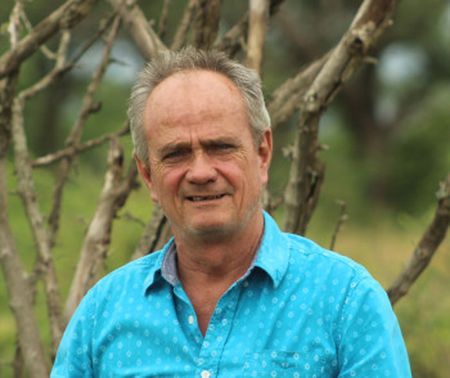
/file/attachments/orphans/tony-bones-8-Ezemvelo-CEO-Sihle-Mkhize-image-tony-carnie_390016.jpg "Ezemvelo KZN Wildlife chief executive Sihle Mkhize. (Photo: Tony Carnie)")
CEO Mkhize suggests that there may be a viable – albeit controversial – alternative that should be explored: reopening a legal international trade in rhino horns. This trade has been officially prohibited for five decades on a global level, without any end in sight to the assault by criminal horn syndicates.
“We believe that a legal, controlled trade would help to flood the market and reduce poaching levels. We have a stockpile of rhino horns that is worth billions… Let’s utilise that stockpile (to address this crisis). We are hoping to get to that stage, but we are taking a cautious approach and have to follow the framework of the law.” DM


Comments
Scroll down to load comments...