




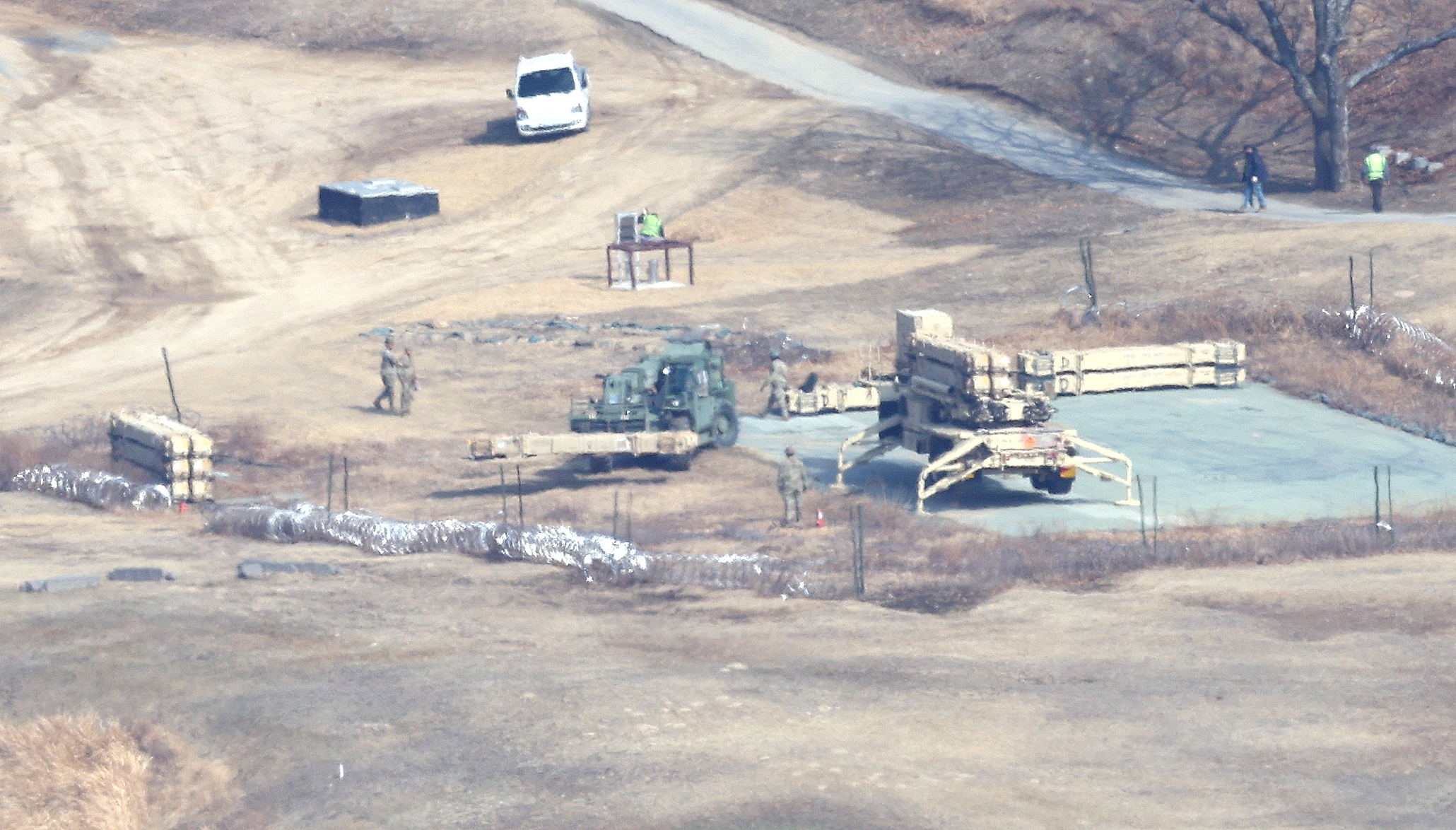
 U.S. troops take down a launch vehicle of the Terminal High Altitude Area Defense (THAAD) system at a U.S. military base in Seongju, North Gyeongsang Province, South Korea, 05 March 2026 (issued 10 March 2026). The United States has been moving parts of its THAAD anti-missile system from South Korea to the Middle East, the Washington Post reported on 10 March, citing two officials. EPA/YONHAP SOUTH KOREA OUT
Reports on shifting key U.S. military assets have sparked concern in Asia about the potential gaps in regional defences if Washington diverts ships and missiles used to deter military flexing by China and North Korea to other theatres.
"It appears that there is controversy recently over U.S. Forces in Korea shipping some weapons, such as artillery batteries and air-defence weapons, out of the country," Lee said in a cabinet meeting, noting that while Seoul had expressed opposition, it was not in a position to make demands.
Lee said the removal of some U.S. weapons from the country "does not hinder deterrence strategy towards North Korea," noting South Korea's defence spending and conventional capabilities far exceeded those of North Korea.
South Korea hosts a major U.S. military presence in combined defence against nuclear-armed North Korea, with about 28,500 troops and surface-to-air defence systems.
NORTH KOREA THREATSouth Korean Foreign Minister Cho Hyun said on Friday that U.S. and South Korean militaries were discussing the possible redeployment of some U.S. Patriot missile defence systems to the conflict in the Middle East.
South Korean media reported some missile batteries had been shipped out of Osan Air Base and were likely to be redeployed to U.S. bases in Saudi Arabia and the United Arab Emirates, though South Korean authorities have not confirmed these reports.
On Tuesday, The Washington Post reported that the Pentagon was moving parts of a Terminal High Altitude Area Defense (THAAD) system to the Middle East from South Korea, citing two officials.
The U.S.-made THAAD system is used for high-altitude interception of ballistic missiles, while Patriot batteries provide lower-tier defence against shorter-range threats.
U.S. Forces Korea declined to comment on the relocation of military assets, citing operational security.
Reuters photographs at the Osan Air Base showed on Tuesday multiple mobile launchers on the tarmac that experts confirmed appeared to be Patriot PAC-2 and PAC-3 interceptors.
Military analysts said that while Lee was correct that South Korea is capable of deterring Pyongyang on its own, the presence of U.S. weapons underscored Washington's commitment to regional security.
"There is a risk that North Korea could miscalculate the relocation of some of these weapons as a pretext for low-level provocations to test the allies' defence posture," said Choi Gi-il, a military studies professor at Sangji University.
North Korean leader Kim Jong Un said in February he would focus on expanding his country's nuclear arsenal and called South Korea its "most hostile enemy," while overseeing the test-firing of a missile on a naval destroyer last week.
DESTROYERS MOVED FROM JAPAN
U.S. and Israeli forces have been striking strategic targets inside Iran for more than a week, prompting concern that a prolonged conflict drawing Washington's focus away from Asia could threaten regional peace and stability.
Japan also hosts major U.S. military bases, and two U.S. guided-missile destroyers homeported in Yokosuka are currently deployed in the Arabian Sea to support the military operation against Iran, according to a report by the U.S. Naval Institute.
The only U.S. carrier deployed in Asia is undergoing maintenance at Yokosuka.
The head of Japan's main opposition party raised concerns about the reports about the deployment of U.S. vessels based in Japan to the Middle East in parliament on Monday.
"Japan has not permitted the stationing of U.S. forces so they can sortie from those bases to fire missiles towards the Middle East," Junya Ogawa said, adding that they should be ensuring Japan's security and maintaining peace in East Asia.
Japan's government has not commented on the deployment of the U.S. vessels.
(Reporting by Heejin Kim and Kyu-seok Shim in Seoul, Hongji Kim in Osan, and John Geddie and Nobuhiro Kubo in Tokyo; Editing by Ed Davies, Lincoln Feast and Thomas Derpinghaus)
Comments
Scroll down to load comments...